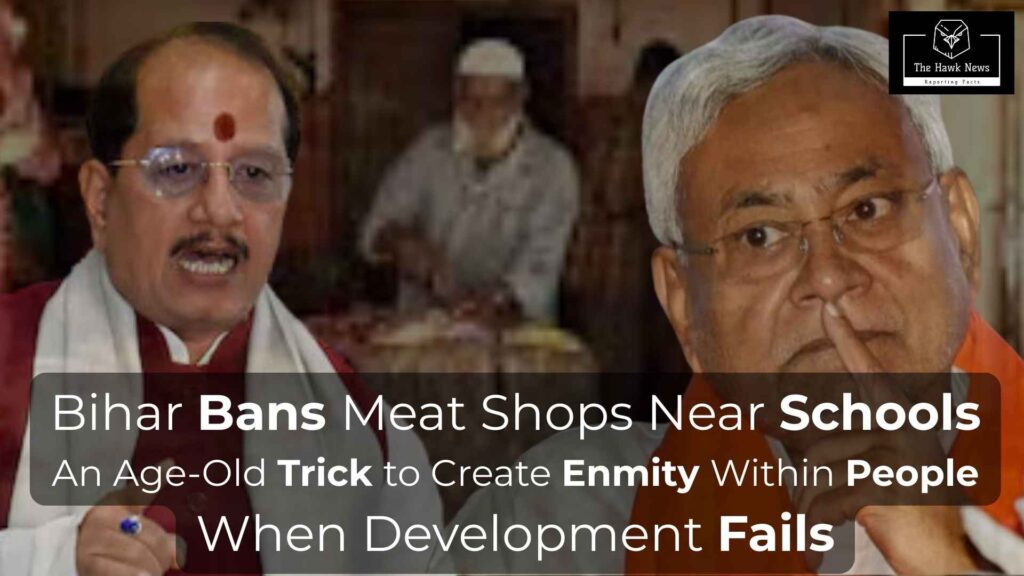
The government of Bihar has instructed urban local bodies to shut meat, fish and poultry shops operating near schools, temples and crowded public spaces. The action is being presented as a hygiene and regulatory enforcement drive.
Officials claim the objective is to protect children and preserve social harmony. But beyond official statements, the move has ignited a wider debate about governance priorities and political intent.
Municipal teams have been told to inspect vendors, verify licences, and seal outlets deemed too close to educational institutions. Even licensed shopkeepers now face uncertainty under loosely defined location norms.
What the Government Says
Deputy Chief Minister Vijay Kumar Sinha has stated that open meat sales near schools disturb public sentiment and may promote violent tendencies among children. The administration insists this is not about banning food choices.
According to the state, this is merely enforcement of municipal law and urban cleanliness standards. Officials stress that only unlicensed or improperly located shops are being targeted.
Yet if hygiene and child welfare were truly the concern, such enforcement would have been consistent for years. The sudden urgency raises unavoidable questions about timing and motive.
When Development Fails, Division Begins
History offers a familiar lesson. When governments become impotent in development, they stop competing on delivery and start competing on identity.
Unable to provide jobs, roads or hospitals, rulers redirect public frustration inward by manufacturing social conflict. It is easier to divide citizens than to answer for administrative failure.
This approach did not originate today. Colonial administrators perfected divide-and-rule politics, fragmenting society to weaken collective demands for reform.
Modern governments merely recycle this strategy, replacing imperial authority with electoral calculation.
The Immediate Human Cost
The first to suffer are small vendors and daily-wage sellers whose livelihoods depend on narrow margins. Overnight closures translate directly into lost income and financial instability.
There is no announced rehabilitation package, no alternate livelihood plan, and no compensation framework for displaced shopkeepers. Economic shock arrives without warning or support.
For families already living close to the edge, such enforcement is not a policy adjustment. It is a crisis.
Administrative action without economic empathy deepens vulnerability and resentment.
Bihar’s Development Reality vs Southern India
Bihar continues to lag behind much of the country in employment generation, industrial growth and urban infrastructure. Large numbers of young people migrate every year in search of work.
This migration is not driven by ambition alone. It reflects the state’s inability to create sustainable local opportunities.
Compare this with Tamil Nadu, Kerala, Karnataka and Andhra Pradesh.
These states invested early in education, healthcare and manufacturing ecosystems, building resilient economies and stronger human development indicators.
Bihar’s prolonged underinvestment has left it struggling to catch up.
Covid and the Collapse of Health Infrastructure
The pandemic brutally exposed Bihar’s fragile healthcare system. Hospitals faced shortages of beds and oxygen, while primary health centers were overwhelmed.
Rural populations were left dangerously underserved, revealing years of neglect masked by routine administrative optimism.
A functioning healthcare system cannot be assembled during a crisis. It requires long-term planning, staffing and infrastructure investment.
If child welfare truly mattered, policy would focus on strengthening hospitals, improving school sanitation and expanding nutrition programs.
Closing meat shops near schools does little to repair systemic health failures.
Creating Enmity Instead of Building Institutions
Policies framed around cultural discomfort inevitably deepen social fault lines. Food becomes identity, vendors become symbols, and communities begin to view each other with suspicion.
Minority groups, because of occupational patterns, bear a disproportionate share of the economic impact. This imbalance is predictable, not accidental.
There is still no safety net for displaced sellers, no microcredit support, and no transition roadmap. What exists instead is visible enforcement and silent suffering.
Development cannot be replaced by moral theater.
You cannot substitute industrial policy with symbolic crackdowns, or hospital construction with sentiment speeches.
When rulers fail to deliver progress, they manufacture enmity within people.
It is an age-old trick.
And Bihar deserves governance, not division.