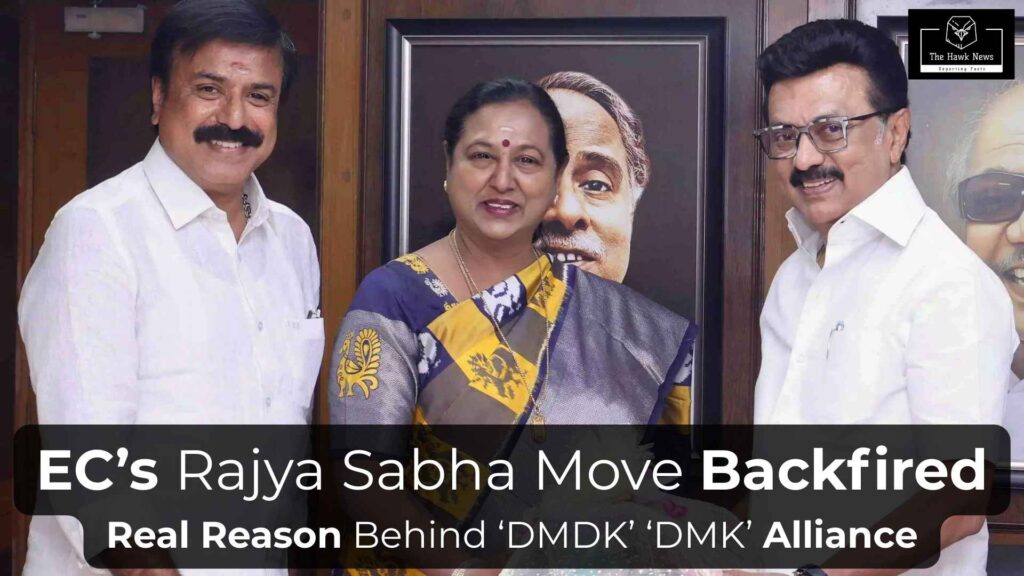
The Rajya Sabha election announcement by the Election Commission of India was officially described as part of the regular electoral calendar. But in Tamil Nadu, the timing immediately raised political eyebrows.
By advancing the process ahead of the Assembly elections, the Commission effectively froze alliance arithmetic. Parties were forced to negotiate parliamentary seats based on current MLA strength rather than future electoral outcomes.
Why Rajya Sabha Elections Are About Numbers, Not Narratives
Unlike general elections, Rajya Sabha polls depend entirely on sitting MLAs. Whoever controls Assembly numbers controls the Upper House entries.
This made the early announcement strategically significant. It removed post-election flexibility and compelled parties to settle seat-sharing immediately, long before voters could reshape the political landscape.
BJP’s Preventive Calculation in a Difficult State
For the Bharatiya Janata Party, Tamil Nadu remains an alliance-dependent state with limited independent electoral strength. Parliamentary representation here is secured only through careful coalition management.
The early Rajya Sabha schedule appeared aimed at locking MPs before Assembly uncertainties emerged. It was a move intended to secure institutional presence using existing MLA numbers.
How the Strategy Exposed NDA’s Structural Weakness
Instead of strengthening the National Democratic Alliance, the decision exposed its internal constraints. Tamil Nadu had six Rajya Sabha vacancies, but NDA’s current strength could realistically deliver only two seats.
That limited availability immediately triggered competition among partners. Every ally wanted representation, but mathematical reality left no room for accommodation.
AIADMK’s Compulsions Narrowed Options Further
Within the All India Anna Dravida Munnetra Kazhagam, leadership faced pressure from cadres demanding at least one Rajya Sabha berth for party loyalists.
Allocating both NDA seats to allies would have created unrest inside AIADMK. This internal requirement alone reduced the coalition’s flexibility and tightened negotiations.
Senior Allies Had Already Staked Claims
At the same time, allies such as Anbumani Ramadoss and G K Vasan were seeking Rajya Sabha representation as compensation for their continued alliance support.
With only two seats available, accommodating these expectations became nearly impossible. The NDA leadership found itself managing more promises than positions.
DMDK Quietly Slips Out of the Equation
The Desiya Murpokku Dravida Kazhagam entered alliance talks with the expectation of parliamentary representation. For DMDK, a Rajya Sabha seat was central to its strategic relevance.
After the EC announcement, that possibility effectively disappeared. There was no public rejection, but internal messaging made it clear that no seat could be offered.
Political Silence Delivered the Message
DMDK did not receive formal denial. Instead, it encountered silence and ambiguity during backchannel negotiations.
In Tamil Nadu politics, this usually signals exclusion. Without parliamentary assurance, DMDK had little incentive to remain within the NDA framework.
DMK Steps In With Certainty
While NDA struggled internally, the Dravida Munnetra Kazhagam saw an opportunity. With strong Assembly numbers, DMK had both Rajya Sabha capacity and negotiating space.
Discreet discussions followed, leading to informal assurance of parliamentary representation. That clarity changed DMDK’s political trajectory almost immediately.
The Alliance Shift Was Arithmetic, Not Ideological
DMDK’s move to DMK appeared sudden to the public, but it was driven by simple political arithmetic. The party crossed over because DMK could offer what NDA could not: guaranteed representation.
This was not an ideological pivot. It was a survival decision shaped entirely by institutional timing.
How the Rajya Sabha Move Ultimately Backfired
The preponement was intended to secure BJP’s parliamentary presence before Assembly elections. Instead, it accelerated alliance fractures and forced smaller parties to seek alternatives.
By compressing negotiations, the NDA eliminated its own flexibility. What was designed as consolidation ended up costing the BJP a prospective ally.
Institutional Timing and Its Political Consequences
Although the Election Commission functions independently, its leadership selection process involves the ruling establishment. This structural reality fuels criticism that electoral timelines increasingly reflect central political strategy.
Regardless of intent, the Tamil Nadu outcome demonstrates how administrative timing can reshape alliance dynamics.
What NDA Lost and DMK Gained
The NDA’s loss of DMDK weakens its regional footprint and reinforces perceptions of limited negotiating space. For DMK, the gain strengthens coalition optics and expands political reach ahead of Assembly polls.
The episode underlines how regional alliances often provide more stability than nationally driven coalitions in Tamil Nadu.
Conclusion
The Rajya Sabha schedule was meant to secure BJP’s interests before electoral uncertainty. Instead, it exposed alliance fragility and pushed DMDK toward DMK.
By acting early, the NDA forced premature decisions and paid the price in political capital. What was intended as a preventive move ultimately reshaped Tamil Nadu’s alliance map.
Sometimes, strategic timing does not consolidate power.
Sometimes, it redistributes it.
And this time, it moved DMDK out of NDA’s orbit.