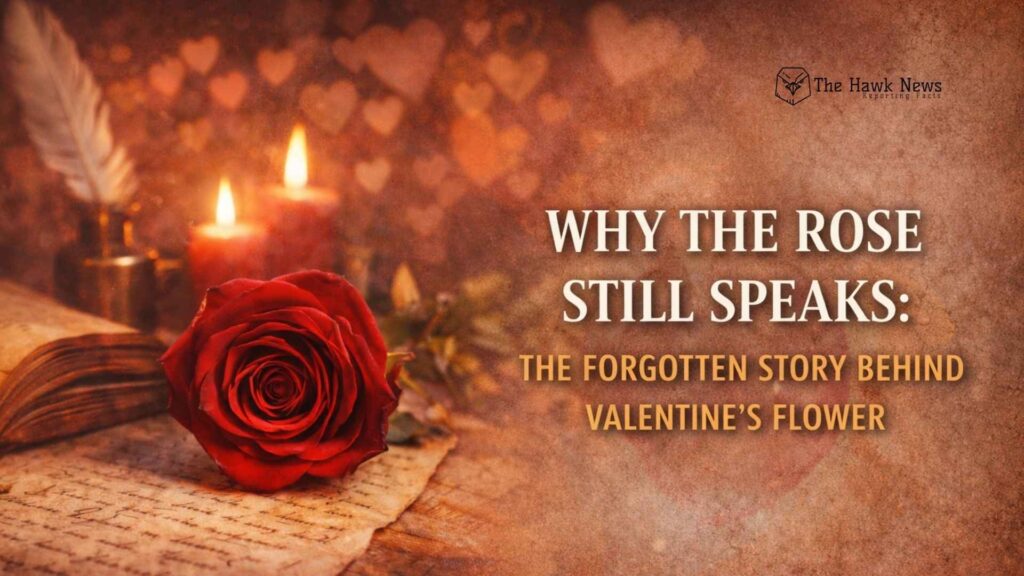
Long before it became the emblem of Valentine’s Day, the rose was already the world’s oldest metaphor for love — a symbol born in myth, crowned by poets, and preserved by hearts that never stopped believing in its bloom.
A Flower Older Than Memory
The rose is not just a flower; it is a chapter of civilization.
Fossil records show that wild roses existed over 35 million years ago, long before the first human whispered love into language.
Native to Asia, Europe, and North America, the rose has appeared in almost every culture’s mythology — often representing beauty, secrecy, and devotion.
“The rose speaks of love silently, in a language known only to the heart.”
— Unknown
In ancient Persia and Greece, the rose was sacred to Aphrodite and Venus — goddesses of love and beauty.
Legend says a red rose first bloomed from Aphrodite’s tears as they fell upon the blood of her dying lover, Adonis.
Thus, from the very beginning, the rose carried the paradox of love — beauty born from suffering, devotion shadowed by loss.
The Rose and the Martyr
When Christianity spread through the Roman Empire, symbols were reinterpreted rather than erased.
The rose became associated with St. Valentine, the priest who secretly performed marriages despite the emperor’s ban.
In later legends, Valentine was said to have handed out roses to couples he blessed — an act that transformed the pagan flower of passion into a Christian emblem of sacrificial love.
“Love grows more richly in moments of defiance.”
— Editorial reflection, The Hawk News
From that mingling of myth and martyrdom, the rose’s dual nature — desire and devotion — was set forever in human memory.
The Renaissance and Romanticism — The Rose as Love’s Language
By the Middle Ages and Renaissance, the rose had become the emblem of courtly love — refined affection shaped by virtue and restraint.
Poets like Geoffrey Chaucer and William Shakespeare gave the flower new life in verse and metaphor.
Valentine’s Day was reborn not in ceremony, but in poetry.
The rose became ink, metaphor, and messenger. Lovers painted it, poets praised it, and dreamers gifted it as a silent confession of the heart.
Centuries later, during the Victorian era, the tradition blossomed into a quiet code called floriography — the language of flowers. Every petal carried meaning:
- Red roses — true love and passion
- White roses — innocence and new beginnings
- Yellow roses — friendship or jealousy
- Pink roses — admiration and gratitude
When words felt too dangerous, people spoke through roses.
It was the poetry of discretion — love without noise, only fragrance; devotion distilled into scent and silence.
“In an age when confessions were perilous, the rose became the safest place to hide a heart.”
— Editorial reflection, The Hawk News
The Science and Symbolism of the Rose
Beyond its romantic heritage, the rose is a marvel of nature.
There are over 300 species and tens of thousands of cultivated varieties across the world.
Roses are part of the Rosaceae family — cousins to apples, strawberries, and almonds.
The world’s oldest known rose bush grows against the wall of Hildesheim Cathedral and is estimated to be over 1,000 years old.
In the 18th century, the first hybrid tea rose — the ancestor of most modern varieties — was bred in France, forever merging beauty with resilience.
“A single rose can be my garden… a single friend, my world.”
— Leo Buscaglia
Even in science, roses defy simplicity: their scent comes from complex compounds like geraniol and citronellol, and their colors evolve through natural mutations and centuries of human selection.
The Modern Bloom — From Symbol to Spectacle
By the 20th century, Valentine’s Day had become a festival of commerce, and the rose — timeless, marketable, universal — became its crown jewel.
Today, over 250 million roses are produced globally every February, with red roses accounting for the majority of sales.
Yet, even amid commercialization, the symbol endures.
When someone gives a rose, something ancient still moves within us — the echo of Aphrodite’s grief, Valentine’s courage, and every poet who ever tried to put love into language.
“The rose is not loved because it lasts, but because it dares to bloom.”
— Editorial reflection, The Hawk News
Reflection: Why the Rose Still Speaks
The rose remains love’s truest symbol because it tells the truth about love:
it is beautiful but fragile, fragrant yet thorned, fleeting but unforgettable.
Perhaps that’s why it has survived empires, revolutions, and trends — because it resembles us.
Our hearts, too, are red with risk and soft with hope.
So the next time you hold a rose on Valentine’s Day, remember —
you are holding a history of love, written in scent and silence,
a story that began long before you, and still dares to bloom because you believe in it.
“A rose dreams of enjoying the company of bees, but none appears.
Still, the rose blooms, for love’s sake.”
— Paulo Coelho