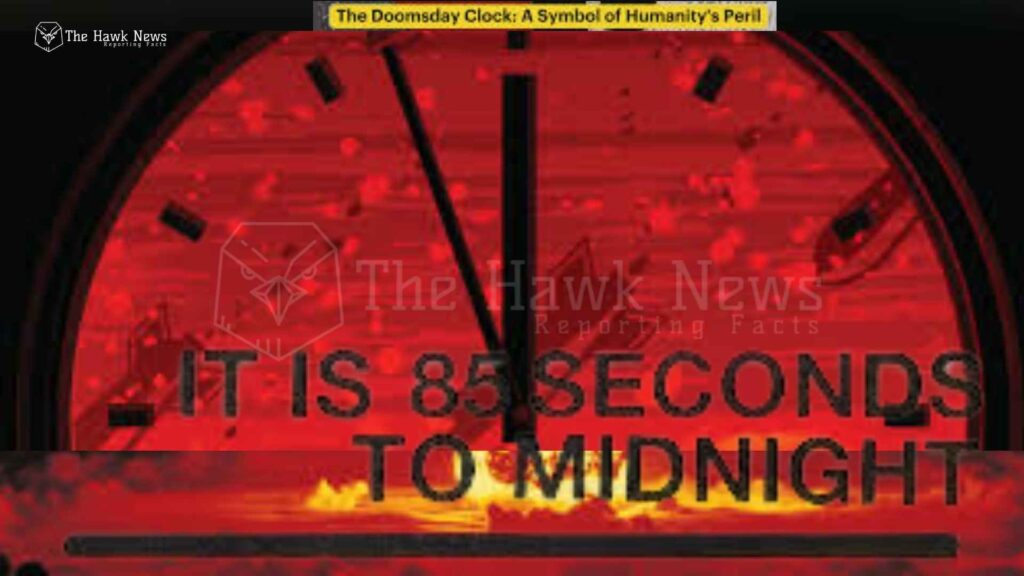
Born in the shadow of nuclear fear, the Doomsday Clock has become the world’s symbolic heartbeat — counting down not to apocalypse, but to awareness.
The Origin: When Science Needed a Symbol
The Doomsday Clock was created in 1947 by the Bulletin of the Atomic Scientists, a group founded by Manhattan Project researchers who had witnessed the birth of the atomic bomb.
They wanted a simple, universal image to show how close humanity was to self-destruction — and they found it in a clock face set close to midnight.
The concept was haunting in its simplicity:
- Midnight represented global catastrophe — nuclear war, climate collapse, or other civilization-ending events.
- The minutes before midnight represented how close humanity was to that brink.
When the clock was first unveiled, it was set at seven minutes to midnight (11:53 p.m.) — a warning born out of guilt, not spectacle.
“The Bulletin’s clock is a metaphor — a reminder of how perilously we live on borrowed time.”
— Eugene Rabinowitch, co-founder of the Bulletin
The Hands That Move Without Sound
Unlike ordinary clocks, this one doesn’t tick by seconds — it shifts with world events.
Each movement of its hands is decided by a board of scientists, Nobel laureates, and policy experts. They meet every year to evaluate global threats: nuclear weapons, climate change, biotechnology, artificial intelligence, cyberwarfare.
Each announcement is both scientific and symbolic — a warning wrapped in ritual.
Over the decades, the clock has moved closer or farther from midnight depending on the world’s pulse.
A Timeline of Humanity’s Anxiety
| Year | Time to Midnight | Context |
|---|---|---|
| 1947 | 7 minutes | Atomic bomb’s aftermath |
| 1953 | 2 minutes | U.S. & USSR test hydrogen bombs |
| 1991 | 17 minutes | Cold War ends — optimism rises |
| 2018 | 2 minutes | Rising nuclear tensions & climate crisis |
| 2023–2024 | 90 seconds to midnight | Closest ever — nuclear risk, AI threats, and climate breakdown |
Each movement of the hands tells a story:
of progress, relapse, and the uneasy truth that our intelligence often outruns our wisdom.
Beyond Bombs: The New Frontiers of Doom
The Doomsday Clock has evolved.
Once focused solely on nuclear annihilation, it now encompasses the broader threats of our age:
- Climate Change: Rising temperatures, melting ice caps, and irreversible ecosystem collapse.
- Artificial Intelligence: Autonomous weapons, misinformation, and the fear of machines that think without conscience.
- Cyberwarfare & Disinformation: Wars now fought with data, not bombs — eroding truth itself.
“We created machines that could think — but not feel.
We built networks that connect — but not heal.”
— Editorial reflection, The Hawk News
Why It Still Matters
Critics call it alarmist. Supporters call it prophetic.
But the Clock’s purpose isn’t prediction — it’s persuasion. It is a moral instrument, not a mechanical one.
It reminds policymakers and citizens alike that apocalypse is not an event — it’s a slow decision, made daily, in boardrooms, battlefields, and living rooms.
From an editorial perspective, the Doomsday Clock stands as the most enduring piece of activism disguised as art — a chronometer of conscience.
It doesn’t measure time. It measures temperament.
“The end of the world will be legal, efficient, and well-documented.”
— Nicolas Gomez Davila
The Reflection: Humanity’s Clock Without Hands
Every January, when the Bulletin announces the time, the world pauses — not to panic, but to ponder.
The clock tells us less about the end of the world and more about the condition of the human will.
Each move closer to midnight is a warning that our progress is outrunning our purpose.
And perhaps, that’s the irony of modern civilization:
we built a clock to remind ourselves that we are running out of time —
and yet, we still keep hitting snooze.
“Teach us to number our days, that we may gain a heart of wisdom.” — Psalm 90:12