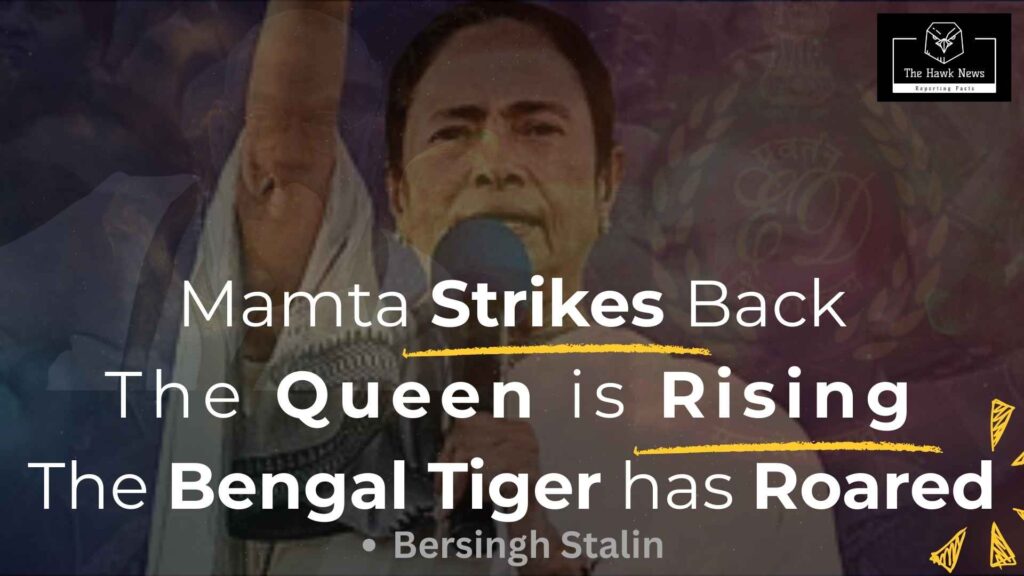
The Queen Is Rising: How Mamata Banerjee Broke BJP’s Most Powerful Weapon ED
India is not witnessing a raid.
India is witnessing resistance.
For more than a decade, one formula has ruled Indian politics with surgical precision:
Use central agencies. Break the opposition. Control the narrative. Win elections before ballots are cast.
That formula worked everywhere.
Until it hit West Bengal.
What unfolded in Kolkata is not a legal episode.
It is a constitutional moment.
And at the centre of it stands one woman – Mamata Banerjee.
Not retreating.
Not negotiating.
But striking back.
The BJP’s Sharpest Weapon: Fear in the Name of Law
Let’s be clear.
The Enforcement Directorate is no longer perceived as a neutral investigative body.
Across India, its pattern is unmistakable.
- Opposition leaders raided before elections
- Arrests timed with polling schedules
- Cases that stretch endlessly without conviction
- Bail denied as punishment
- Media trials replacing court verdicts
This is not coincidence.
This is political engineering.
Ask Arvind Kejriwal, jailed in the middle of an election campaign.
Ask Hemant Soren, forced out of office before facing voters.
Ask leaders in Maharashtra, Telangana, Tamil Nadu, Kerala,,,
-raids first, silence later.
Some resisted briefly.
Most bent eventually.
Fear works.
That was the BJP’s confidence.
Until Bengal refused.
What Actually Happened: Not a Raid, But a Breach
The ED did not raid a shell company.
They did not raid a benami property dealer.
They entered election war rooms.
The Indian Political Action Committee (I-PAC) – a professional political consultancy – was searched.
Its offices.
Its data systems.
The residence of its chairman Pratik Jain.
Every location had one common link:
They were working on Trinamool Congress’ election strategy.
This is the line that cannot be crossed in a democracy.
Campaign strategy is political speech.
Political speech is constitutionally protected.
When a central agency seizes campaign data,
it is no longer investigation
it is political espionage.
And Mamata Banerjee understood that instantly.
The Moment That Changed Everything
Instead of issuing statements,
instead of filing quiet petitions,
instead of waiting for TV debates
Mamata Banerjee walked into the raid site.
With the state police.
In full public view.
She confronted the ED.
She challenged their authority.
She accused them openly of stealing party data.
No Indian Chief Minister has ever done this.
This single act shattered BJP’s psychological advantage.
Because the ED’s power does not come from law.
It comes from submission.
And Bengal refused to submit.
From Raid to Revolt
What followed was escalation.
- FIRs filed against ED officials for trespass
- Mass protests across Kolkata
- Trinamool MPs detained during protests in Delhi
- A demonstration near Amit Shah’s residence
- Courtroom chaos so intense that the judge stepped out
This was not optics.
This was constitutional confrontation.
The Centre accused Mamata of “interfering with investigation.”
But what was she actually doing?
Defending federalism.
India is a Union of States
not a command centre with provinces.
Why Bengal Is Different
The BJP miscalculated one thing:
Bengal’s political memory.
This is a state that fought colonial rule through resistance, not obedience.
A state shaped by mass movements, not elite consensus.
Mamata Banerjee is not a dynast.
She is not a corporate-backed politician.
She rose by confronting power
CPM first,
then BJP.
You cannot scare a leader whose entire political life is built on defiance.
That is why the threat of arrest here is not routine.
If Mamata Banerjee is arrested like Kejriwal,
Bengal will erupt.
Because Bengal will see it not as law,
but as occupation.
The “Coal Scam” Narrative: A Familiar Script
The ED’s justification is predictable:
“Coal scam proceeds.”
“Hawala channels.”
“Money laundering.”
But here’s what is missing — as always:
- No transaction trail
- No beneficiary proof
- No documented link between alleged proceeds and I-PAC work
This is the ED’s oldest method:
Accuse first. Investigate endlessly. Never conclude.
The process becomes the punishment.
But Bengal didn’t wait for verdicts.
It challenged intent.
A History of Silencing
Let’s not pretend this started with Mamata.
Over the last decade:
- Opposition governments collapsed after raids
- Leaders were jailed without conviction
- Media amplified accusations, not acquittals
- Institutions slowly bent under pressure
Democracy didn’t die suddenly.
It was strangled politely.
What Mamata Banerjee did was disrupt this silent suffocation.
She forced the country to confront a question many avoided:
Who watches the watchdogs?
The Bengal Tiger vs The Centralised State
The BJP’s model is simple:
Centralise power.
Control institutions.
Neutralise opposition before elections.
Mamata Banerjee smashed that model
not with alliances,
not with slogans,
but with direct confrontation.
She exposed the one weakness in BJP’s armour:
They depend on fear more than legitimacy.
When fear fails, the system stutters.
Why This Moment Matters Beyond Bengal
This is not about Trinamool Congress.
This is not about 2026 elections alone.
This is about whether India remains a federation or becomes a managed democracy.
For the first time in years,
an opposition leader did not plead victimhood.
She counter-attacked.
And suddenly, something shifted.
Across India, people are watching and thinking:
“If one state can resist, why can’t others?”
Hope is dangerous to authoritarian systems.
The Queen of Bengal
Call it symbolism or call it reality
politics runs on perception.
Right now, Mamata Banerjee is not seen as a regional leader.
She is seen as resistance personified.
A queen who did not wait to be rescued.
A leader who didn’t outsource courage to courts alone.
A politician who understood that democracy sometimes needs street-level defence.
Democracy’s Small Opening
Make no mistake
the system is still stacked.
Agencies still answer upward.
Media still amplifies power.
Institutions are still under strain.
But cracks have appeared.
And history shows
every collapse begins with cracks.
Final Word
This was not recklessness.
This was strategic defiance.
Mamata Banerjee did what most leaders feared to do:
She exposed the bully by standing up to him.
The Queen is rising.
The Bengal Tiger has roared.
And for the first time in years,
India is not just watching power at work
it is watching power being challenged.
Hope doesn’t arrive with permission.
It arrives with courage.
And in Bengal,
courage just made a comeback.