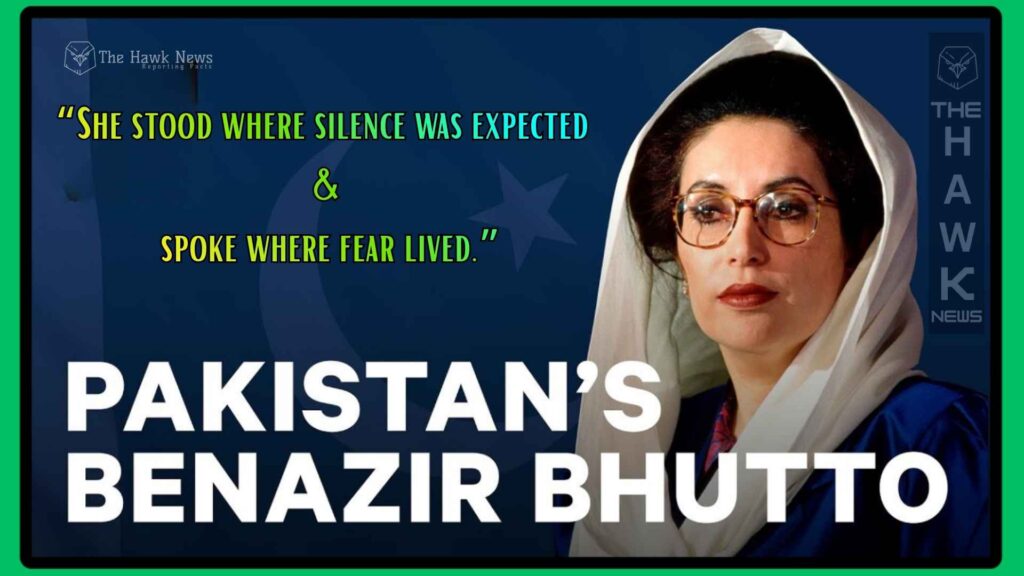
December 2, 1988 — A day when history didn’t just turn a page; it rewrote its handwriting.
On this date, the world witnessed something astonishing:
A woman — young, determined, and fiercely intelligent — rose to lead a Muslim-majority nation.
Not through symbolism.
Not through tokenism.
But through grit sharpened in prison cells, exile homes, and political battlefields.
Benazir Bhutto’s election as Prime Minister of Pakistan was more than a political event.
It was a collision between legacy and rebellion, between tradition and transformation.
It was the moment a daughter refused to let the fate of her father become the fate of her country.
A Childhood Not Meant for Politics — Yet Born for It
Benazir was raised in corridors filled with power, yes — but also in spaces filled with fragility.
Being the daughter of Zulfikar Ali Bhutto meant she was surrounded by political giants.
But it also meant she lived in a house where decisions echoed like thunder and threats lurked in the shadows.
She was educated at Harvard and Oxford, sharpened not only by books but by the responsibility she knew was waiting.
But even she didn’t know how soon it would come.
From Daughter to Defender: The Tragedy That Initiated a Leader
Her father’s overthrow.
His imprisonment.
His execution.
These were not simply personal tragedies — they were political earthquakes.
Benazir, barely in her 20s, was pushed into a storm she did not ask for.
Prison became her classroom.
Solitary confinement became her test of purpose.
Exile became her strategic pause.
By the time she stepped into Pakistan again, she was no longer the “Bhutto daughter.”
She was Benazir — unbroken, unbowed, and unmistakably destined for the front line.
1988: When a Woman Walked Into a Room the World Said She Didn’t Belong In
Her victory shook the region.
South Asia wasn’t used to women in high office.
The Islamic world wasn’t either.
Western analysts doubted her.
Eastern traditionalists dismissed her.
But Benazir didn’t win as a symbol — she won as a strategist.
She spoke of democracy in a country tired of military rule.
She spoke of hope in a nation exhausted from loss.
She spoke of change when everything around her felt cemented.
Her leadership was not perfect, and her governments faced turbulence.
Yet, the significance of her election transcended the lifespan of her cabinet.
Breaking Dynasties — By Becoming One Herself
She inherited a legacy — yes.
But she refused to become a puppet of it.
Her leadership made it clear:
A dynasty can be continued without being repeated.
Benazir modernized the political voice of the Bhutto family.
She transformed inherited influence into earned credibility.
She became an icon not because she stood where her father did, but because she stood where no woman had before.
Breaking Dictatorships — By Daring to Speak Where Silence Was Safer
When a nation lives under military rule long enough, silence becomes survival.
Benazir broke that.
She challenged General Zia’s regime head-on.
Her rallies were monitored.
Her home was raided.
Her life was threatened.
But she kept speaking.
That is what dictatorships fear the most —
Not armies.
Not rebellions.
But a voice that refuses to shut down.
Because voices inspire crowds.
Crowds become movements.
Movements become change.
Breaking Gender Ceilings — Without Breaking Her Identity
Benazir wasn’t a leader who hid her womanhood for power.
She embraced it.
Her dupatta became a political symbol.
Her maternity became global news.
Her presence at the UN holding her newborn son became a visual rebellion against centuries of exclusion.
She led a nation with the same hands that rocked a cradle — and proved one truth the world still forgets:
Strength and softness are not opposites.
They are twin engines of leadership.
Her Assassination Did Not End Her Story — It Multiplied It
Benazir Bhutto was assassinated in 2007.
Her loss cracked the world.
But it didn’t silence her.
If anything, it made her message louder:
Democracy is fragile.
Courage is costly.
And progress requires protectors.
Today, girls who pick up microphones, run for office, stand at protests, or simply dare to dream — all carry a little bit of Benazir with them.
The Legacy That Did What Bullets Could Not
December 2, 1988, is not just Pakistan’s political milestone.
It is a global reminder that change does not wait for permission.
Benazir Bhutto:
- broke dynasties by refusing to be defined by one,
- broke dictatorships by refusing to fear them,
- broke ceilings by rising higher every time she fell.
Her life teaches one enduring truth:
A woman’s place is wherever history needs rewriting.
And on December 2, 1988, she rewrote it for the entire world.