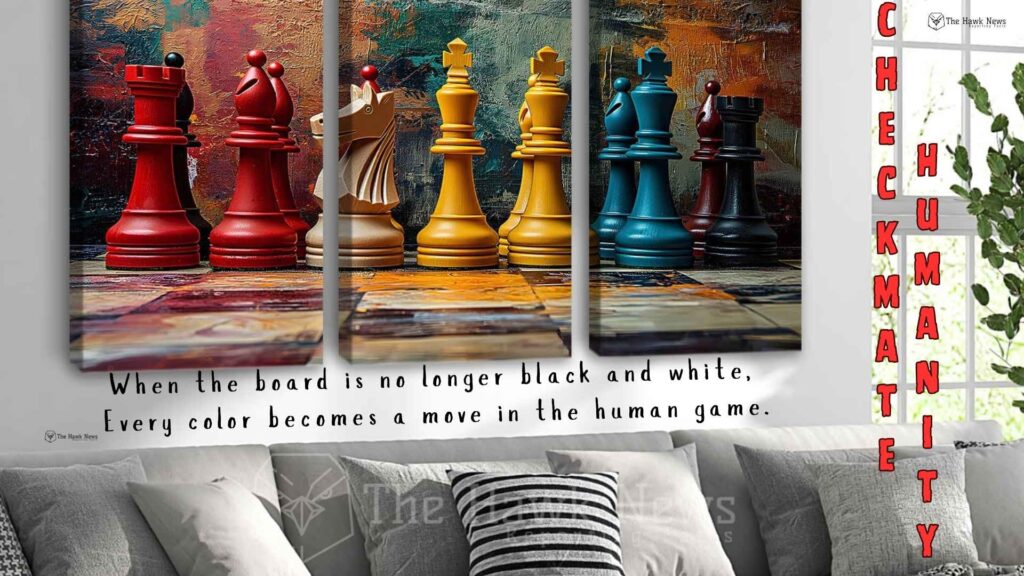
When the board is no longer black and white, every color becomes a move in the human game.
The painting is still. The chess pieces stand frozen — tall, vivid, and alert. Yet, within their silence lies a world of movement.
Red, gold, ivory, blue, black — colors that defy the centuries-old tradition of monochrome chess. And in that rebellion, something profound emerges: a mirror of our times.
We no longer live in a world defined by black and white. We live in the in-between — the blurred hues of belief, the mixed tones of morality, the complex shades of choice.
This image, vibrant and deliberate, feels like an echo of humanity itself — poised between conflict and cooperation, between ambition and awareness.
It reminds us that the game we play daily isn’t just about winning; it’s about how we play.
A Game That Mirrors Life
Chess, at its core, is a dialogue between intention and consequence. Every piece — from the pawn to the king — has purpose.
But what makes this colorful depiction different is how it breaks the boundaries of predictability. It doesn’t obey the old order; it reimagines it.
That’s our world today — diverse, unpredictable, and richly colored. Once, we could divide everything into two sides: right and wrong, rich and poor, East and West.
But the global board has changed. Nations, people, and even individuals now move with shades of both light and shadow.
We are all pieces in motion — some advancing boldly, others guarding quietly, all part of an unfolding pattern too vast for a single view.
“Power isn’t just about who moves next; it’s about who understands the meaning of stillness.”
The New Colors of Power
In this modern world, power doesn’t always roar; sometimes, it whispers.
It can wear the red of politics, the gold of economy, the blue of innovation, the ivory of knowledge, or the black of control. Yet beneath each color lies a single truth — all are part of the same game.
Social media influencers can now move crowds like bishops on diagonals of influence. Tech leaders build empires faster than kings ever could. Even a single voice, raised in truth, can shift the entire board.
But the question remains — to what end?
If every move is made only to win, then what do we lose?
Beyond Victory
There is something haunting about a chessboard after the game ends — pieces fallen, the air thick with silence. That silence speaks. It asks, What was it all for?
Modern society is so busy strategizing — racing, reacting, competing — that we forget the soul behind the move. In our pursuit of dominance, we often trade empathy for efficiency, kindness for speed, depth for noise.
And like lost kings, we stand victorious yet empty!!!
Perhaps what we need is not another move forward — but a pause. A breath. A willingness to see the colors of others without trying to overtake them.
The Symphony of Coexistence
In this artwork, no two pieces are the same color, yet none overshadow the other. They share the same board, the same light, the same purpose. That, is the hidden wisdom of life.
Humanity’s greatest move is not conquest, but coexistence. The board is vast enough for all — if only we learn to play with grace.
Diversity is not disorder. It’s the melody of the universe — every hue, every belief, every story adding depth to the human song.
We were never meant to erase differences, but to orchestrate them.
“When you stop fighting to win, you start playing to understand.”
The Stillness Between Moves
Look closer at the painting — the shadows between the pieces, the quiet tension before the next move. That is where meaning lives.
In an age that rewards speed, the greatest wisdom might lie in patience — in waiting, in observing, in choosing purpose over impulse.
The world is full of voices now, all speaking, all moving, all demanding to be heard. But perhaps the true leaders — the ones who change the world quietly — are those who listen between the noise, who see before they move.
The Human Board
Life has always been a game of balance — between ambition and compassion, pride and humility, movement and stillness. Every one of us, in our own way, plays.
But this image — these colors, this board — reminds us that the ultimate checkmate is not the fall of another, but the awakening within ourselves.
When we learn to see each person not as an opponent, but as a piece of the same divine pattern, we begin to change the rules entirely.
That’s when power finds meaning. That’s when victory finds peace.
And so —
Maybe this painting isn’t about chess at all.
Maybe it’s a portrait of humanity — complex, colorful, and caught between pride and purpose.
And maybe, just maybe, it’s whispering something to us — that the true art of life is not to conquer the board, but to understand the beauty of every piece upon it.
“Checkmate,” life says — not as an ending, but as an awakening.
For the real victory is not when others fall,
but when we rise above the need to make them.
A Warning from the Board
Beware the illusion of control.
In the quest to win, many lose themselves. The greatest trap is not defeat, but detachment — when we start seeing life only as a sequence of moves to outsmart others.
If we keep playing without purpose, one day we might look up and realize — the game has ended, but we never truly played.
The real victory is not in cornering the king, but in preserving the soul.
In remembering that behind every piece stands a story, a pulse, a breath.
So before you make your next move — pause. Ask yourself:
Are you playing life, or is life playing you?
Because on this vast board of existence, even the mightiest king falls when the HEART FORGETS TO FEEL.