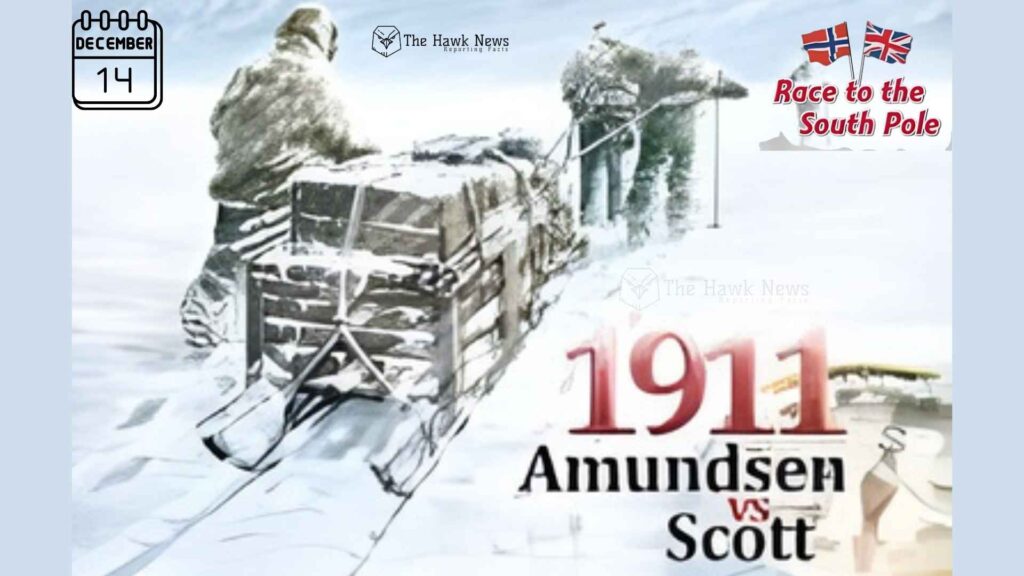
On December 14, 1911, five men stood at the most unforgiving point on Earth. There were no crowds, no banners, no applause—only wind, ice, and a silence so complete it felt absolute.
At 90° South, Roald Amundsen planted the Norwegian flag and quietly completed one of the greatest feats of human exploration.
He had reached the South Pole first.
This moment marked the end of a race that had captured the imagination of the world—and revealed a truth that still resonates with adventurers today:
Survival Favors Preparation over Bravado, Strategy over Spectacle.
The Last Blank Space on the Map
At the dawn of the 20th century, Antarctica represented the final unknown.
While continents had been charted and oceans crossed, the South Pole remained untouched—an abstract point buried beneath ice, mystery, and myth.
This was the Heroic Age of Antarctic Exploration, when national pride and personal legacy were tied to endurance against nature itself.
To reach the Pole was to step beyond the limits of the known world.
Two men would attempt it almost simultaneously—each carrying the hopes of his nation.
Two Explorers, Two Mindsets
Roald Amundsen, a Norwegian explorer, had already navigated the Northwest Passage and lived among Arctic peoples to learn survival techniques. His approach to exploration was pragmatic, almost clinical.
Robert Falcon Scott, a British naval officer, was a symbol of Edwardian heroism. His expedition combined exploration with scientific research and carried the weight of imperial expectation.
Scott would later write in his diary:
“We took risks, we knew we took them… but things have come out against us.”
Amundsen believed risks should be eliminated before the journey ever began.
Preparation: Where the Race Was Won
Amundsen understood a truth many explorers learned too late: Antarctica does not reward courage—it rewards competence.
He made a series of decisive choices:
- Chose the Bay of Whales, a shorter route to the Pole
- Used sled dogs, skis, and fur clothing modeled on Inuit practices
- Carefully laid supply depots with precise navigation
- Selected a small, highly skilled team of five
Amundsen later wrote:
“Victory awaits him who has everything in order—luck, people call it.”
Scott’s expedition, by contrast, relied on experimental motor sledges, Siberian ponies, and man-hauling—methods that proved vulnerable to Antarctic conditions.
Into the White
Amundsen’s team departed in October 1911. From the start, the journey was relentless.
Temperatures plunged below −40°C. Winds erased tracks within minutes. Whiteouts blurred sky and ground into a single disorienting void.
Every day required absolute focus: navigating crevasses, rationing food, protecting fingers and toes from frostbite.
Yet the expedition moved with efficiency. Skiing allowed faster travel. Dogs bore the brunt of the labor. Camps were set with methodical precision.
There was no romance in the march—only discipline.
December 14, 1911: Arrival at the End of the Earth
After 56 days on the ice, Amundsen and his team reached their goal.
They confirmed their position through repeated measurements, wary of error. They pitched a tent—named Polheim, “Home of the Pole”—and planted the Norwegian flag.
Inside the tent, Amundsen left a letter addressed to Scott, in case the British explorer arrived after him.
There was no celebration. No speeches. The Pole was not a place to linger.
Amundsen later described the moment with restraint, noting only the importance of accuracy and return.
The Quiet Exit—and the Shadow That Followed
Amundsen’s team returned safely to their base in January 1912. Every man survived. Every calculation held.
Scott arrived at the Pole on January 17, 1912, 33 days later.
His diary recorded the crushing realization:
“The worst has happened… All the day dreams must go.”
Scott and his four companions died on the return journey—exhausted, underfed, and trapped by weather just miles from a supply depot.
Their fate cast a long shadow over the triumph of the Pole, transforming the race into a study of contrasting philosophies rather than simple victory and defeat.
Why Amundsen Succeeded
History has stripped away nationalism and myth, leaving clarity.
Amundsen succeeded because he:
- Respected indigenous knowledge
- Optimized tools for the environment
- Valued efficiency over symbolism
- Planned for survival, not glory
This was not a triumph of strength—it was a triumph of humility.
Antarctica was not conquered. It was negotiated with.
What the South Pole Teaches Today’s Adventurers
For modern wanderers and adventure seekers—whether scaling mountains, crossing deserts, or chasing creative frontiers—Amundsen’s journey offers enduring lessons:
Preparation Is Not the Enemy of Adventure
Planning does not diminish discovery; it enables it.
Adaptation Beats Tradition
What has “always been done” is often less important than what works.
Ego Is Heavy Baggage
Survival improves when pride is left behind.
Success Can Be Silent
Not all victories are dramatic. Some are simply safe returns.
The Pole as a Mirror
Today, satellites can pinpoint the South Pole in seconds. Aircraft can land near it. Yet Amundsen’s journey remains unmatched in meaning.
It represents a moment when humanity faced the planet at its most indifferent—and prevailed not through domination, but through understanding.
At 90° South, Amundsen did not prove man’s supremacy over nature.
He proved that listening to it was the wiser path.
Victory awaits him who has everything in order — luck people call it. Defeat is certain for him who has neglected to take the necessary precautions in time; this is called bad luck.— Roald Amundsen
In the end, the greatest exploration race was not won on the ice—it was won in the mind long before the first step south.