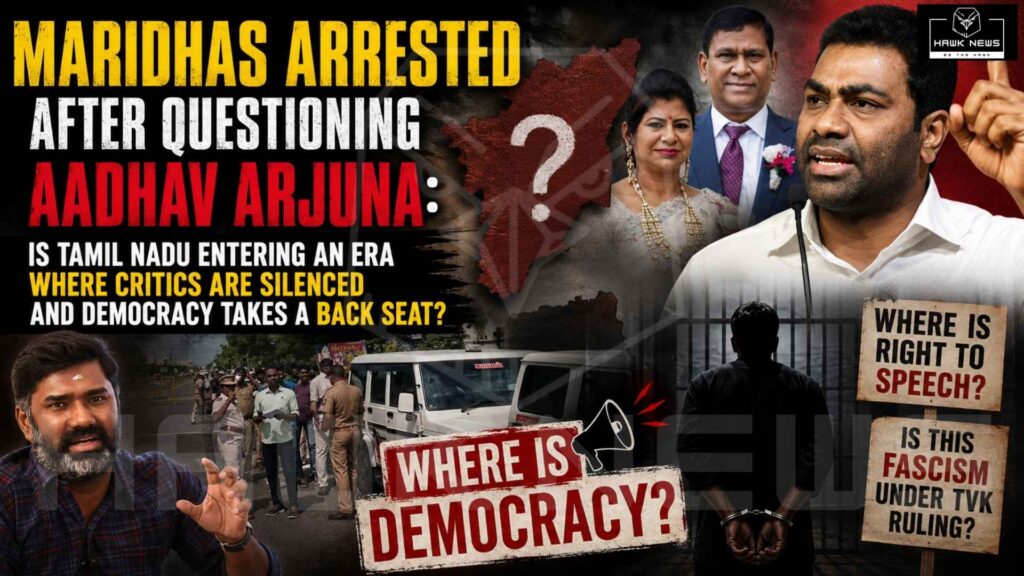
The arrest of political commentator Maridhas has triggered a debate that extends far beyond one YouTube channel, one cyber crime case, or one individual critic. The real question now being asked across Tamil Nadu is whether the state is witnessing a growing intolerance toward dissent under the new TVK government.
For years, Maridhas has built his reputation around aggressive political commentary. His supporters view him as a whistleblower willing to ask uncomfortable questions. His critics view him as a controversial figure who frequently pushes the boundaries of political criticism. Regardless of which side one takes, his arrest has opened a larger conversation about free speech, political power, and the limits of democratic criticism.
The Arrest That Sparked Questions
According to police, the arrest stems from content published by Maridhas on social media and YouTube, including material that allegedly contained defamatory claims and manipulated content involving government ministers.
Cyber Crime officials from Chennai travelled to Madurai, where Maridhas was taken into custody and brought to Chennai for questioning.
Legally, the government has every right to investigate content that it believes violates the law. No democratic society places speech entirely above legal scrutiny. However, the controversy begins with the timing and context surrounding the arrest.
Why did the arrest occur at this particular moment?
Why did it come shortly after a series of videos in which Maridhas questioned Minister Aadhav Arjuna and discussed allegations, controversies, and relationships involving politically connected individuals?
Those questions are now at the center of public debate.
The Aadhav Arjuna Factor
In the days leading up to his arrest, Maridhas reportedly released videos discussing Minister Aadhav Arjuna and individuals connected to his extended family network.
Among the issues raised were questions surrounding relatives, business interests, and allegations that have surfaced in various enforcement investigations involving politically connected figures.
Whether Maridhas’ claims were accurate, exaggerated, or entirely wrong is a matter that can be challenged through facts, evidence, and legal proceedings.
But critics of the arrest argue that the government’s response appears directed at the messenger rather than the message.
If the allegations were false, why not publicly rebut them?
Why not issue a legal notice?
Why not hold a press conference and present evidence?
Why does an arrest become the first visible answer to political criticism?
These are the questions being raised by opposition parties and civil liberty advocates.
Democracy Is Not Tested by Praise
Democracy is not measured by how governments respond to supporters.
Democracy is measured by how governments respond to critics.
Every government welcomes praise. Every leader enjoys applause. The real test begins when uncomfortable questions are asked.
A democracy grows stronger when criticism is answered with facts.
It becomes weaker when criticism is answered with fear.
This is why the Maridhas case has resonated far beyond his own audience. Many people who may not even agree with his politics are asking whether criticism itself is becoming risky.
When citizens begin wondering whether a YouTube video can result in police action, the debate is no longer about one commentator.
It becomes a debate about the boundaries of democratic speech.
Is Tamil Nadu Moving Toward Political Intolerance?
Supporters of the government argue that freedom of speech does not include freedom to spread misinformation, defamation, or manipulated content.
That argument has merit.
No democracy can function if falsehoods are allowed to circulate without accountability.
But accountability must be balanced with transparency.
When governments act against critics, they must demonstrate clearly that the action is based on law rather than political discomfort.
The absence of that clarity creates suspicion.
And suspicion creates a dangerous perception that criticism itself is becoming criminalized.
This is where the current controversy becomes politically significant.
The question is no longer whether Maridhas is right or wrong.
The question is whether Tamil Nadu is entering a political climate where critics increasingly fear consequences for speaking against those in power.
The Bigger Fear Behind the Debate
The word “fascism” is now being used frequently by opponents of the arrest.
That is a serious accusation and one that should not be used casually.
But history offers an important lesson.
Democracy rarely disappears overnight.
It weakens gradually.
First, critics are dismissed.
Then critics are targeted.
Then critics become examples.
Finally, criticism itself becomes dangerous.
Whether Tamil Nadu is anywhere near such a situation is a matter of political opinion.
However, the fact that such questions are now being openly asked should concern everyone, regardless of party affiliation.
Because free speech is not a right reserved for one political side.
It belongs equally to supporters, opponents, journalists, activists, and ordinary citizens.
The Questions That Remain Unanswered
The arrest of Maridhas has created more questions than answers.
Was this purely a cyber crime investigation based on alleged legal violations?
Or was the timing influenced by the politically sensitive subjects he had been discussing?
Did his criticism of powerful individuals make him a target?
Could the same objective have been achieved through legal notices, summons, or public rebuttals instead of arrest?
Most importantly, what message does this send to others who wish to question those in power?
Until those questions receive convincing answers, the controversy will continue.
Democracy’s Most Important Test
The Maridhas controversy is ultimately not about Maridhas alone.
It is about the relationship between power and criticism.
Governments change.
Parties rise and fall.
Leaders come and go.
But the principle remains constant.
A democracy becomes stronger when questions are answered.
It becomes weaker when questions are feared.
As Tamil Nadu watches this controversy unfold, one question now hangs over the state’s political landscape:
If asking questions becomes dangerous, where does democracy end and intimidation begin?