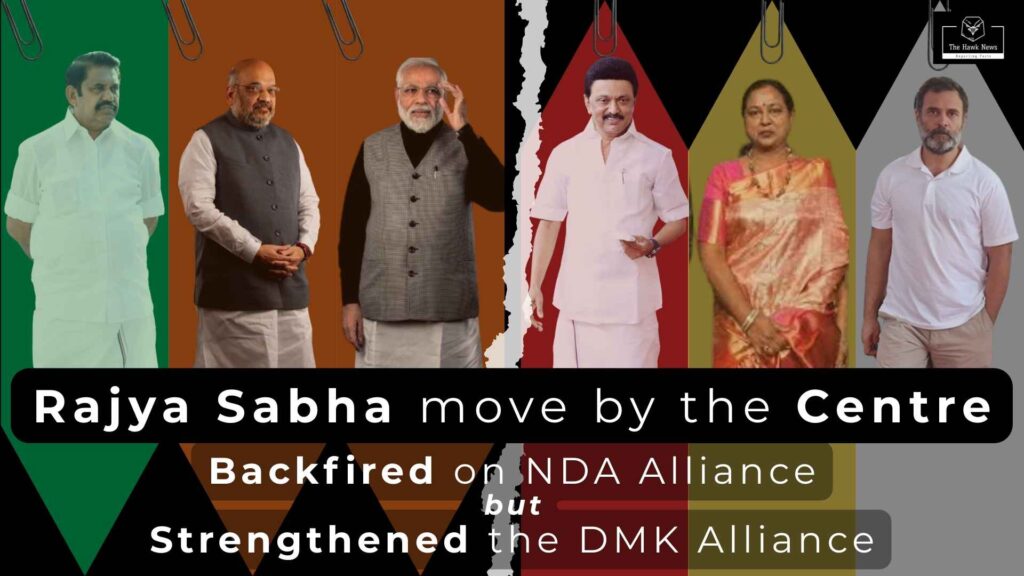
Indian politics often runs on arithmetic. Seats, alliances, timing and legislative numbers decide the direction of power in both Parliament and the states. Yet political strategy often produces unintended consequences, especially when national calculations collide with regional realities.
The recent Rajya Sabha election schedule is one such case. What appeared to be a calculated institutional move to secure parliamentary numbers has ended up reshaping alliance dynamics in Tamil Nadu ahead of the 2026 Assembly election.
The result is a political paradox. A decision designed to secure numbers in the Upper House has unexpectedly strengthened the DMK alliance at the state level and altered the bargaining equations among several regional parties.
Rajya Sabha Elections and the Legislative Arithmetic
Rajya Sabha members are not elected directly by voters. They are chosen through a system where MLAs vote using proportional representation. This means the composition of each state assembly directly determines who enters the Upper House.
The Election Commission announced biennial Rajya Sabha elections for multiple states because several members are completing their six year term. Among the states where elections are scheduled, Tamil Nadu holds significant political attention due to the approaching Assembly election.
In Tamil Nadu, six Rajya Sabha seats are becoming vacant. The MLAs of the current Assembly will vote to elect the next set of members who will serve in Parliament for the next six years.
The key factor in this process is timing. These elections will be conducted using the present Assembly strength rather than the Assembly that will emerge after the 2026 state election.
Why the Timing Became Politically Significant
The Rajya Sabha election system requires a specific number of MLAs to elect one member. In the Tamil Nadu Assembly, which has 234 seats, roughly thirty four MLAs are required to secure one Rajya Sabha seat through the proportional voting formula.
This mathematical structure makes legislative numbers extremely important for alliance negotiations. Parties that control large blocks of MLAs can distribute Rajya Sabha seats to their allies as part of political agreements.
If the Rajya Sabha elections had taken place after the 2026 Assembly election, the political arithmetic might have changed significantly depending on which alliance forms the government in Tamil Nadu.
Because the elections are happening before the Assembly polls, the current legislative balance decides the outcome. This factor has quietly influenced alliance negotiations across the state.
Tamil Nadu’s Alliance Landscape
Tamil Nadu politics traditionally revolves around two large alliance blocs. One is led by the DMK, while the other is anchored by the AIADMK with support from the BJP and other allies.
In closely contested elections, the outcome often depends on how effectively each alliance manages smaller parties. Even a marginal vote share from regional parties can influence results in several constituencies.
That is why parliamentary seats such as those in the Rajya Sabha become important bargaining tools. A party that cannot offer many Assembly constituencies can still offer representation in Parliament to keep allies satisfied.
The current Rajya Sabha cycle has therefore become an important instrument in shaping alliance negotiations for the upcoming election.
DMDK’s Entry into the DMK Alliance
One of the most significant developments triggered by this situation is the entry of the Desiya Murpokku Dravida Kazhagam into the DMK alliance.
The party, founded by actor Vijayakanth, has experienced electoral decline in recent years but still retains pockets of influence across certain regions of Tamil Nadu.
For a party in such a position, representation in the Rajya Sabha provides political visibility and relevance at the national level.
The DMK alliance reportedly offered a Rajya Sabha seat as part of the negotiation process. This parliamentary guarantee created a strong incentive for DMDK to align with the DMK coalition.
The development added another regional player to the DMK alliance structure ahead of the Assembly election.
AIADMK’s Structural Limitation
While the DMK had room to negotiate with Rajya Sabha seats, the AIADMK faced a structural limitation based on its current MLA strength.
According to the legislative arithmetic, the party is positioned to secure only two Rajya Sabha seats in this election cycle.
Both of those seats already carry political implications. One of them is linked to the alliance equation with the Pattali Makkal Katchi, whose leader Anbumani Ramadoss remains an important figure within the NDA bloc in Tamil Nadu.
The other seat becomes crucial for maintaining balance within the AIADMK leadership and organizational hierarchy.
If both seats were allocated to alliance partners, it could trigger internal political dissatisfaction within the party.
This constraint effectively meant that the AIADMK did not have a Rajya Sabha seat available as a bargaining tool during alliance negotiations with parties like DMDK.
Congress and the Negotiation Deadlock
Another important dimension of the Rajya Sabha equation involved the Congress party within the DMK alliance.
During seat sharing discussions for the 2026 Assembly election, Congress initially demanded around forty Assembly constituencies.
The DMK leadership, however, was unwilling to concede such a large number of seats and offered a smaller allocation along with a Rajya Sabha berth.
This difference triggered tension within the alliance and led to speculation about possible political realignment.
However, the Rajya Sabha factor eventually played a decisive role in resolving the deadlock.
Congress ultimately accepted a compromise arrangement that included twenty eight Assembly seats along with a Rajya Sabha seat in the current cycle and another in a later term.
The settlement ensured that the alliance remained intact and avoided a fragmentation that could have reshaped the electoral contest.
Legislative Arithmetic Behind Rajya Sabha Elections
| Category | Numbers |
|---|---|
| Total Assembly Seats in Tamil Nadu | 234 |
| Majority Mark in Assembly | 118 |
| MLAs Required for One Rajya Sabha Seat | Around 34 |
| Rajya Sabha Seats Vacant in 2026 | 6 |
These numbers illustrate how the Rajya Sabha election system operates in practice.
Every alliance calculates its strategy based on this legislative arithmetic. Parties with stronger MLA numbers gain greater flexibility to distribute parliamentary seats among allies.
This flexibility often determines whether smaller parties join a coalition or seek alternative alliances.
Rajya Sabha Seats as Political Currency
In coalition politics across India, Rajya Sabha nominations often function as political currency.
Major parties use these seats to accommodate allies who may not receive many Assembly constituencies but still require representation at the national level.
Tamil Nadu has witnessed this pattern multiple times over the decades. Parliamentary nominations have frequently been used to stabilize alliances before major elections.
For smaller regional parties, a Rajya Sabha seat offers access to national politics, legislative influence and media visibility.
For larger parties, it becomes a strategic instrument to maintain coalition unity.
The Broader National Strategy
At the national level, early Rajya Sabha elections help maintain parliamentary continuity. Members elected now will remain in office for six years, meaning their tenure will extend well beyond the upcoming Assembly elections.
This ensures that the current composition of several state assemblies continues to influence the balance of power in the Upper House.
From the perspective of national political strategy, this approach secures parliamentary stability regardless of changes in state governments.
However, the same calculation can produce unexpected consequences when applied to individual states.
Tamil Nadu appears to be one such example.
Electoral Margins and Alliance Impact
Tamil Nadu elections often produce closely contested results in many constituencies.
Even small variations in vote share can influence outcomes across dozens of seats.
Regional parties with limited vote share may still play a decisive role in tight electoral contests.
If a party with two or three percent vote share aligns with a larger coalition, that marginal support can shift the balance in multiple constituencies.
This is why alliance arithmetic remains central to Tamil Nadu politics.
The addition or departure of even a minor partner can alter the strategic landscape of the election.
The Political Irony
The Rajya Sabha election schedule was primarily designed to address parliamentary numbers.
Yet the ripple effects of that decision have extended far beyond the Upper House.
In Tamil Nadu, the same process has contributed to alliance consolidation within the DMK coalition.
DMDK has moved into the alliance structure, while Congress has ultimately remained within the coalition after negotiations.
At the same time, the AIADMK faced limited flexibility because its Rajya Sabha seats were already politically committed.
The result is a political irony. A move intended to secure parliamentary arithmetic at the national level may have indirectly strengthened an opposition alliance in one of the country’s most politically decisive states.