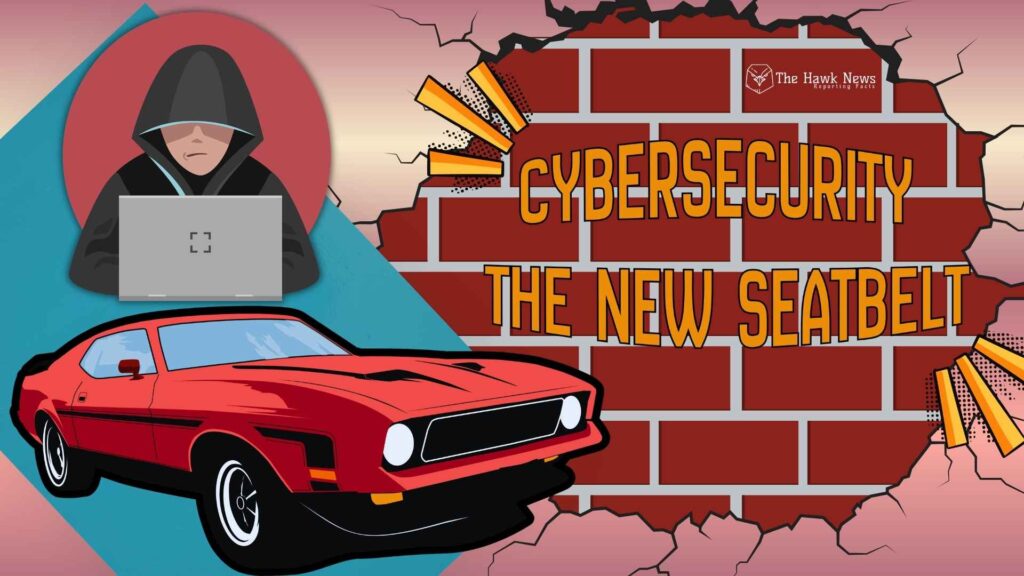
The New Engine Isn’t Mechanical — It’s Digital
Once upon a time, a car’s safety was measured by its airbags, brakes, and crash ratings.
Today, it’s measured by code.
Modern vehicles are no longer just machines; they’re computers on wheels — powered by millions of lines of software.
From adaptive cruise control and infotainment systems to over-the-air updates and driver-assist features, software defines every move a vehicle makes.
But this evolution, while revolutionary, has opened the garage door to a new threat — cyberattacks.
“In the past, road safety meant protecting lives from collisions. Now, it means protecting cars from code intrusion,” said a lead engineer at Bosch Mobility.
The Digital Highway — and Its Hazards
A decade ago, a hacker would need physical access to tamper with a vehicle.
Today, a skilled attacker can exploit vulnerabilities remotely — through Wi-Fi, Bluetooth, satellite links, or even your phone.
In 2015, researchers famously hacked a Jeep Cherokee while it was driving on a U.S. highway, remotely disabling its brakes and engine. That moment shocked automakers into recognizing cybersecurity as a core safety concern.
Since then, the threat landscape has grown:
- Data breaches from infotainment systems storing contact lists, messages, and routes.
- Remote hijacking of vehicle functions through telematics or mobile apps.
- Ransomware threats on electric-vehicle charging networks.
- Supply-chain infiltration through compromised automotive software vendors.
Every connection is a potential corridor — and every convenience, a possible compromise.
Regulation Rides In
Recognizing the gravity, regulators worldwide are steering cybersecurity into law.
The United Nations Regulation R155 mandates that all new vehicles (from 2024 onward in several regions) include certified cybersecurity management systems.
Similarly, the ISO/SAE 21434 standard now governs automotive cybersecurity engineering — ensuring that protection is built in from concept to production.
“Cybersecurity is no longer optional for automakers; it’s a global compliance requirement,” says Kaspersky’s automotive-security director.
Manufacturers must now prove they can detect, respond to, and recover from cyberattacks — just as they must demonstrate crash resilience.
The Invisible Airbag — Software Protection Systems
The digital equivalent of an airbag is an intrusion-detection and prevention system (IDPS) — constantly scanning vehicle networks for anomalies.
In addition, automakers are investing heavily in:
- Secure boot mechanisms — ensuring only verified software runs in the car.
- Over-the-air (OTA) encryption — preventing update tampering.
- Firewalls for CAN Bus systems — the central nervous system linking all car components.
- AI-driven anomaly detection — learning to recognize attacks faster than humans can.
These systems operate quietly — unseen, but vital — defending drivers from threats they’ll hopefully never know existed.
The Rise of Ethical Hackers
Cybersecurity isn’t about fear; it’s about foresight.
Automotive giants now collaborate with ethical hackers to test their systems before criminals can exploit them.
Companies like Tesla and Toyota run bug-bounty programs, rewarding independent researchers for discovering vulnerabilities.
This new partnership between automakers and hackers marks a shift — from secrecy to shared defense.
“Every carmaker today must think like a tech company,” notes a senior analyst at McKinsey & Company. “Because the next recall might not be for faulty brakes, but for compromised code.”
Privacy on the Road
With connected vehicles collecting massive amounts of driver data — from GPS routes to voice commands — privacy becomes the next battleground.
Studies show that over 60 % of drivers are unaware of how much personal information their cars store or transmit.
Automakers must now balance innovation with integrity — securing not only the machine, but the mind behind the wheel.
The emergence of data-governance policies ensures that personal data stays encrypted, anonymized, and used only for legitimate purposes.
Because in this new world, the person who controls the data controls the direction.
The Road Ahead
As cars evolve toward Level 4 and 5 autonomy, the line between technology and transportation will blur even further.
Tomorrow’s car will drive itself — but can it defend itself?
The future of road safety depends not only on brakes and belts, but on firewalls, encryption, and AI vigilance.
“Cybersecurity will define the next decade of automotive trust,” says a European Automobile Manufacturers Association report.
Automotive software is no longer a feature — it’s the foundation.
And protecting that foundation will be the true test of every automaker’s integrity.
In Closing
We’ve come a long way from the mechanical age to the digital dawn — from grease to code, from horsepower to processing power.
But one truth remains constant:
safety is sacred.
If a car once needed a driver’s hands to steer, it now needs an engineer’s foresight to defend.
Because the future of driving won’t be defined by speed or style —
but by security and trust.