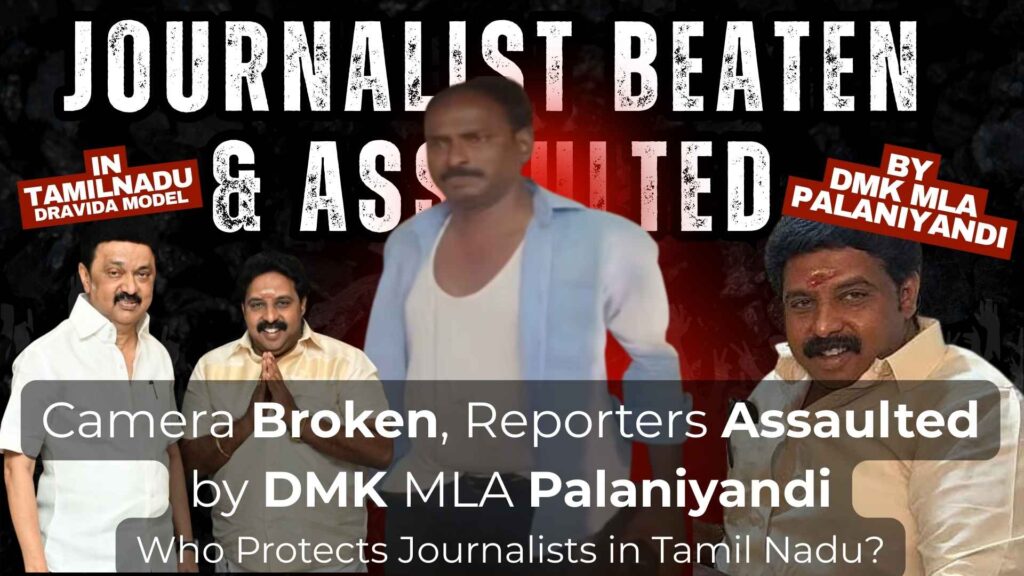
What Safety Does a Journalist Have When He Does His Duty in Tamil Nadu?
Journalism is not a favour.
It is a function.
When a journalist walks into a field, records evidence, and asks uncomfortable questions, the state is obligated to ensure his safety. That obligation does not change based on who is in power.
Yet, in Tamil Nadu today, that obligation appears to be selectively applied.
The assault on journalists in Karur district while they were documenting alleged illegal quarrying linked to M Palaniyandi raises a question far larger than one violent incident.
If a journalist is attacked for doing his job and the accused continue untouched, what does safety even mean in this state?
A Field Assignment That Turned Into a Crime Scene
The journalists did not arrive at the quarry with political slogans or personal vendettas. They came responding to complaints of alleged illegal quarrying operations. This is standard field journalism, particularly in districts where mining violations have historically gone unchecked.
What they encountered was not resistance through explanation or denial. It was violence.
According to multiple regional reports, the journalists and their cameraman were assaulted, their equipment damaged, and they were forcibly taken away from the site. For close to an hour, they were held against their will until police intervention ensured their release.
This was not a misunderstanding.
This was not a spontaneous reaction.
This was a deliberate attempt to stop documentation.
Why This Quarry Mattered
Illegal quarrying in Tamil Nadu is not an isolated administrative violation. It is a deeply entrenched economic and political ecosystem.
The quarry the journalists were filming was allegedly linked to a sitting DMK MLA. That allegation is not new. Palaniyandi’s name has surfaced repeatedly in connection with quarrying and stone-crushing operations over the years.
Earlier enforcement actions reportedly imposed massive penalties on quarry operations associated with him, running into hundreds of crores. In another case, the Madras High Court set aside his acquittal in a staffer’s death linked to a stone-crushing unit and ordered a re-hearing.
These are matters of public record.
When journalists step into such locations, they are not chasing rumours. They are stepping into spaces with documented histories of controversy.
Violence as a Tool of Control
The assault was not only about physical harm. It was about erasing evidence.
Cameras were damaged.
Recording was interrupted.
Fear was induced.
This is a pattern repeatedly observed in illegal mining cases across India. When documentation threatens revenue streams, intimidation becomes the first line of defence.
Stopping a journalist is cheaper than stopping illegal activity.
That calculation appears to have played out in Karur.
The Silence Around the MLA
The most striking aspect of this case is not the attack itself.
It is what followed.
Despite widespread reporting and public circulation of the incident, there has been no visible action against the MLA whose name has been linked to the quarry.
No statement denying involvement.
No clarification.
No announcement of internal inquiry.
No distancing by the ruling party.
In a functional democracy, even an allegation of this gravity demands transparency. Silence from power is not neutral. It shapes perception.
And the perception here is deeply damaging.
Police Action Without Accountability
Police teams did reach the spot. Senior officers reportedly intervened and recovered the journalists. Statements were recorded.
But recovery is not justice.
As of now, there is no publicly available FIR copy detailing the sections invoked. There is no clarity on arrests, remand, or the investigation’s scope.
Most importantly, there is no visible indication that political influence is being examined as part of the probe.
In Tamil Nadu, policing is not insulated from politics. That reality cannot be ignored when assessing such cases.
Journalism Without Institutional Backing
Perhaps the most uncomfortable truth is the response from within the media itself.
There has been no sustained outrage.
No joint statement from journalist associations.
No coordinated pressure on the government.
The assaulted journalists were field reporters, not primetime anchors. They did not represent a corporate media house with institutional muscle.
In today’s media hierarchy, that distinction matters.
Silence from colleagues is not accidental. It reflects a shrinking collective conscience within the profession.
A Repeating Pattern in Tamil Nadu
This incident does not exist in isolation.
Over the past decade, journalists covering sand mining, granite quarrying, land encroachments, and local corruption in Tamil Nadu have repeatedly faced threats and physical attacks.
Data from journalist safety organisations consistently show that reporters covering local-level corruption face higher risk than those covering national politics.
Mining-related reporting features disproportionately in assault cases.
This is not coincidence. It is economics.
The Economics of Illegal Quarrying
Illegal quarrying is not a side activity. It is a multi-crore enterprise.
Revenue flows through construction contracts, transport permits, political donations, and local patronage networks. Every truckload extracted illegally represents direct cash flow.
A journalist with a camera threatens that flow.
When power and profit converge, accountability becomes the enemy.
The Dravida Model Under Scrutiny
The ruling party frequently projects Tamil Nadu as a model of governance rooted in rationalism and social justice.
Models are tested under pressure.
When journalists are assaulted and the accused face no immediate consequences, the model collapses at ground level.
Freedom of expression is not defined by speeches. It is defined by how the state reacts when that freedom is attacked.
On that metric, the response so far is deeply inadequate.
From Journalists to Citizens
The implications of this incident extend beyond media.
If journalists are unsafe while performing their duty, what about ordinary citizens who raise objections?
What about villagers opposing land acquisition?
What about whistleblowers without visibility?
When violence silences journalism, it sends a warning to society at large.
Questioning power comes at a cost.
Laws That Exist Only in Books
India’s legal framework includes provisions to protect public servants on duty, criminalise intimidation, and penalise unlawful confinement and destruction of property.
The problem is not absence of law. It is absence of will.
In politically sensitive cases, investigations often stall, charges weaken, and accountability evaporates.
This is not a failure of policing. It is a failure of governance.
Data and the Culture of Impunity
Analytical reviews of journalist assault cases across India reveal a grim pattern.
Conviction rates are negligible.
Cases drag for years.
Political actors are rarely held accountable.
Impunity encourages repetition.
When attackers see that violence carries no consequence, it becomes a viable tool.
Media Freedom Is Not a Decoration
Press freedom cannot survive on slogans.
It requires institutions willing to defend their own, even when the victim is inconvenient, local, or powerless.
When media houses look away, they weaken the profession they claim to represent.
An attack on one journalist is an attack on the credibility of all.
The Questions Tamil Nadu Must Answer
Why has there been no visible action against the MLA linked to the quarry?
Why has the ruling party not issued a clear condemnation?
Why are investigation details not transparent?
Why is silence being normalised?
And the question that refuses to disappear.
Is this the Dravida Model of governance, where journalists are assaulted and power remains untouched?
The Larger Truth
Tamil Nadu prides itself on political maturity.
That maturity is now under examination.
A state cannot claim progress while tolerating intimidation.
A government cannot claim moral authority while protecting silence.
A society cannot claim safety when truth-tellers are beaten.
If this is the field reality for journalists, the concern extends to every citizen.
The real question is no longer about media safety alone.
Are people safe at all?