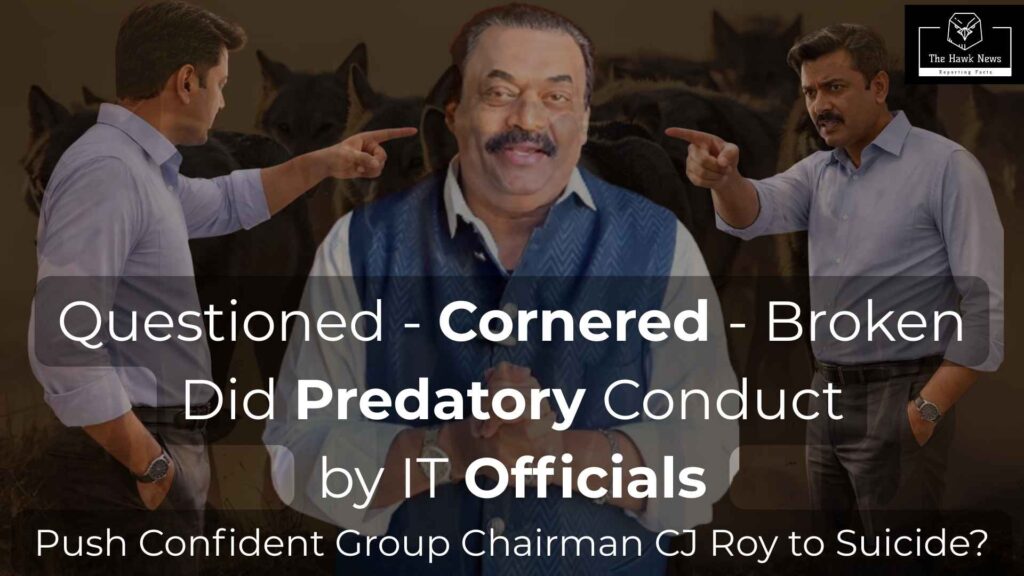
The death of CJ Roy, chairman of the Confident Group, during an ongoing Income Tax inquiry in Bengaluru has unsettled India’s business and regulatory ecosystem in a way few incidents have in recent years.
This was not a private tragedy unfolding in isolation.
It occurred inside a formal, state-sanctioned enforcement process.
It happened under the watch of officials vested with immense power.
When a businessman dies while being questioned by the state, the issue is no longer about individual resilience. It becomes a question of institutional behaviour.
And that question cannot be buried under procedural language.
The Man, the Company, and the Context
CJ Roy was not a marginal entrepreneur operating at the fringes of the economy. He was a seasoned real estate developer with operations across Karnataka, Kerala, and overseas markets including Dubai. Over decades, he built the Confident Group into a diversified business entity employing hundreds and contributing significant tax revenue.
He was familiar with regulatory scrutiny.
He had faced audits before.
He had navigated financial cycles and political uncertainty.
This context matters because it dismantles the convenient assumption that he was unprepared for questioning. A businessman of this scale does not collapse simply because officials arrive with files.
Something else happened.
What the Income Tax Action Involved
According to publicly reported details, Income Tax officials from Kerala had been conducting searches and inquiries related to the Confident Group for several days. The action culminated in questioning at Roy’s Bengaluru office, where officials reportedly continued the inquiry for three consecutive days.
On the final day, Roy requested a break to speak to his mother. Shortly thereafter, he was found with a gunshot wound inside his office cabin. He was rushed to hospital and declared dead.
No suicide note has been officially disclosed so far.
The case has been registered as suicide, but the circumstances remain under investigation.
What remains conspicuously absent from official communication is a clear account of how the inquiry was conducted.
Inquiry Rooms Are Not Neutral Spaces
On paper, an Income Tax inquiry is an administrative exercise. In reality, it is an intense power encounter.
Officials enter private offices armed with authority, suspicion, and discretionary control. The person being questioned often has little clarity on timelines, consequences, or boundaries.
Legal experts have long pointed out that enforcement actions in India blur the line between investigation and intimidation. Unlike court proceedings, inquiries happen behind closed doors, without public oversight or recorded accountability.
The tone used, the language deployed, and the psychological pressure applied remain invisible to the outside world.
This opacity is precisely what makes cases like this dangerous.
The Question of Psychological Pressure
Three continuous days of questioning is not routine documentation.
It is prolonged exposure to stress.
Behavioural psychologists note that extended interrogation environments can lead to emotional exhaustion, loss of perspective, and impaired judgment, especially when reputational stakes are high.
Roy was questioned inside his own office, surrounded by employees and staff. If criticism, suspicion, or insinuation was expressed publicly, the impact would not have been merely professional. It would have been existential.
Respect once lost in such a setting is difficult to recover.
The law does not recognise psychological coercion unless it leaves visible scars. But its damage is often deeper.
When Authority Turns Predatory
The headline term “predatory” is not rhetorical excess. It describes a pattern increasingly documented by civil liberties groups and former bureaucrats themselves.
Predatory conduct is not about physical violence.
It is about asymmetry of power.
It is about sustained pressure without safeguards.
It is about making individuals feel cornered rather than questioned.
In recent years, both the Income Tax Department and the Enforcement Directorate have been criticised for operating with minimal restraint. Raids are publicised. Allegations leak before trials begin. Reputations are damaged long before courts weigh evidence.
The enforcement process itself becomes the punishment.
A Historical Pattern India Refuses to Confront
This is not the first time India has witnessed a high-profile death under financial or regulatory pressure.
In 2019, Café Coffee Day founder V G Siddhartha died after leaving behind a letter describing unbearable pressure from lenders and tax authorities. His death prompted brief outrage and then silence.
Each time, the pattern repeats.
Shock.
Condolences.
Assurances of inquiry.
And eventual institutional amnesia.
No structural reform follows. No interrogation protocols change. No officer is held personally accountable.
Business, State, and the Fragile Trust Between Them
India’s economic growth depends on private enterprise. Businesses generate employment, taxes, and innovation. The relationship between the state and entrepreneurs must be firm but fair.
When enforcement agencies treat businessmen as presumed criminals, trust collapses.
Analysts warn that fear-based compliance discourages risk-taking, slows investment, and pushes capital away from transparent systems into informal survival strategies.
A democracy cannot thrive when its wealth creators operate in constant fear of humiliation.
Naming the Officer Is Not Vilification, It Is Due Process
The inquiry into the Confident Group was reportedly led by Krishnaprasad, an IRS officer from Kochi.
This is not an accusation.
It is a factual assertion of responsibility.
When a death occurs during an official process, every authority figure involved must submit to scrutiny. This is how democratic accountability works.
The question is simple and unavoidable.
What methods were used during those three days?
What language was employed?
What pressure was applied?
If nothing improper occurred, transparency will clear the air.
If something did, silence will only deepen suspicion.
The Role of the State After the Death
The Bengaluru Deputy Chief Minister has announced that a Special Investigation Team will be constituted to probe the incident.
This announcement carries weight only if the SIT’s mandate is broad and fearless.
Investigating merely the act of suicide is insufficient. The investigation must examine the environment that preceded it.
This includes interrogation style, duration, psychological impact, and adherence to humane protocols.
Anything less will be perceived as institutional self-protection.
Who Watches the Watchmen in India
India lacks a robust mechanism to investigate investigators.
There is no automatic suspension pending inquiry when a death occurs during enforcement action. There is no independent civilian oversight board for tax or financial agencies.
This structural vacuum creates moral hazard. Power exercised without consequence inevitably drifts toward abuse.
Analysts argue that until enforcement agencies are subjected to the same scrutiny they impose, tragedies like this will recur.
Suicide Is Not an Endpoint, It Is an Alarm
Calling CJ Roy’s death a suicide does not end the conversation. It begins it.
When a citizen dies inside a legal process, the legitimacy of that process comes under question.
The law must examine itself with the same intensity it applies to others.
Otherwise, the message to society is clear.
Power is absolute.
And accountability is optional.
The Question That Refuses to Go Away
If an inquiry is conducted lawfully, respectfully, and humanely, no one should leave it broken.
If a man named his company Confident Group and lost all confidence inside an inquiry room, the system must ask itself why.
Until the conduct of the officials involved is examined openly, CJ Roy’s death will remain a stain on India’s enforcement culture.
And every future inquiry will carry the weight of this unanswered question.
What really happened inside that room?