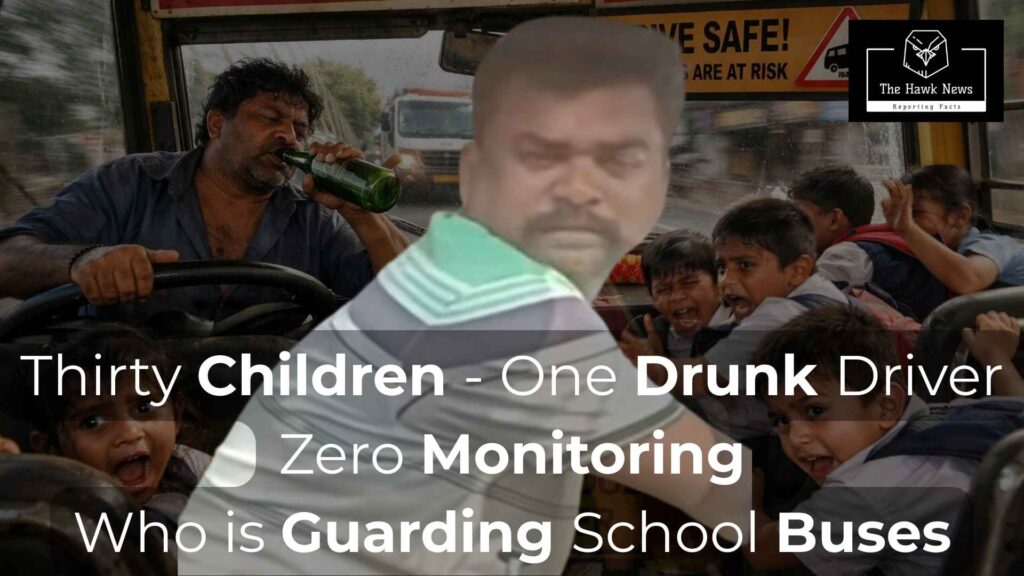
A school bus in Puducherry’s Thondamanatham area was allegedly driven by a man who was not in proper consciousness. Reports indicate that the driver was intoxicated. Around thirty children were inside the bus. The vehicle moved on public roads, endangering every child seated behind him.
This was not discovered by any authority. It was noticed by the public.
That single detail exposes the true state of child safety in school transportation. When ordinary citizens are the first line of defense, it means institutional safeguards have already failed.
This incident is not just about one drunk driver. It is about a system that allowed him to sit behind the wheel of a school bus in the first place.
A School Bus Is a Contract of Trust, Not Just Transport
Every morning, parents place their children on a school bus believing one fundamental thing. That the system has done its job. That someone has checked. That someone is responsible. That someone is watching.
A school bus is not a convenience service. It is a contract of trust between parents, schools, and the state. Children cannot assess risk. They cannot protest unsafe driving. They cannot escape a moving vehicle. They are entirely dependent on adults to protect them.
When a drunk driver drives a school bus, it is not only a legal violation. It is a betrayal of that trust.
The Most Disturbing Question: Where Were the Authorities
According to available information, the driver’s condition was identified by members of the public. They observed rash driving. They suspected intoxication. They questioned him and alerted the police.
This leads to an unavoidable question.
If the public could notice, why could the authorities not?
Traffic police patrol these roads every day. School buses follow fixed routes and fixed timings. Morning hours are predictable. Monitoring school transport should be the easiest form of preventive policing.
Yet this bus moved freely until civilians intervened.
That is not a lapse. That is absence.
Monitoring Exists Only on Paper
Rules for school transport already exist across states. Driver verification, fitness certificates, vehicle inspection, speed limits, emergency contacts, and safety markings are all mandated.
But rules without enforcement are theatre.
There is no evidence of daily sobriety checks. No visible mechanism to test drivers before duty. No surprise inspections that actually create fear of consequence. No real-time oversight.
Compliance is assumed, not verified.
In systems dealing with children, assumption is negligence.
Outsourcing Has Become an Excuse for Abdication
Most schools outsource transport operations. This has created a dangerous loophole. Schools collect transport fees, brand buses with their names, and advertise safe transport. But when something goes wrong, responsibility is pushed onto a contractor.
This logic is flawed.
If a school profits from transport services, it must also own the risk. Outsourcing does not absolve moral or legal responsibility. It only shifts operational work, not accountability.
A child does not differentiate between a school bus and a contractor’s bus. For parents, it is the school’s vehicle.
Traffic Police Visibility Stops Where Accountability Begins
Traffic enforcement today is visible when fines are involved. Helmet checks. Document checks. Parking penalties.
But proactive safety enforcement, especially for school transport, is rare.
School buses should be the most monitored vehicles on the road. Instead, they often pass unchecked. No breath analyser checks. No route-specific patrols. No mandatory daily inspections.
If enforcement only appears after tragedy, it is not enforcement. It is reaction management.
This Is Not an Isolated Incident. History Proves It
Across India, school transport negligence has repeatedly resulted in deaths and injuries.
Children have died in overloaded vans.
Children have been injured in buses driven by untrained drivers.
Children have been killed due to overspeeding and reckless driving.
In several cases, drivers were found unlicensed, intoxicated, or fatigued. Each time, authorities promised reform. Each time, guidelines were reiterated. Each time, the system reverted to complacency.
The Puducherry incident fits a long and disturbing pattern.
Children Pay the Price for Adult Indifference
Children do not get warning signs. They do not get second chances. A drunk driver does not need to crash at high speed to cause irreversible damage. A delayed reaction, a missed signal, a poor judgment is enough.
Adults debate responsibility after incidents. Children suffer before debates begin.
This imbalance is unacceptable.
Parents Are Forced to Trust Blindly
Parents have limited choices. Many depend on school transport because of work schedules, distance, and safety concerns with public transport.
But incidents like this destroy confidence.
Parents are not given access to driver background checks. They are not informed about sobriety monitoring. They are not shown audit reports. They are expected to trust without transparency.
Trust without information is coercion, not consent.
Who Will Be Held Accountable Beyond the Driver
Arresting the driver is necessary, but it is insufficient.
Who allowed him to report for duty?
Who signed off on his assignment that day?
Who failed to check his condition?
Who ignored enforcement responsibility?
If accountability stops with the driver, the system escapes untouched. And an untouched system will repeat its mistakes.
Institutional negligence must attract institutional consequences.
Schools Cannot Claim Innocence Through Silence
Schools cannot hide behind outsourcing contracts.
If a school runs transport under its name, it owns the risk.
If it collects transport fees, it owns the duty of care.
If it puts its logo on the bus, it owns the accountability.
Claiming ignorance is not innocence.
Safety cannot be delegated. Only operations can.
What Safety Means When the Victims Are Children
Children do not get a second chance.
A small swerve. A delayed reaction. A drunk misjudgment.
That is enough to end dozens of lives.
When adults gamble with children’s safety, it is not negligence. It is moral failure.
Trust Once Broken Is Almost Impossible to Restore
Parents will now hesitate. Children will feel unsafe. Communities will question.
And they should.
Because trust that survives without accountability is blind trust. Blind trust kills.
This Incident Demands More Than Condemnation
It demands mandatory daily breath testing for all school drivers.
It demands public disclosure of transport audit reports.
It demands dedicated traffic patrols for school routes.
It demands strict penalties for schools violating safety norms.
It demands criminal liability beyond the driver when negligence is systemic.
Anything less is cosmetic outrage.
Final Question
If a drunk driver can drive a school bus full of children until the public intervenes, what exactly is the safety system doing?
And if this is how careless the system is with school transport, what safety do children truly have?
Until these questions are answered with action, not statements, every school bus on the road remains a risk.
Not because children are unsafe.
But because the system entrusted to protect them has failed.