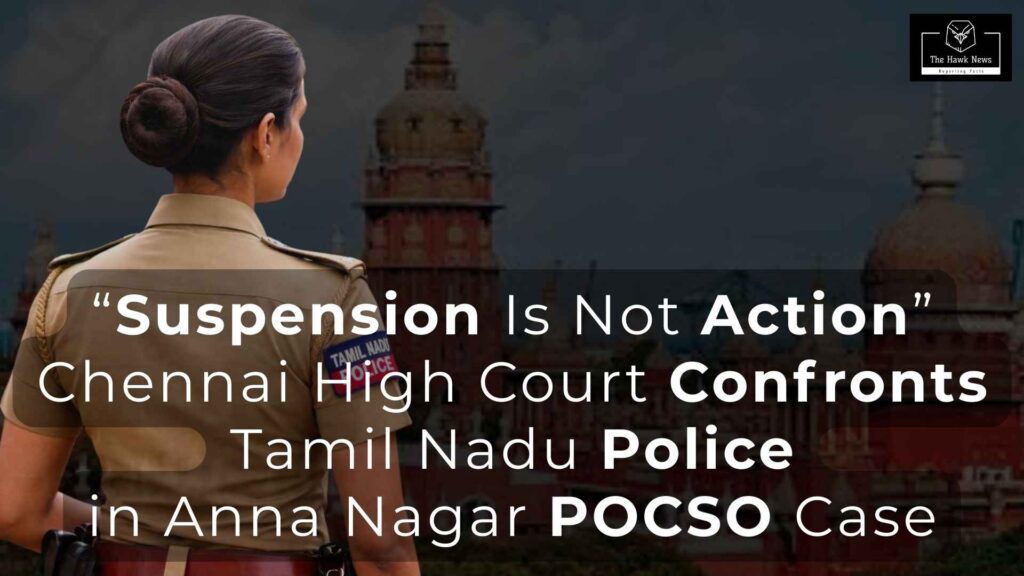
Suspension Is Not Accountability
The Madras High Court’s sharp question to the Tamil Nadu Police today cuts through years of institutional comfort.
What action have you taken against the officer? And why is suspension projected as punishment?
That question is not procedural. It is moral. It exposes a dangerous habit within the police system where suspension is showcased as accountability, while in reality it functions as paid leave, reputation management, and damage control.
The Anna Nagar POCSO case is not just about a child who was sexually assaulted. It is about what happened after the crime. It is about how power behaved when it was supposed to protect.
A Child Assaulted, A Family Broken
In August 2024, a ten year old girl from Anna Nagar was admitted to Kilpauk Medical College Hospital with severe abdominal pain. Medical examination confirmed repeated sexual assault.
This alone should have triggered the strongest possible response from the system.
The Protection of Children from Sexual Offences Act exists for one reason. To ensure that when a child is violated, the system becomes her shield, not another weapon.
Instead, what followed was a chain of events that showed how fragile justice becomes when police power is left unchecked.
The Police Station Became Another Crime Scene
When the survivor’s parents approached the Anna Nagar All Women Police Station to seek justice, they expected empathy and urgency.
What they allegedly received was violence.
Inspector S Raji, who was in charge of the case, is accused of assaulting and manhandling the parents inside the police station itself. According to the parents, this was done in the presence of others, creating fear, humiliation, and intimidation.
This allegation alone should have resulted in immediate departmental proceedings, criminal action, and removal from service pending inquiry.
Instead, the system hesitated.
From Protection to Pressure
The case took a darker turn with allegations that the child was questioned late at night at the hospital without her parents present. This is not a procedural lapse. It is a direct violation of POCSO safeguards.
The parents later alleged that the child was pressured to alter her statement.
When a ten year old is isolated, questioned at night, and made to feel threatened, the damage is irreversible.
This was not an accident. This was misuse of authority.
The Audio Leak That Shamed the System
As if assault and intimidation were not enough, an audio recording of the child’s statement was leaked.
This violated every principle of confidentiality under the POCSO Act.
The identity and voice of a child survivor are meant to be protected at all costs. The leak turned the survivor into public evidence, stripped of dignity.
This was not just unethical. It was criminal.
Courts Step In Because Police Failed
The magnitude of misconduct forced the judiciary to intervene.
The Madras High Court took suo motu cognisance of the case. It questioned the investigation, the conduct of officers, and the handling of the survivor.
An order was passed transferring the probe to the CBI, indicating complete loss of faith in the state police machinery.
The state government challenged this in the Supreme Court, resulting in the formation of a Special Investigation Team.
Courts had to monitor what the police should have handled responsibly from day one.
Arrest Came Late, Damage Was Done Early
In January 2025, Inspector S Raji was finally arrested by the SIT. Charges included mishandling the investigation, assaulting the parents, and shielding the accused.
An AIADMK functionary was also arrested for obstructing justice.
These arrests did not happen because the system corrected itself. They happened because judicial pressure made silence impossible.
Suspension Is Not Punishment
Today, the Madras High Court questioned the police department directly.
What action have you taken?
And more importantly, why is suspension being treated as departmental action?
This question strikes at the heart of police impunity in Tamil Nadu.
Suspension is not accountability.
Suspension is rest.
Suspension allows officers to draw salary, avoid scrutiny, and return later with lessons learned not about ethics, but about secrecy.
When suspension becomes the default response, misconduct becomes temporary inconvenience.
A Rotten Culture, Not Isolated Officers
The Anna Nagar case is not an exception.
Across Tamil Nadu, reports of custodial violence, intimidation, political shielding, and procedural abuse continue to surface.
The problem is not one inspector.
The problem is a culture where power is exercised without fear of consequence.
When officers know that the worst outcome is suspension, misconduct becomes routine.
Departmental Action Must Mean Consequences
True departmental action involves dismissal, criminal prosecution, loss of pension, and permanent removal from positions of authority.
Anything less is cosmetic justice.
If assaulting a victim’s parents inside a police station leads only to suspension, what message does that send to the force?
It tells them they can cross lines and return later.
The Chief Minister Cannot Look Away
Tamil Nadu’s Chief Minister also holds the Home portfolio.
That makes him directly responsible for the functioning, discipline, and culture of the police department.
Silence is not neutrality.
When repeated incidents of police excess emerge and are met with minimal action, responsibility climbs to the top.
The police force reflects the priorities set by political leadership.
Power Without Control Becomes Violence
Police power exists to protect citizens, not to dominate them.
When oversight weakens, power mutates into intimidation.
The Anna Nagar case shows what happens when accountability mechanisms fail and authority becomes personal.
A child suffered.
A family was assaulted.
Justice was delayed.
The Question That Must Not Fade
The High Court’s question must not become another headline that fades.
If suspension is not punishment, what is the state willing to do?
If departmental action does not mean consequences, what deterrence exists?
If the Chief Minister does not intervene now, when will he?
Conclusion
The Anna Nagar POCSO case is a mirror.
It reflects a police system that has grown comfortable with minimal accountability.
Suspension cannot be sold as justice.
Rest cannot replace responsibility.
Unless firm, irreversible action is taken against officers who abuse power, the system will continue to rot from within.
And every time that happens, it will not be the powerful who pay the price.
It will be the child.
It will be the family.
It will be justice itself.