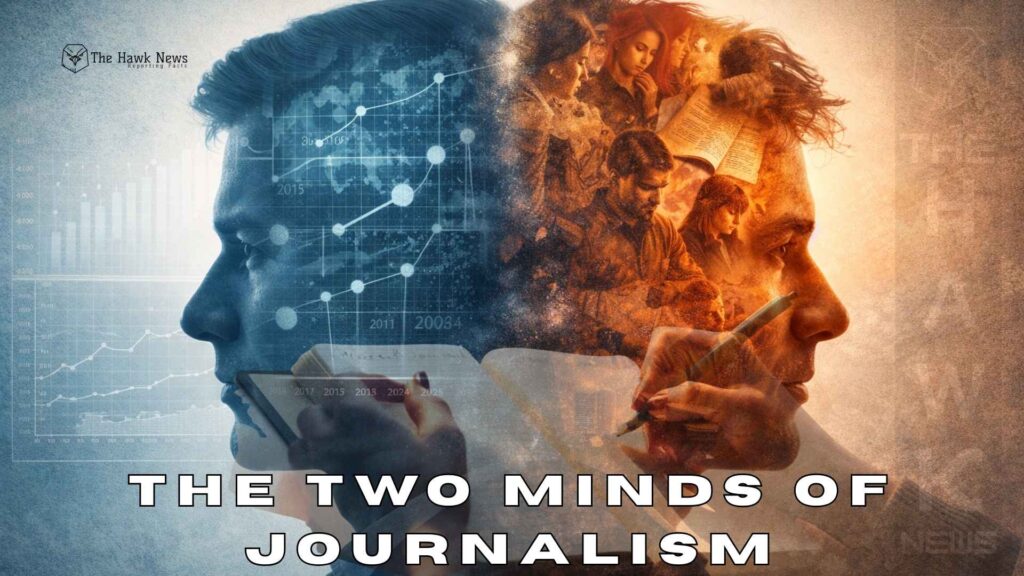
The Two Roads of a Story
Every story has two roads — one straight, one winding.
The straight road leads to facts. The winding one leads to truth.
Both are essential, both are journalism.
In the fast-ticking world of newsrooms, journalists often find themselves choosing between linear thinking and layered thinking — the two mental architectures that shape how we see, write, and reveal.
The linear mind asks, “What happened?”
The layered mind asks, “Why does this keep happening?”
And between those two questions lies the difference between reporting and understanding.
Linear Thinking — The Straight Road to Clarity
Linear thinking is the classic backbone of journalism — clear, chronological, concise.
It thrives in the world of deadlines and data, where accuracy must sprint faster than speculation.
It’s the logic of hard news — where structure matters more than symbolism, and the duty is to deliver facts, not feelings.
Think of a breaking story:
“A bridge collapsed after heavy rainfall, injuring 12 people. Rescue operations are underway.”
Every word is positioned like a brick in a wall of clarity.
There’s no time for metaphor — only meaning.
Linear thinking builds trust through order. It teaches readers what happened, when, and why.
It’s the journalist’s compass in chaos — straightforward, factual, and essential.
But truth, as we’ve learned, doesn’t always live in a straight line.
Layered Thinking — The Art of Depth
Layered thinking begins where the linear ends.
It looks not at the event, but at the echoes.
It asks not just for details, but for depth.
A layered journalist might approach the same bridge collapse differently:
“This bridge didn’t just fall last night — it’s been crumbling for years under neglect, corruption, and collective silence.”
That’s not just reporting. That’s revealing.
Layered thinking turns journalism into storytelling with conscience.
It’s what shapes long-form features, human-interest stories, investigative pieces, and editorials that stir reflection rather than reaction.
It’s where timelines meet textures — where one headline opens a hundred questions.
“The linear thinker informs,” Shiphrah writes. “The layered thinker interprets.”
The Balance of Both
A good newsroom — and a great journalist — lives between these two worlds.
Linear thinking ensures truth is verified.
Layered thinking ensures truth is understood.
One builds the scaffolding; the other paints the mural.
One teaches us what to know. The other teaches us what to feel.
In an age of information overload, linear journalism informs,
but layered journalism transforms.
That’s the real craft — learning when to report and when to reveal, when to hold the mirror and when to turn it toward ourselves.
The Psychology of the Two Minds
Linear thinking follows logic — it’s the journalist’s defense against bias.
Layered thinking follows pattern — it’s the journalist’s bridge to empathy.
Linear asks, “What’s the sequence?”
Layered asks, “What’s the story beneath the sequence?”
The danger of being too linear is coldness — reporting without resonance.
The danger of being too layered is drift — emotion overtaking evidence.
But when the two meet —
when facts are held steady by empathy, and insight is tethered by truth —
journalism becomes both mirror and microscope.
The Modern Shift — Depth in a Headline World
Today’s audience scrolls faster, reads shorter, and forgets sooner.
Headlines flash; attention wanes.
That’s why layered thinking is more crucial than ever.
Because if linear journalism tells us what’s happening in the world, layered journalism reminds us why it matters.
It humanizes information. It reclaims depth in an age that rewards speed.
It’s the difference between:
“Unemployment rises by 6%.”
and
“Six percent isn’t just a statistic — it’s the father who lost his job and still wakes early to pack his children’s lunch.”
The first gives numbers.
The second gives narrative.
For the Journalist and the Reader
Linear thinking is the journalist’s discipline.
Layered thinking is the journalist’s heart.
And when readers engage with both — facts and feelings — a strange alchemy happens.
Understanding deepens. Compassion grows. Society becomes a little less numb.
The best stories are not built; they’re unearthed — one layer at a time.
“To see linearly is to witness,” writes Shiphrah. “To think in layers is to understand.”
Conclusion — The Two Roads Must Meet
In the end, journalism cannot live on either road alone.
The linear without the layered is sterile.
The layered without the linear is unstable.
A complete story needs both — the discipline of accuracy and the courage of depth.
Because while facts may inform, only meaning transforms.
And perhaps that’s the journalist’s true mission —
to walk the straight road toward the story,
and then dare to dig beneath it.