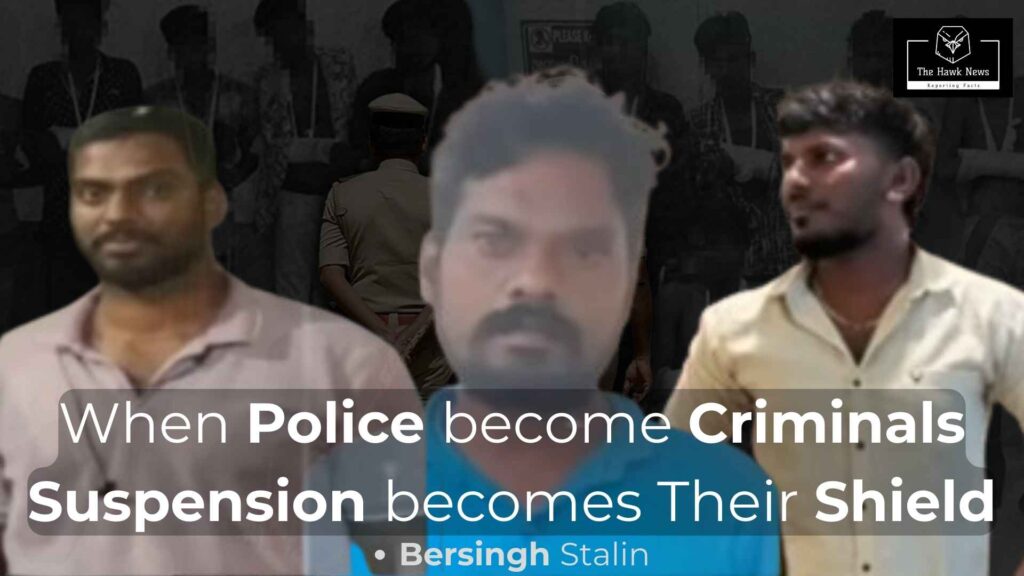
Suspension Is Not Justice. It Is Permission.
In a state that calls itself a guardian of law, suspension has quietly become the most convenient escape route for abuse of power. When uniformed officers are accused, when evidence points inward, when a woman is dragged through humiliation by those sworn to protect her, the system reaches for the same tired word. Suspension. Not arrest. Not prosecution. Not prison. Just suspension.
The Mylapore Police Station case in Chennai is not a procedural lapse. It is not an error of judgment. It is not a mistake committed under pressure. It is an alleged manufactured crime, a deliberate act to frame a woman by planting illicit liquor in water cans, according to a departmental inquiry. If this ends with nothing more than suspension, then the message is unmistakable. Do it again. Do it better. Do it without getting caught next time.
What Happened in Mylapore
On December 24, 2025, police from Mylapore conducted a raid on a woman running a packaged drinking water business. The allegation put on record was sensational and convenient. Illicit liquor stored in water cans. A clean story for headlines. A quick arrest. A routine bootlegging case.
But the woman and her family refused to stay silent. They alleged what citizens are often afraid to say. That the case was planted. That she was targeted after refusing to pay a bribe. That the uniform was used not to enforce law but to settle scores.
What followed was not media theatrics. It was an internal inquiry. And that inquiry found prima facie evidence that the liquor was planted. Not discovered. Not recovered. Planted.
According to the inquiry, a bootlegger was allegedly instructed to place the illicit liquor in water cans to frame the woman. The liquor itself was reportedly sourced from Andhra Pradesh. This was not spontaneous. This was coordinated.
Names. Designations. Accountability.
The officers identified in the inquiry were not faceless. They were not anonymous constables lost in the system. They were named.
Pragalanathan, a police officer reportedly attached to Royapettah Police Station, but part of the special team operating under Mylapore jurisdiction.
Selvakumar, part of the same operational team.
Vinoth, also part of the team that carried out the raid and filed the case.
These were the officers involved in the operation that allegedly framed a woman using planted evidence. This is not social media gossip. This is what a departmental inquiry itself has concluded at the preliminary stage.
And what happened next?
They were placed under suspension. Or shifted to vacancy reserve. The language changes. The effect does not.
Suspension Is Not Punishment
Let us be brutally clear. Suspension is not punishment. It is administrative convenience. It is paid leave. It is a cooling off period. It is time away until the outrage fades and the files gather dust.
If a common citizen plants evidence, that citizen goes to jail. If a police officer plants evidence, the officer goes home.
This is the core rot eating away at public trust.
What kind of deterrence does suspension create? What fear does it instill in a force that already knows how to close ranks? What lesson does it teach a young constable watching this unfold?
The lesson is simple. The worst that can happen is temporary embarrassment. Not handcuffs. Not court. Not conviction.
The Harassment That No File Can Capture
Imagine the psychological violence inflicted on the woman at the center of this case. A business owner suddenly branded a criminal. A woman accused of selling illegal liquor. Arrested. Paraded. Her dignity shredded in her neighborhood. Her customers gone. Her reputation destroyed in minutes.
And for what? Because she refused to pay. Because she was an easy target. Because the system believed her voice would not matter.
This is not just harassment. This is state enabled cruelty.
Even if the case collapses in court, who compensates her for the trauma? Who restores her name? Who refunds the years she will spend fighting a legal battle that should never have existed?
Suspension of officers does nothing for her. It does nothing for society. It only protects the institution from embarrassment.
Misuse of Power Is a Crime, Not a Misconduct
There is a dangerous habit in Tamil Nadu policing. Crimes by citizens are treated as crimes. Crimes by police are treated as misconduct.
Planting evidence is not misconduct. It is a criminal offense. Wrongful confinement is not misconduct. It is a criminal offense. Abuse of authority is not a departmental issue. It is a violation of fundamental rights.
If the inquiry has found that evidence was planted, then why are these officers not arrested under the same sections they routinely invoke against citizens?
Why no FIR against them? Why no remand? Why no judicial custody?
Is the uniform a shield against the Indian Penal Code?
What Police Force Are We Becoming?
Tamil Nadu Police often project themselves as one of the finest forces in the country. Efficient. Modern. Professional.
But what credibility does that claim have when officers accused of framing a woman walk free while she fights to clear her name?
A force is judged not by how it arrests the powerless, but by how it punishes its own.
Right now, the message from the system is loud. Power protects power.
Who Is Responsible?
Responsibility does not stop with three names.
Who supervised this team?
Who approved the raid?
Who signed off on the arrest memo?
Who accepted the case diary without questioning obvious inconsistencies?
And above all, who decided that suspension was enough?
Is it the Commissioner?
Is it the senior officers who ordered the inquiry but stopped short of prosecution?
Is it the political leadership that prefers silence over accountability?
Every level that allows this to end quietly becomes complicit.
The Cycle That Never Breaks
This is how it always works.
An abuse happens.
Public outrage rises.
An inquiry is ordered.
Officers are suspended.
Time passes.
Officers return.
The same officers wear the same uniform.
The same streets are patrolled.
The same power imbalance remains.
Sooner or later, another citizen becomes the next victim.
Suspension does not reform. It delays.
The Fear Inside Every Citizen
Every ordinary person watching this case understands one thing. If it can happen to her, it can happen to anyone.
A water can today. A bag tomorrow. A phone the next day. Evidence can be created. Charges can be written. Lives can be ruined.
And when the truth comes out, the system shrugs.
This is not policing. This is intimidation.
What Justice Should Have Looked Like
Justice would have been immediate criminal cases against the accused officers.
Justice would have been arrest under the same laws they misused.
Justice would have been judicial remand.
Justice would have been transparent prosecution.
Justice would have been a clear message that the uniform is not above the law.
Anything less is not justice. It is damage control.
A Question Tamil Nadu Must Answer
What kind of police force do we want?
One that protects citizens or one that preys on them?
One that enforces law or one that manufactures crime?
One that fears accountability or one that embraces it?
If suspension is the highest punishment for planting evidence and destroying a woman’s life, then Tamil Nadu should prepare for more such crimes. Because the system has made it safe.
The Final Warning
Soon, these officers will return. Files will close. Transfers will happen. Promotions will continue. And the woman will still be fighting for dignity.
This is how institutions rot. Not because of one crime, but because of repeated forgiveness of power.
If the state does not act now, if it does not draw a hard line, then it forfeits the moral right to talk about law and order.
Because when the protectors become predators and face no real consequence, the question is no longer about one police station in Chennai.
The question is about who protects the people from the police.