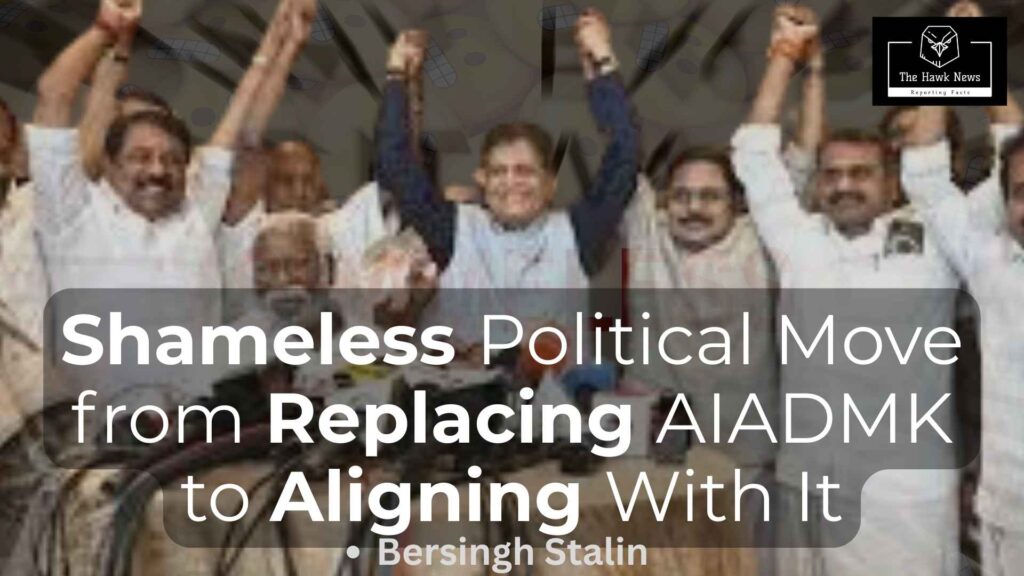
TTV DINAKARAN’S ENTRY INTO NDA & THE COLLAPSE OF POLITICAL PURPOSE
The political entry of TTV Dhinakaran into the NDA alliance has triggered intense debate in Tamil Nadu. While the move is being publicly justified as strategic consolidation against the DMK, a deeper examination reveals a decision driven more by compulsion than conviction.
This alignment may make tactical sense in the short term. But historically and politically, it exposes a serious erosion of purpose, credibility, and ideological consistency.
A DECISION BORN OUT OF POLITICAL NECESSITY
From an internal perspective, TTV Dhinakaran had limited options left. His party, Amma Makkal Munnetra Kazhagam, has struggled to convert vote share into actual power. Despite maintaining pockets of influence, AMMK has failed to secure legislative representation that would keep the party relevant in state-level power equations.
Repeated electoral setbacks have a cumulative effect. Cadres lose motivation. Financial resources thin out. Negotiating strength weakens with every election cycle. In such a situation, remaining outside a major alliance is not a sign of ideological purity. It becomes a political risk.
Seen from this angle, TTV’s decision to enter an alliance is understandable. Survival in electoral politics often demands compromise. However, the nature of the alliance he chose raises deeper questions.
THE CONTRADICTION AT THE HEART OF THIS MOVE
AMMK was not created as a general political alternative. It was created with a specific political objective. The party emerged from the internal fracture of AIADMK after Jayalalithaa’s death and positioned itself directly against the leadership of Edappadi K Palaniswami.
For years, TTV Dhinakaran’s political narrative revolved around one central claim. That EPS had betrayed the party, hijacked power, and diluted Jayalalithaa’s legacy. This was not incidental rhetoric. It was the ideological foundation on which AMMK was built.
By entering an alliance that includes AIADMK under EPS’s leadership, that foundation collapses. This is not merely a tactical shift. It is a fundamental contradiction.
A party formed to oppose EPS can no longer justify its independent existence once it aligns with EPS for electoral gain.
THE ROLE OF BJP AND ALLIANCE ENGINEERING
This alliance did not materialize organically. It was clearly facilitated by the BJP as part of a broader opposition consolidation strategy in Tamil Nadu. The NDA’s priority has been to prevent fragmentation of anti-DMK votes, particularly in regions where narrow margins can decide outcomes.
Senior BJP leaders, including Piyush Goyal, played a role in bridging resistance between factions that had remained hostile for years. The objective was practical, not ideological. Bring all possible vote-holders under one umbrella, even if internal contradictions remain unresolved.
From the BJP’s perspective, this approach is consistent with coalition politics elsewhere in the country. From Tamil Nadu’s perspective, it exposes how state-level ideological differences are often subordinated to national-level electoral calculations.
EPS AND THE LIMITS OF ACCEPTANCE
While EPS publicly welcomed the alliance, it is important to note that this acceptance is conditional and limited. TTV is entering as the leader of a separate party within the alliance, not as a reintegrated member of AIADMK.
This distinction matters. EPS has consistently resisted the return of individual leaders such as O Panneerselvam and V K Sasikala into the party structure. Their inclusion would require internal accommodation, power-sharing, and symbolic concessions.
TTV’s case is different. By remaining outside AIADMK and operating as an alliance partner, EPS avoids internal disruption while still benefiting from vote consolidation. This is a calculated acceptance, not reconciliation.
PRESSURE, LEGAL CONTEXT, AND POLITICAL REALITY
TTV’s recent public statements hinted at discomfort and constraint rather than enthusiasm. References to alliance decisions coming from “bigger places” suggested that the choice was influenced by factors beyond state politics.
In Indian politics, legal vulnerability often intersects with political negotiation. Leaders facing prolonged cases or investigations rarely operate in isolation from broader power structures. While no explicit admissions have been made, it is widely understood that political isolation increases exposure, while alliance provides insulation.
This context does not invalidate TTV’s agency, but it does frame the decision within a landscape where pressure and pragmatism coexist.
WHY ALTERNATIVE PATHS FAILED
There were discussions and speculation around TTV aligning with Tamilaga Vettri Kazhagam, led by Vijay. That possibility carried a different political implication.
TVK represents a new political force with growing youth appeal and a narrative of clean politics. However, such platforms rarely offer dominance to established leaders from legacy power struggles. Any alignment there would have reduced TTV to a secondary role.
For a leader accustomed to central control, that was a difficult proposition. The NDA alliance, despite its contradictions, offered relevance and negotiating space.
CASTE ARITHMETIC AND ELECTORAL VALUE
One cannot ignore the caste dimension in this alliance. TTV retains influence among segments of the Thevar community, particularly in southern districts. Historically, this vote base has leaned against the DMK, making it valuable in a closely contested election.
For the NDA, consolidating this support reduces fragmentation. For AIADMK, it minimizes vote leakage that previously benefited rivals. From a purely numerical standpoint, the alliance adds value.
However, caste arithmetic alone does not guarantee electoral success. Voter loyalty is shaped by trust, clarity, and consistency. When alliances contradict long-standing narratives, enthusiasm weakens even if arithmetic improves.
CADRE CONFUSION AND GROUND REALITIES
At the cadre level, this alliance creates uncertainty. AMMK workers who spent years opposing EPS now face the task of campaigning alongside AIADMK cadres. Such transitions are not seamless.
Political workers are motivated not only by leadership decisions but by belief. When belief erodes, mobilization weakens. Whether this alliance can translate into coordinated ground-level execution remains an open question.
History shows that alliances formed under pressure often struggle to integrate at the booth level, especially when personal rivalries and ideological hostility are recent.
THE LARGER QUESTION OF POLITICAL PURPOSE
Beyond immediate electoral outcomes, this episode raises a broader issue. What happens to political purpose when survival becomes the sole objective.
AMMK’s original claim was moral distinction. That it represented a correction, not merely an alternative. By aligning with the very force it sought to replace, that claim dissolves.
This does not automatically invalidate the alliance electorally. But it reshapes how history will judge it.
WHO BENEFITS AND WHO PAYS THE COST
In the short term, the NDA benefits from consolidation. AIADMK benefits from reduced fragmentation. TTV benefits from continued relevance.
The cost, however, is paid elsewhere. Voters are presented with alliances that lack ideological coherence. Cadres are asked to suppress years of political hostility. Political discourse shifts further away from accountability and closer to arithmetic.
CONCLUSION
TTV Dhinakaran’s entry into the NDA alliance is not a political scandal. It is something more subtle and more serious. It is the quiet abandonment of purpose in favor of survival.
Such decisions are not rare in Indian politics. But they carry long-term consequences. Parties lose identity. Leaders lose credibility. Voters grow cynical.
This alliance may produce seats. It may alter margins. But historically, it will stand as a moment when political necessity overtook political meaning.
And Tamil Nadu politics has seen enough of that already.