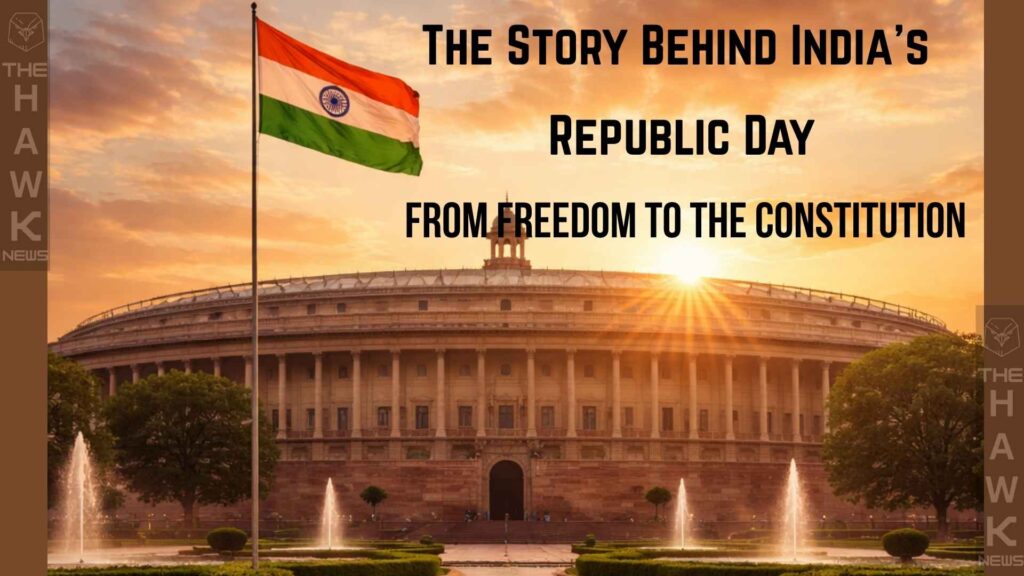
1. The Backdrop: Freedom Was Just the Beginning
India achieved independence on August 15, 1947, after nearly two centuries under British rule. But that moment, though triumphant, was incomplete.
The country had freed itself politically — yet it was still governed under the Government of India Act, 1935, a colonial framework designed for control, not democracy.
A free India needed its own legal spine — a document that reflected its people, its ideals, and its promise to the future.
That document would become the Constitution of India — and its adoption would give birth to the Republic.
“Independence gave us the body; the Constitution gave us the soul.”
2. The Birth of the Constitution: Drafting a Nation’s Conscience
On August 29, 1947, the Constituent Assembly of India appointed a Drafting Committee, chaired by Dr. B. R. Ambedkar. This committee was tasked with translating India’s moral aspirations into legal principles.
The Assembly met for almost three years (2 years, 11 months, and 18 days) — holding 11 sessions and over 160 days of debates. Every line of the Constitution was argued, revised, and voted upon with fierce democratic passion.
The members studied constitutions from over 60 countries — including those of the United States, Ireland, Canada, Australia, and France — adopting and adapting the best ideas while rooting them in Indian realities.
The result was monumental:
- A preamble promising justice, liberty, equality, and fraternity.
- A structure defining India as a *Sovereign, Socialist, Secular, Democratic Republic.
- Fundamental rights, directive principles, and an independent judiciary — to guard freedom and fairness forever.
“We are entering into a life of contradictions,” Dr. Ambedkar had warned. “In politics, we will have equality; in social and economic life, we will still have inequality.”
His words remain among the most prophetic ever spoken in Indian democracy.
3. November 26, 1949: The Constitution Is Born
The Constitution was adopted by the Constituent Assembly on November 26, 1949, a date now observed as Constitution Day (Samvidhan Divas).
But it did not come into effect immediately. The Assembly chose January 26, 1950, as the day of implementation — and that choice was deeply symbolic.
4. Why January 26 Was Chosen
January 26 wasn’t an arbitrary date — it was a salute to India’s first declaration of independence.
Back in 1929, at the Lahore Session of the Indian National Congress, Pandit Jawaharlal Nehru had hoisted the Tricolour and proclaimed “Purna Swaraj” (Complete Independence) from British rule.
The following year, January 26, 1930, was observed across India as Independence Day, marked by civil processions and patriotic defiance.
When India finally achieved real freedom in 1947, that symbolic date was revived to honour the earlier generation’s struggle and continuity.
Thus, January 26, 1950, became the day India gave itself not freedom, but form. The Constitution came into force, and India became a Republic — a nation governed by the will of its people.
“If August 15 was India’s tryst with destiny, January 26 was its covenant with democracy.”
5. The First Republic Day Parade
The first Republic Day parade took place on January 26, 1950, at Irwin Stadium (now Major Dhyan Chand National Stadium) in Delhi.
Dr. Rajendra Prasad was sworn in as India’s first President, marking the end of the Governor-General’s British authority. The national anthem, Jana Gana Mana, was played, and a new chapter began.
By 1955, the celebrations moved to Rajpath (now Kartavya Path), where the grand Republic Day parade continues to this day — showcasing India’s military strength, cultural diversity, and scientific achievements.
6. The Spirit of Republic Day
Republic Day is not merely ceremonial. It celebrates the transformation of power from rulers to representatives, and of laws from colonial codes to constitutional conscience.
It’s the only day of the year when India salutes its founding document — not its leaders, not its armies, but its principles.
The annual celebrations symbolize:
- The unity of India’s federal structure.
- The endurance of its democratic system.
- The inclusivity of its cultural fabric — from Kashmir to Kanyakumari, from Gujarat to the Northeast.
The President of India, as head of state, takes the salute — representing the people’s sovereignty.
A foreign dignitary is traditionally invited as Chief Guest, reflecting India’s diplomatic outreach and global respect.
7. The Republic’s Promise: Then and Now
As of 2026, India’s Constitution stands as one of the longest and most detailed in the world — but more importantly, as one of the living documents that continues to evolve.
Amendments, debates, and reinterpretations show its flexibility, while the Republic Day celebrations remind citizens of its unchanging spirit: the idea that power must answer to principle.
Each year, the event renews India’s pledge to liberty and equality, reminding generations that democracy is not a destination but a discipline.
“The Republic was never an achievement to display — it was a promise to keep.”
8. Reflection: The Meaning of a Republic
Being a Republic means more than having a written constitution. It means the authority of the state originates from its citizens, not its rulers. It’s the transformation of people from subjects to stakeholders.
It’s why the Republic Day is not just patriotic — it’s personal. Every citizen is both author and guardian of the nation’s laws.
In that sense, January 26 is India’s most introspective celebration. It’s a reminder that freedom achieved must also be protected, practiced, and perfected.
Conclusion: A Nation Still Becoming
Republic Day is not a chapter of the past — it’s the pulse of the present.
From the farmers who feed the nation to the soldiers who defend it, from judges interpreting the law to students learning its values, every Indian lives the Republic daily.
And each year, as the Tricolour rises and the anthem echoes across the land, the meaning renews itself:
Freedom gave India wings; the Constitution gave it direction.
“On January 26, 1950, India did not just declare itself a Republic — it declared faith in its people.”