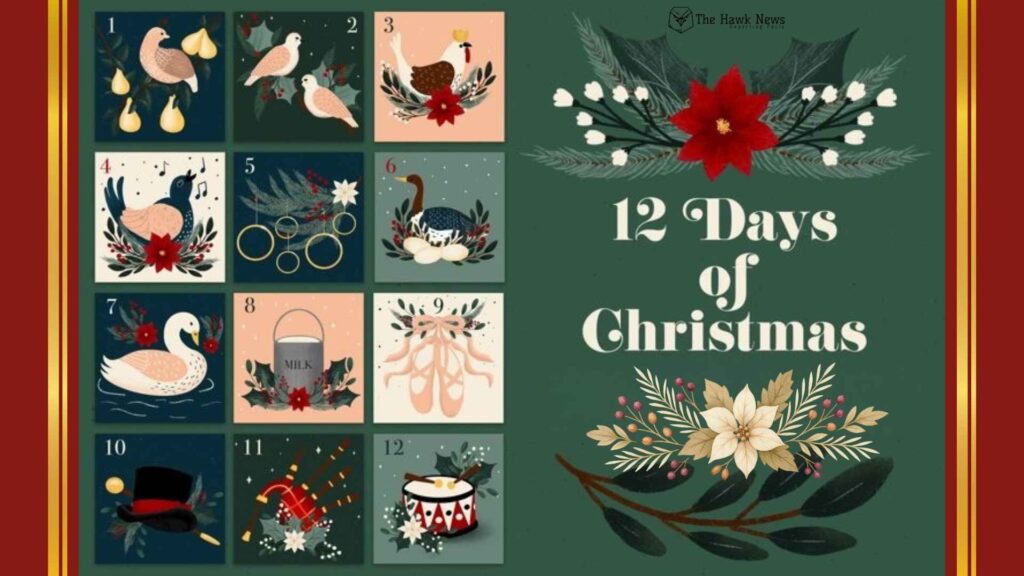
For many today, the “Twelve Days of Christmas” is little more than a catchy holiday song—one that grows increasingly absurd with each verse. Partridges, turtle doves, golden rings, leaping lords. Sung cheerfully, often without context, it feels playful, even nonsensical.
But behind the rhyme lies a tradition far older—and far more serious—than the song suggests.
The Twelve Days of Christmas were never meant to be a countdown to Christmas. They were meant to be a journey after it.
Rooted in medieval Christianity, shaped by politics and persecution, and carried forward through song and ritual, the Twelve Days represent one of the longest-lasting cultural frameworks of the Christmas season.
To understand modern Christmas—its timing, its symbolism, even its fatigue—we need to understand these twelve days.
What Are the Twelve Days of Christmas?
Traditionally, the Twelve Days of Christmas begin on December 25 (Christmas Day) and end on January 5, with January 6 celebrated as Epiphany.
In the Christian liturgical calendar, these twelve days commemorate the period between:
- The birth of Jesus Christ (Christmas)
- The arrival of the Magi (Epiphany), symbolizing the revelation of Christ to the wider world
In other words, Christmas was not the climax. It was the beginning.
Celebration, feasting, gift-giving, and community gatherings were meant to unfold across these days, not be compressed into a single date.
Why Twelve Days?
The number twelve carries deep symbolic weight across cultures and religions:
- Twelve months in a year
- Twelve tribes of Israel
- Twelve apostles
- Twelve zodiac signs
In medieval Europe, twelve represented completeness and divine order. Applying it to Christmas placed the birth of Christ within a cosmic rhythm—time itself bending around the sacred event.
The season was designed to slow people down, not rush them forward.
Life in the Middle Ages: Why the Days Mattered
In pre-industrial societies, winter was harsh and isolating. Work slowed. Travel became dangerous. Food had to be preserved carefully.
The Twelve Days of Christmas offered:
- A sanctioned period of rest
- Communal feasting after Advent fasting
- Shared storytelling, music, and worship
- Social leveling, where peasants and lords participated in the same festivals
During these days, normal hierarchies softened. Games, masquerades, and role reversals were common. The season allowed societies to release tension before the hardships of late winter resumed.
Christmas, then, was not just spiritual—it was social survival.
The Song: Where Did “The Twelve Days of Christmas” Come From?
The famous song first appeared in print in England in 1780, though it likely circulated orally for decades before.
Originally, it was a memory game, often sung at gatherings where participants had to recall each verse correctly or face a playful penalty.
Over time, speculation arose that the song was a coded religious teaching tool during periods when Catholicism was suppressed in England.
While this theory is popular, historians caution that there is no conclusive evidence that each gift had a secret catechism meaning.
What is clear is that the song reflects abundance, repetition, and escalation—themes central to festive celebration.
It was meant to overwhelm, delight, and linger in the mind.
The Purpose: Celebration After the Waiting
One of the most misunderstood aspects of Christmas today is timing.
Historically:
- Advent (the four weeks before Christmas) was a period of restraint and anticipation
- Christmas marked the release of celebration
- The Twelve Days allowed joy to unfold gradually
Modern culture has inverted this rhythm.
Today, celebration peaks before December 25 and collapses immediately after. Decorations vanish. Sales end. The emotional drop is sharp.
The original purpose of the Twelve Days was to prevent exactly that: emotional whiplash.
Epiphany: The Forgotten Climax
The twelfth day, Epiphany (January 6), once rivaled Christmas Day in importance.
It commemorates:
- The visit of the Magi
- The recognition of Christ beyond Jewish society
- The idea that the sacred belongs to the entire world
In many cultures, Epiphany remains a major celebration:
- Spain and parts of Latin America exchange gifts on this day
- France marks it with the Galette des Rois
- Eastern Christian traditions follow extended calendars
Epiphany reminds us that Christmas is not inward-looking—it is outward-facing.
The Impact on Modern Christmas Culture
Even as religious observance declines in some regions, the structure of the Twelve Days still shapes global Christmas practices:
- Extended holiday breaks
- Multiple family gatherings
- Staggered gift exchanges
- Seasonal storytelling and music cycles
The idea that Christmas is a season, not a moment, persists—even when we forget its origin.
Ironically, the commercialization of Christmas has shortened attention spans while expanding consumption. The Twelve Days have been compressed into twelve frantic shopping days before Christmas instead of reflective days after.
Why the Tradition Still Matters Today
In an era defined by speed, burnout, and algorithmic urgency, the Twelve Days of Christmas offer a counter-cultural message:
- Joy does not need to be rushed
- Meaning unfolds with time
- Celebration is a process, not a performance
For younger generations especially—raised on instant gratification—the idea of lingering joy feels radical.
The Twelve Days suggest that rest is not laziness, that reflection is not inefficiency, and that celebration is deeper when shared across time.
A Season Designed to Last
The Twelve Days of Christmas were never about gifts piling higher or songs growing louder.
They were about sustaining joy in a dark season, honoring community, and allowing meaning to settle slowly rather than explode and vanish.
In that sense, the tradition feels unexpectedly modern.
In a world that rushes past its own milestones, the Twelve Days whisper a quieter truth:
Some moments are meant to be lived with patience—not scrolled past.