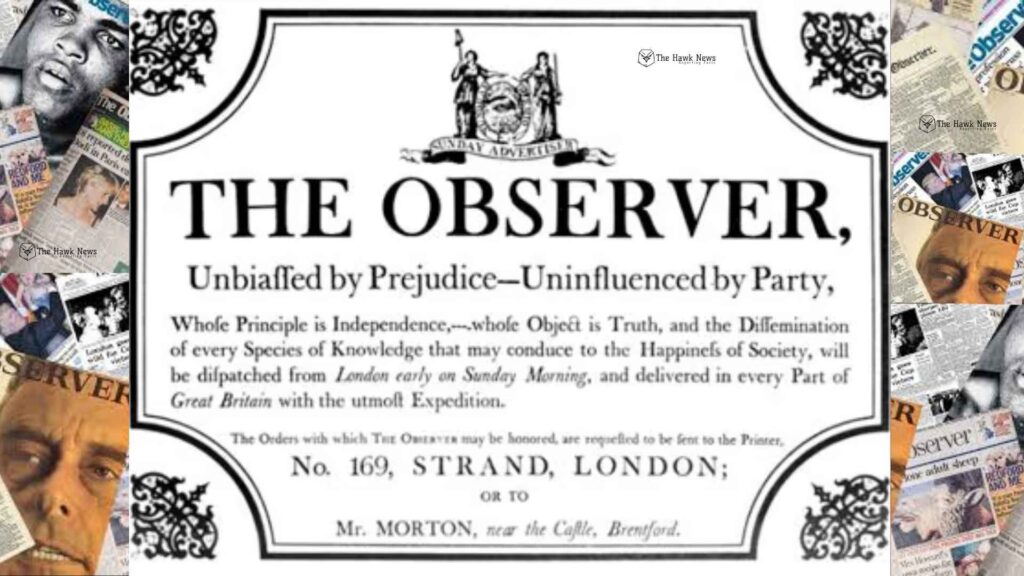
How the world’s oldest Sunday newspaper grew from a fragile seed in 1791 into a towering giant of global journalism.
When The Observer first appeared on 4 December 1791, it was nothing more than a thin, four-page sheet. No images. No bold headlines. No colour.
Just columns of dense serif text and advertisements — the kind of printing that smelled of ink, horse carts, and long nights in cramped London rooms where publishers worked by candlelight.
No one at that moment could have imagined that this modest paper — born in a Britain still reeling from the French Revolution and on the brink of the Industrial age — would become the world’s oldest Sunday newspaper.
A respected authority in global journalism, and a towering cultural institution read far beyond the boundaries of the UK.
But like every great forest, The Observer began with a seed.
The Seed: A Bold Idea in a Turbulent World (1791)
When the first issue went to print, Europe was unstable. Revolutions were reshaping governments. Empires were rising and falling. Britain was entering a new world of machinery, factories, and mass communication.
Into this charged atmosphere stepped W.S. Bourne — the man who launched The Observer. He proposed something unusual:
A newspaper published only on Sundays, at a time when Sundays were meant for rest, church, and quiet reflection.
The idea was bold, perhaps even foolish.
Who would buy it?
Who would write it?
And who would dare break the unwritten rules of the sacred Sunday?
Yet Bourne took the gamble. His four-page seed — a publication full of adverts and cautious reporting — planted itself into the soil of British media. It wasn’t perfect. It wasn’t powerful. It didn’t yet have opinion leaders or global correspondents.
But it existed.
And like every living thing, existence is the first miracle.
The Sapling: Survival, Struggle & Slow Growth (1800s)
From the early 1800s to the mid-19th century, The Observer learned to survive.
The conditions were harsh:
- Strict government censorship
- Stamp taxes that crippled newspapers
- Political pressure
- Competition from other rising publications
The paper changed hands many times — an early sapling caught in conflicting winds. Yet it kept growing, page by page, edition by edition. Slowly, The Observer developed a voice of its own. It reported politics courageously. It expanded its cultural coverage. It experimented with new editorial styles.
Think of a young plant learning how to anchor its roots deeper:
The Observer learned how to stand firm.
The Tree: Rising Into Influence (20th Century)
The real transformation — when the sapling became a tree — happened in the 20th century.
The world entered an era of wars, social movements, scientific breakthroughs, and shifting moral tides. And The Observer stood at the center of it all.
Key turning points:
1. A Reputation for Courage
The paper became known for taking principled, sometimes unpopular stances:
opposing dictators, supporting human rights, exposing injustices.
2. Foreign Correspondence
It built a reputation for powerful international reporting — dispatches from wars, revolutions, and emerging nations.
3. Cultural Authority
Art, literature, theatre, film, food — The Observer became one of Britain’s most respected cultural curators.
4. Joining the Guardian Family (1993)
When it became part of the Guardian Media Group, the tree gained a powerful ecosystem.
Shared resources. Shared digital infrastructure.
Shared commitment to progressive, fact-checked journalism.
By now, The Observer was no longer just a tree.
It was part of a forest.
The Forest: A Modern News Ecosystem (21st Century)
The 21st century brought a new kind of storm — not political but technological.
Print began to decline.
Online news consumption exploded.
Social media changed reading habits.
Attention spans shrank.
Misinformation spread like wildfire.
Many old newspapers struggled.
Some fell.
But The Observer adapted — not by abandoning its roots but by growing new branches.
Digital Expansion
It launched its online presence, then podcasts, newsletters, and multimedia storytelling.
Modern Format
It moved from broadsheet to a more contemporary format, making it easier for younger readers to engage.
Digital Subscriptions
Recently, The Observer launched its first-ever digital subscription, signaling its shift from a once-a-week print model into a seven-day online journalism platform.
Editorial Identity for a New Generation
Today’s Observer focuses on:
- investigative reporting
- climate
- global politics
- inequality
- technology
- culture
- voices and essays
- long-form storytelling
It’s serious but accessible.
Deep but not dense.
Rooted in history but aware of TikTok attention cycles.
This is what a forest looks like in the digital age:
Multiple platforms, voices, formats, and communities — all branching from a 233-year-old trunk.
Why The Observer Still Matters Today
In a world overflowing with:
- fake news,
- algorithmic echo chambers,
- clickbait journalism,
- and information fatigue,
The Observer stands for something simple but rare:
Slow, thoughtful, human-centered journalism.
Its Sunday identity remains powerful — a day when readers pause, reflect, and absorb deeper stories. Even in digital form, that Sunday soul is preserved.
And importantly:
Its history gives it weight.
Its voice gives it clarity.
Its global perspective gives it relevance.
Its connection to The Guardian gives it reach.
The seed from 1791 has grown into something astonishing:
A living archive of human history, and a living participant in shaping tomorrow.
The Forest Lives On
Today, if you look at that first sheet — the fragile, ink-soaked, four-page paper from 1791 — it feels like a relic from another universe.
But if you look closely, you’ll see the DNA of everything The Observer has become:
- curiosity,
- courage,
- commitment to truth,
- and a willingness to publish boldly, even when the world is uncertain.
A seed cannot predict the tree.
The tree cannot predict the forest.
Yet here it stands —
A publication older than nations, older than photography, older than electric lights — still speaking, still influencing, still growing.
The Observer began as one man’s risky Sunday experiment.
It became a newspaper.
Then an institution.
Now a global digital forest of stories, perspectives, and ideas.
And like all living things, it continues to grow — upward, outward, and forward.