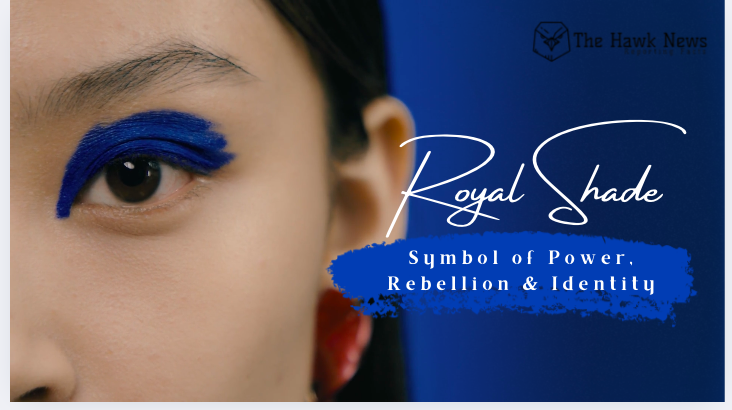
Some beauty trends appear, shimmer for a season, and vanish.
But deep blue eyeshadow is not a trend — it’s a survivor.
It has lived through empires, revolutions, dynasties, patriarchy, Hollywood, pop culture, and social media. It has been worn by queens, rebels, rockstars, and teenage dreamers sitting in front of bedroom mirrors.
Every time someone dips a brush into that cobalt, sapphire, or midnight hue,
they’re not putting on makeup.
They’re putting on history.
This is the story of a color that went from the sands of Egypt to the runways of Paris, from ancient altars to Instagram reels — a color that refuses to die.
The First Queens of Blue — Egypt’s Divine Women
The earliest blue eyeshadow wasn’t a cosmetic choice.
It was protection. Ritual. Power.
Cleopatra didn’t wear blue to be pretty — she wore ground lapis lazuli, the stone of royalty, spirituality, and cosmic protection.
It was believed to ward off evil, connect the wearer to the gods, and signify intelligence and command.
When Egyptian women painted their eyelids with deep blue, they were saying:
“I am aligned with the heavens.
I am not ordinary.
I bear authority.”
The world’s longest-running beauty symbol began as a form of sacred armor.
The Color of Rebellion — Ancient to Modern
Blue is a paradox.
It’s soft yet intense.
Cool yet fierce.
Calm yet confrontational.
Throughout history, deep blue on the eyes became a signal of defiance:
- In Persia, it was worn by women during ceremonies as a sign of inner strength.
- In the Roman Empire, blue pigments were used by women who wished to stand apart from traditional norms.
- In the medieval period, when cosmetic use was restricted or judged, blue became a quiet, coded rebellion against control.
Blue eyeshadow became a declaration:
“My identity is not yours to define.”
The 60s & 70s — When Blue Became Pop Culture
Then came the decades that changed everything.
The 1960s and 70s brought a cultural storm — feminism, rock music, sexual liberation, and the rejection of “proper” femininity.
Blue eyeshadow became the stamp of:
- Mods
- Disco queens
- Hollywood sirens
- Teenage rebellion
- Women refusing quietness
Blue wasn’t subtle, and that was exactly the point.
A bold color for a bold generation.
The Age of Icons — Blue on Screen, Stage & Fashion
From Madonna’s early stage looks
to Cher’s powerhouse glam
to Bollywood’s golden-age heroines
to Beyoncé’s cobalt lids
to editorial covers by Vogue —
Deep blue eyeshadow became cinematic.
Fashion houses embraced it because it carried symbolism:
mystery, depth, intelligence, fearlessness, and a refusal to blend in.
It photographed beautifully in low light.
It created dimension.
It became the signature of women who were larger than life.
The Psychology Behind the Shade
Blue is the color of:
- The ocean
- The sky
- Freedom
- Depth
- Intelligence
- Spirituality
A woman who chooses deep blue chooses a color that symbolizes immersion — as if she carries the night sky on her eyelids.
It’s a silent message that says:
“Look deeper.
I am not surface-level.
I have depth you haven’t yet explored.”
Today — Blue as Identity and Reclamation
In the era of minimalist makeup and neutral palettes, deep blue remains one of the few colors that refuses to bow down.
Today, wearing blue eyeshadow means:
- I choose boldness.
- I choose visibility.
- I choose the story of women who came before me.
- I choose my own narrative.
It’s retro yet futuristic.
Royal yet rebellious.
Timeless yet fresh.
It’s a color that tells the world:
“I contain multitudes.”
The Real Secret
Deep blue eyeshadow is not about beauty.
It’s about identity.
Every time someone wears it, they become part of a lineage —
not followers of a trend, but inheritors of a legacy.
From goddesses to queens, from rebels to icons,
from ancient altars to bedroom selfies —
Blue eyeshadow never belonged to fashion.
It always belonged to women.