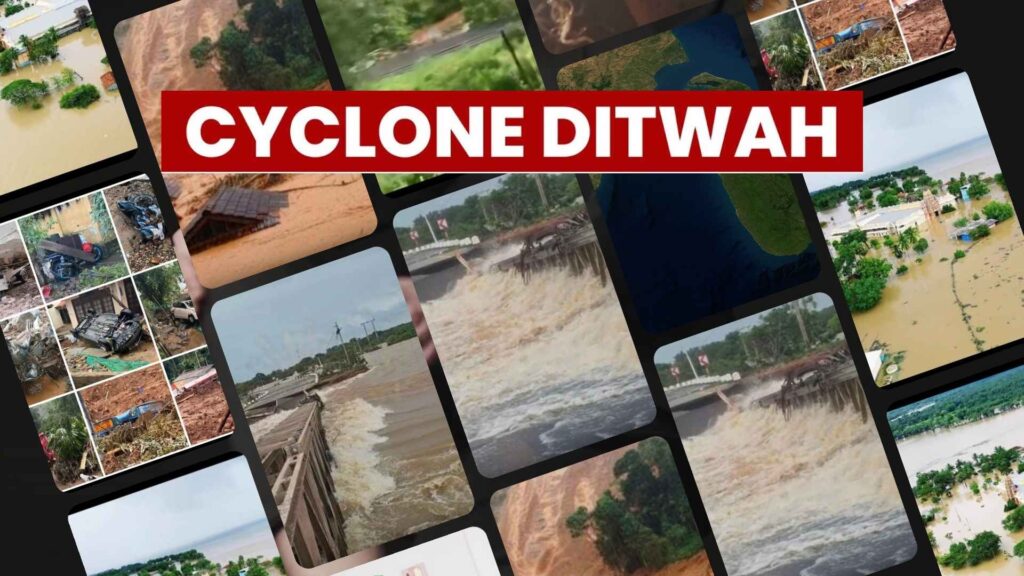
When nature raises its voice, it is rarely to destroy — it is to expose what we refused to see!
Cyclone Ditwah, which swept past Sri Lanka and brushed India’s coastline in late November 2024, may not have made global headlines like Katrina or Haiyan.
It wasn’t the strongest cyclone of the year. It wasn’t the deadliest either. But it was something far more important:
A mirror. A warning. A teacher.
More than 500,000 people were affected in Sri Lanka, over 6,000 displaced, and several districts were submerged under feet of water. Winds touched 90–100 km/h, but it was the floods, not the wind, that brought a nation to its knees.
For India, the storm barely grazed the coast — yet nearly 150 flights were cancelled, harbors were shut, and lakhs were alerted to stay indoors.
This wasn’t a catastrophe of enormous power.
This was a catastrophe of exposed weaknesses.
A Storm Doesn’t Create Chaos — It Reveals It
Every disaster has two stories:
- What nature did, and
- What humans failed to do.
Cyclone Ditwah flooded districts that were already struggling with outdated drainage systems.
It overwhelmed towns that were already overbuilt on wetlands.
It turned roads into rivers because those roads were never designed for the rainfall of modern climate patterns.
Experts have long warned that South Asia’s urban infrastructure was built for a climate that no longer exists.
Ditwah simply proved them right.
The storm didn’t expose a country’s weakness —
it exposed decades of decisions made with yesterday’s weather in mind.
Climate Has Upgraded. Infrastructure Has Not.
What made Ditwah dangerous wasn’t its category — it was its timing and intensity.
Cyclones of this shape, speed, and water-load used to occur once in a few decades.
Now they appear every season.
Sri Lanka faced widespread flooding not because Ditwah was extraordinary —
but because infrastructure designed in the 1970s–1980s is now facing storms shaped by 2020s global warming.
- Drainage canals clogged by years of urban neglect
- Illegal construction blocking natural water pathways
- Cities expanding faster than environmental planning
- Emergency response stretched thin by simultaneous floods
This wasn’t a natural disaster.
It was a systems disaster.
India’s Alerts Show the Difference Preparedness Can Make
On the other side of the sea, India wasn’t hit directly — but it took no chances.
The IMD issued early alerts.
State governments activated shelters.
Fishing communities were warned days in advance.
Airports in Chennai, Kochi, and Trivandrum halted flights before the winds intensified.
The contrast was sharp:
Preparedness vs. Unpreparedness is the real storm.
Ditwah silently showed South Asia this truth.
The Blind Spots That Can No Longer Be Ignored
Cyclone Ditwah forced an uncomfortable conversation:
Are our cities built for the world we live in today?
A few painful realities surfaced:
1. Over-urbanization is outpacing climate readiness
Cities are growing faster than their ability to handle storms.
2. Wetlands and marshes were nature’s protection — and we destroyed them
Floods filled the spaces buildings stole.
3. Climate literacy is low
People still confuse storm categories with risk levels.
Rainfall kills more than wind — and yet evacuation plans rarely reflect this.
4. Emergency systems are reactive, not anticipatory
Disaster management still waits for damage instead of predicting it.
Ditwah didn’t do massive destruction.
Instead, it whispered a truth more dangerous:
“If a moderate storm can do this… what will a real one do?”
A Storm Is Not a Warning. It’s a Preview.
Cyclone Ditwah is the future, arriving early.
The storms of the next decade will not ask whether South Asia is ready.
They will come with more water, more unpredictability, and more pressure.
But Ditwah gave us a chance —
a preview instead of punishment.
The question is whether we will learn.
- Will we rebuild drainage systems for 2050, not 1980?
- Will we stop building over wetlands and call it “progress”?
- Will climate become a budget priority instead of a speech?
- Will governments treat early warnings as lifesavers, not formality?
Nature has always been patient.
But patience is not permission.
Cyclone Ditwah Should Not Be Remembered for What It Destroyed…
…but for what it revealed.
A society can only protect itself from the storms it accepts exist.
And Ditwah has made it clear:
Denial is the real disaster.