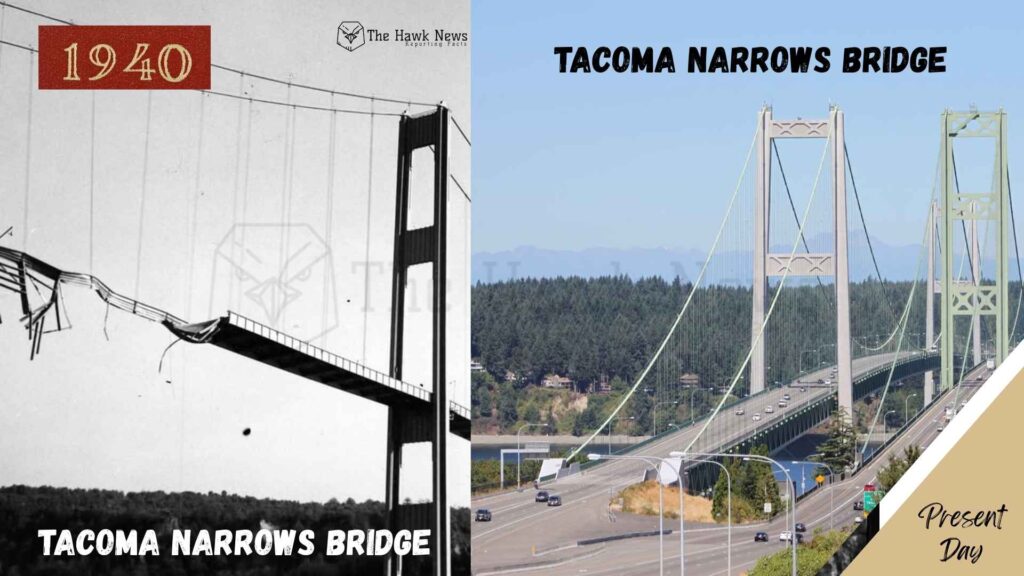
What the Tacoma Narrows Collapse Still Says About Strength, Failure, and the Future…
On November 27, 1940, a document quietly entered the world — a government investigation report on a bridge that no longer existed.
A bridge that lived only four months.
A bridge that twisted itself into history.
The Tacoma Narrows Bridge collapse is one of the most dramatic engineering failures ever caught on film. But what makes it immortal is not the footage — it’s the lesson.
On the day the collapse report was released, engineers began rewriting not just calculations… but philosophy.
Because the truth that emerged from the wreckage was simple, stunning, and strangely human.
The bridge didn’t fall because it was weak.
It fell because it couldn’t adapt.
And from that collapse, the modern world learned a new definition of strength.
When the Wind Became a Teacher
When the Tacoma Narrows Bridge opened in July 1940, it was the third-longest suspension bridge in the world — sleek, slender, modern.
Engineers admired it.
Drivers feared it.
Locals nicknamed it “Galloping Gertie” because even a gentle breeze made it ripple like silk.
Yet everyone believed in its strength.
Until November 7, when a 40-mph wind turned the entire roadway into a rolling wave. The bridge heaved, twisted, bucked — and then surrendered.
It didn’t snap.
It didn’t shatter.
It danced itself to death.
And the collapse wasn’t chaos. It was physics… taken to its logical conclusion.
Small forces, applied repeatedly, in harmony with the structure’s natural frequency, amplified until nothing could resist.
It wasn’t the force that killed the bridge.
It was the rhythm.
The Report That Changed Everything
The collapse report released on November 27, 1940, did something extraordinary: It told the world that strength is not rigidity, and that every design must respect nature rather than fight it.
This single document forced engineering to evolve.
It transformed structural science, aerodynamics, wind-tunnel testing, and even architectural ethics.
Before the collapse, engineers designed for resistance.
After the collapse, they began designing for movement.
Flexibility became a safety feature.
Adaptation became intelligence.
And humility became part of engineering.
The bridge didn’t fall because nature was cruel.
It fell because humans refused to listen.
The Most Beautiful Lesson Hidden in the Failure
The Tacoma Narrows Bridge became a metaphor far beyond engineering:
A system that cannot bend will eventually break.
A person who refuses to adjust will eventually collapse under pressure.
A leader who insists on rigid control will eventually fail the people they serve.
A society that ignores small stresses will eventually face a large rupture.
The wind didn’t kill the bridge.
Its inflexibility did.
That’s why this incident feels so eerily relevant to real life:
We are taught to be strong.
But no one tells us that softness is part of strength.
That the ability to pivot, to reassess, to move with reality — not against it — is what keeps systems alive.
The world remembers Galloping Gertie not as a catastrophe,
but as a reminder:
You don’t survive by resisting nature.
You survive by understanding it.
How the Collapse Saved Millions
The report released that day became the foundation for:
- modern suspension bridge design
- mandatory wind tunnel testing
- aerodynamic stability standards
- mathematical models of oscillation
- the birth of “aeroelasticity” as a field
- safer skyscrapers, stadiums, and towers
In other words:
One bridge died so that millions of others — and millions of people — would live.
Golden Gate, Verrazzano, Akashi Kaikyō, Humber Bridge…
All of them contain the lessons learned from the Tacoma collapse.
In the engineering world, Gertie became a martyr —
and one of the most valuable teachers in history.
A Message for Today’s World
If the Tacoma Narrows collapse happened today, it wouldn’t just be an engineering headline.
It would be a metaphor for our era:
- We resist change until it breaks us.
- We ignore small stresses until they become disaster.
- We treat flexibility as weakness and rigidity as strength — and we pay for that misunderstanding.
But the bridge teaches the opposite:
True strength moves.
True strength allows.
True strength adjusts.
A tree that refuses to sway will snap in a storm.
A structure that refuses to flex will fail in the wind.
A human who refuses to adapt will crumble under life’s forces.
The lesson is universal.
The Collapse Was Not a Failure — It Was a Beginning
The most poetic truth about the Tacoma Narrows collapse is this:
It wasn’t the end of a bridge.
It was the start of modern engineering.
And perhaps the start of a deeper understanding of resilience.
When the report was released on November 27, 1940, the world quietly stepped into a new era — one shaped by the realization that:
Strength is not the refusal to move.
Strength is the ability to move without breaking.
The bridge that broke… taught us how to build.
And that is why Galloping Gertie still matters.