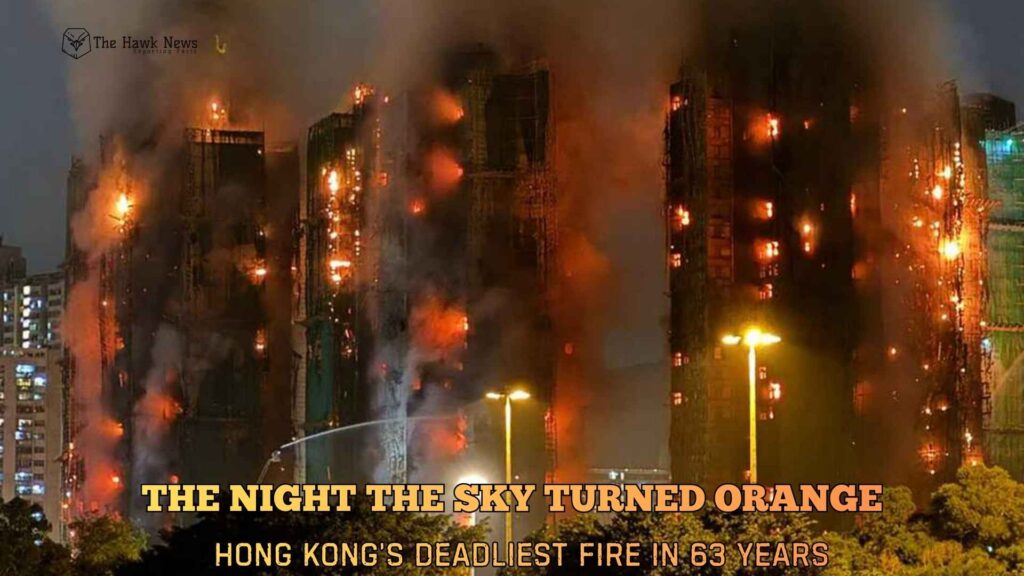
On an ordinary Wednesday night in Tai Po, a woman on the 27th floor opened her door to what she thought was the smell of dinner burning somewhere in the building. Instead, she stepped into a hallway filled with black, rising smoke — thick enough to erase the world in front of her.
She screamed for her husband.
Someone down the corridor banged on doors.
A child was heard crying.
And within minutes, the night sky outside Wang Fuk Court was glowing orange.
What began as a flicker on renovation scaffolding became the deadliest fire Hong Kong has witnessed in more than half a century — a blaze that devoured multiple towers, blackened stairwells, and stole the lives of families who had gone to bed expecting tomorrow.
How the Blaze Began — and Why It Spread So Fast
At around 11 p.m., flames erupted on the external bamboo scaffolding during ongoing renovation work. Bamboo — flexible, traditional, deeply rooted in Hong Kong’s construction culture — burns quickly when coated with the plastic mesh used to contain debris.
According to early investigations, workers may have used non-fire-retardant materials on the exterior. That mesh, once ignited, behaved like a fuse moving upward.
Dr. Michael Tse, a Hong Kong fire-safety engineer, put it bluntly:
“If scaffolding becomes a ladder for the flames, the building becomes a chimney.”
High winds did the rest.
Within minutes, fire was racing vertically, wrapping the facade, and leaping across levels at a speed residents later described as “unnatural” and “terrifying.”
A High-Rise Turned Into a Trap
Inside the towers, things worsened instantly.
Survivors say they heard no alarms.
Some woke only when neighbours smashed their doors open.
Others smelled smoke too late.
The building’s stairwells — the only means of escape — filled with toxic fumes, forcing residents to retreat inside and wait at windows for rescue that, for many, never arrived.
A firefighter described the scene as “a maze of heat, smoke, and collapsed materials,” adding that hoses took time to reach the highest floors, while the fire outside kept climbing.
By dawn, the scale of loss became clear:
- 65 people confirmed dead
- Dozens more injured
- Hundreds missing or unaccounted for
- Over 900 residents displaced
One firefighter lost his life in the rescue, collapsing from smoke inhalation.
The Human Toll: Families Lost in Seconds
The numbers cannot capture the heartbreak.
A mother who couldn’t reach her ageing parents upstairs.
A delivery worker trapped in the lift corridor.
A young couple, married only five months, still listed among the missing.
Children carried out unconscious.
Pets left behind.
Families clutching photos at the evacuation site, waiting for news that may never come.
A resident said:
“The building burned like paper. We watched our homes disappear in less than an hour.”
Who’s Responsible? Early Blame Points to Negligence
The Hong Kong Police wasted no time.
Within hours, they arrested:
- Two construction company directors
- One engineering consultant
All on suspicion of manslaughter and unsafe construction practices.
Initial findings reveal several failures:
▪ Unapproved or unsafe scaffolding materials
▪ Lack of fire-retardant mesh
▪ Inadequate safety protocols during renovation
▪ Insufficient fire warning systems in active construction zones
▪ Poor evacuation support for elderly residents
A fire investigator said something stark:
“This was not a natural disaster. This was preventable.”
Why This Tragedy Matters to Every High-Rise City in the World
Wang Fuk Court is not an isolated case — it is a warning.
Cities like Hong Kong, Singapore, Shanghai, Dubai, and Mumbai stack millions of people vertically. High-density living works only when safety is uncompromising.
But when shortcuts, aging building stock, cost-cutting renovations, and insufficient regulation collide — disaster becomes inevitable.
This fire exposes three uncomfortable truths:
- Renovation work can make buildings more dangerous, not safer — if oversight slips.
- Traditional materials like bamboo scaffolding need modern fire standards.
- High-rise residents rely entirely on the competence of builders, inspectors, and regulations.
When one link breaks, lives are lost.
What Must Change — Immediately
To prevent another night like this:
1. Ban or strictly regulate flammable scaffolding & mesh
Modern, fireproof alternatives exist — cost should not outweigh safety.
2. Mandatory alarms and sprinklers during renovations
No excuses. No exemptions.
3. Independent safety inspections for all construction companies
Not self-reported, not industry-led — certified third-party oversight.
4. Special evacuation plans for elderly and disabled residents
They are always the most vulnerable in high-rise emergencies.
5. Full transparency
Families deserve detailed findings, not vague statements.
If cities are allowed to grow taller, their safety protocols must grow wiser.
The Night After: A City Grieves Together
As rescue teams continue searching through debris, Hong Kong gathers around the wounded.
Neighbours bring food.
Strangers donate clothing.
Evacuation centres offer blankets, counselling, and quiet companionship.
In tragedy, humanity still refuses to dim.
One volunteer said:
“We cannot rebuild what they lost. But we can carry them until they can stand again.”
Closing: The Only Lessons Worth Learning
Buildings can be repaired.
Regulations can be rewritten.
Laws can be enforced.
But lives — once lost — do not return.
The fire at Tai Po is not just another news story.
It is a question every city must ask itself:
Are we building safe homes… or ticking time bombs?
Because safety is not a privilege of the wealthy.
It is the right of every sleeping child, every elderly parent, every working family.
On the night the sky turned orange, Hong Kong paid a price no city should ever pay again.
Let this be the last lesson learned in flames.