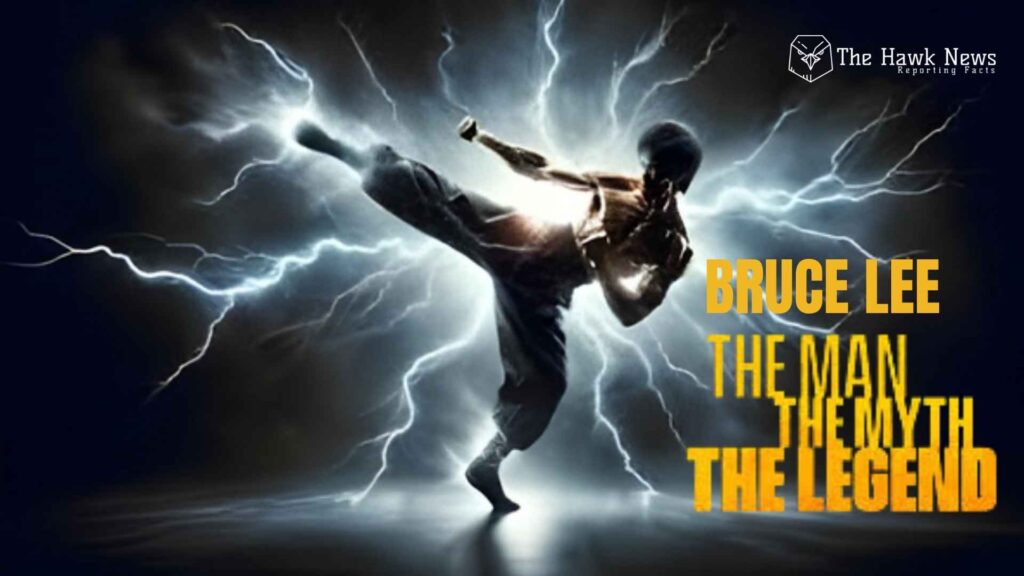
On November 27, 1940, in the year of the dragon, a boy was born in San Francisco who would one day move so fast that film cameras could not capture him — and think so deeply that philosophers would quote him.
Bruce Lee’s greatness is often compressed into punchlines:
the fastest… the strongest… the fighter who shocked Hollywood.
But that’s the surface.
The real story lies elsewhere.
Bruce Lee didn’t just challenge what a human body could do — he redefined what a human mind could be.
A MAN WHO OUTRAN TECHNOLOGY
Before CGI, before high-speed capture, before Hollywood could digitally slow or speed footage, Bruce Lee was performing movements so fast that 1960s cameras created a blur instead of clarity.
Directors complained that his punches looked invisible.
Audiences thought he was faking the moves.
Editors slowed his scenes down — not for dramatic effect, but because the raw footage looked like reality breaking.
Lee once demonstrated his “one-inch punch” on set.
People didn’t believe the footage.
They believed the sound — that deep, sharp thud of a body landing meters away.
Think about this:
Most people train to become the best version of themselves.
Bruce Lee trained until technology had to evolve to keep up with him.
BUT THE REAL POWER WASN’T SPEED — IT WAS PHILOSOPHY
People quote “Be water, my friend” as if it’s a Zen meme.
But for Bruce Lee, that line wasn’t born in a fight.
It was born in observation.
He studied:
- Taoism
- Western philosophy
- Jungian psychology
- physics
- poetry
- human behavior
- metaphysics
Bruce Lee wrote more than 3,000 pages of notes throughout his life — half of them have nothing to do with punches or kicks.
“Be water” meant:
- rigidity destroys
- adaptability wins
- identity must remain fluid
- ego must remain soft
- life isn’t conquered by strength, but by awareness
Water is powerful because it adjusts.
It bends, slips, flows, changes state.
It survives because it refuses to remain one thing.
Bruce Lee didn’t want to teach people how to fight —
he wanted to teach them how to live.
THE BODY THAT DEFIED LIMITS; MIND THAT TRANSCENDED THEM
Bruce Lee wasn’t built like a bodybuilder.
He wasn’t trying to look good on camera.
His entire physique was engineered for function:
- a narrow waist for torque
- lean muscles for explosive energy
- hypertuned fast-twitch fibers
- incredible tendon strength
- absurd flexibility
His body wasn’t a display.
It was a tool — crafted with the precision of an engineer, the intensity of a monk, and the curiosity of a scientist.
And then there was the mind.
Bruce Lee believed all styles were prisons.
So he created Jeet Kune Do — not as a martial art, but as an anti-martial art.
Use what works.
Discard what doesn’t.
Flow around rules.
Do not worship tradition.
Do not be caged by teachers, systems, or labels.
This was rebellion at its purest form — and it became the seed of modern MMA decades later.
THE FIRST TRULY GLOBAL ICON
Most celebrities belong to an industry.
Bruce Lee belonged to cultures.
To nations.
To philosophies.
Chinese enough to be rooted.
American enough to be universal.
Philosophical enough to inspire thinkers.
Physical enough to inspire athletes.
He wasn’t an East-West bridge —
he was a world in motion.
HIS REAL LEGACY: A NEW TEMPLATE FOR HUMAN POTENTIAL
Bruce Lee’s true greatness wasn’t in his kicks.
It was in the way he fused:
- science + art
- philosophy + movement
- discipline + creativity
- mind + body
- identity + fluidity
He didn’t just expand martial arts —
he expanded the idea of what a human can be.
Most legends belong to a time.
Bruce Lee belongs to a concept: limitlessness.
He is proof that a person can be both:
fast enough to outrun cameras
and
deep enough to outthink generations.
He was a fighter, yes —
but more than that, he was a thinker who used motion as his medium.
And that is why, decades after his passing, Bruce Lee doesn’t fade.
He flows.
Like water.