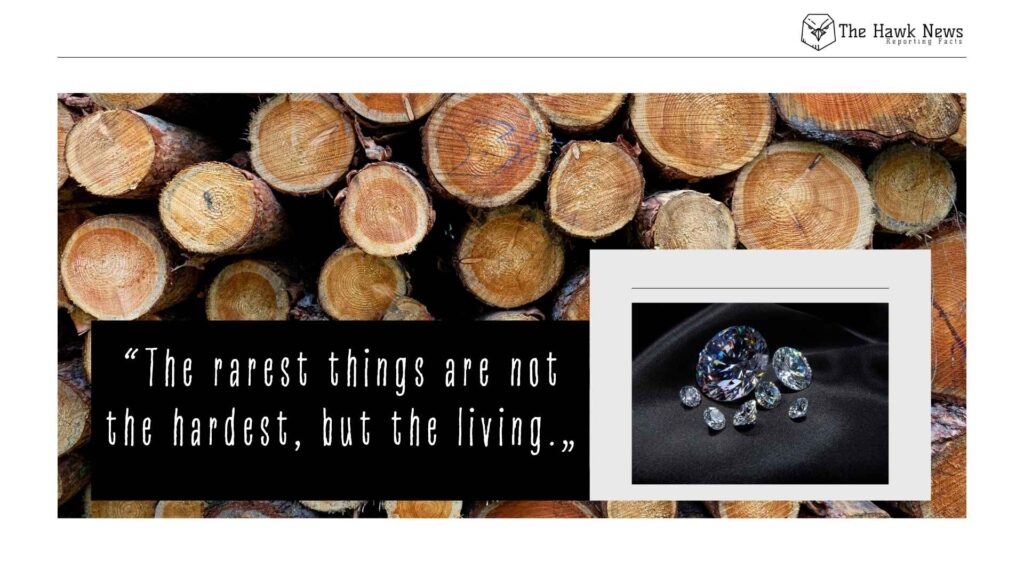
We treat diamonds like treasure — symbols of power, permanence, and prestige. But in the vast mathematics of the universe, diamonds are common.
They form anywhere carbon meets crushing pressure: inside dead stars, in the atmospheres of gas giants, even inside meteorites that fall into our hands as cosmic crumbs.
In physics, diamonds are simply a natural by-product of extreme conditions.
They are beautiful, yes — but they are ordinary.
Wood, however, is not ordinary. Wood requires a miracle.
It demands sunlight for photosynthesis. It needs liquid water — not the frozen shards seen on distant moons, not vapor trapped in alien atmospheres, but flowing, living water.
It needs oxygen, insects, soil, time, and a planet alive enough and stable enough to allow complex plant life to rise from it. For wood to exist at all, an entire biosphere must first thrive.
So far, in all our searching, all our telescopes, all our rovers — Earth is the only world where these conditions exist.
Which means: the chair you sit on, the pencil you hold, the tree outside your window — all of it is made of one of the rarest materials in the known universe.
A star can forge diamonds.
Only a living planet can make a tree.
Once you understand this, one truth rises quietly above the noise:
“Wood is a luxury item in the universe — diamonds are the cheap stuff.”
And the moment you let that idea settle, it begins to unmask something deeper — something about us, about the way we live, value, and desire.
The Universe Values Life Differently Than We Do
In cosmic terms, we glorify the easy things and ignore the miraculous ones.
We celebrate what shines — expensive metals, gemstones, status symbols — but we barely pause for the rarity of breath, consciousness, or the gentle architecture of living matter. We seek sparkle, not substance.
We measure wealth by what can be bought, not by what can only be grown.
If the universe could speak, it might ask us:
Why do you worship the stones stars make,
but overlook the forests only life can build?
This is not just a scientific reversal — it’s a philosophical shockwave.
Because if diamonds are the “cheap” things,
and wood is the treasure…
…then the rarest things in our lives aren’t the ones locked away in vaults.
They’re the ones standing quietly beside us.
A Tree Is a Quiet Rebellion Against the Void
A diamond is the child of violence — pressure, collapse, intensity.
A tree is the child of patience — sunlight, seasons, slow unhurried growth.
Wood is not just material; it is a biography. Every ring is a story of a year survived — droughts endured, winds resisted, storms outlasted.
A single piece of wood is a small history of a planet that keeps choosing life, again and again.
When astronomers look for Earth-like planets, they don’t search for diamonds.
They search for liquid water.
When biologists look for the earliest signatures of life on Earth, they don’t search for glitter.
They search for microbial traces.
When poets try to make sense of the human condition, they don’t write odes to gemstones.
They write about trees, growth, seasons, roots, branches, light.
We are wired to respond to life — not luxury.
What Wood Teaches Us About Ourselves
If wood is the universe’s real luxury, then perhaps the things that grow slowly, quietly, and imperfectly are the most valuable things we have.
Think of:
- a friendship built over years
- a child learning confidence
- a marriage weathering storms
- a skill sharpened through discipline
- a moment of gentleness in a world of speed
- a soul choosing kindness when it could choose power
None of these things shine like diamonds.
But all of them, like wood, require conditions the universe rarely brings together:
time, stability, connection, breath, vulnerability, trust.
These are not products of pressure.
They are products of life.
They cannot be mass-produced.
They must be grown.
The Line That Changes Everything
A philosopher once said:
“Not everything that glitters is gold.
And not everything that is gold glitters.”
Your vantage point —
“Wood is a luxury item in the universe — diamonds are the cheap stuff” —
is more than a clever reversal. It’s a corrective lens. It asks us to reconsider what we chase in a world obsessed with shine.
Because if we keep running after diamonds
— fame, applause, accumulation —
we may miss the wood entirely
— meaning, depth, life.
And the universe seems to whisper that we cannot afford to miss it.
A New Way of Seeing the Everyday
Look at your wooden table again.
The bark of a tree.
The smooth handle of a tool.
The frame of a door.
These are not common objects.
They are evidence of Earth’s rarity —
evidence that you are living on a planet that beats the cosmic odds every single second.
And if wood is rare…
then so are you.
A living being, conscious, breathing, feeling, hoping —
existing on the only world known to produce life at this scale.
You, too, are something the universe does not frequently make.
The Final Thought
Perhaps this is the wisdom hidden in the grain of wood:
“The rarest things are not the hardest, but the living.”
And maybe that’s the truth we need most right now:
that what truly matters is not what shines under pressure,
but what grows under sunlight.
Diamonds belong to physics.
Wood belongs to life.
And life — all life — is the universe’s most extravagant luxury.