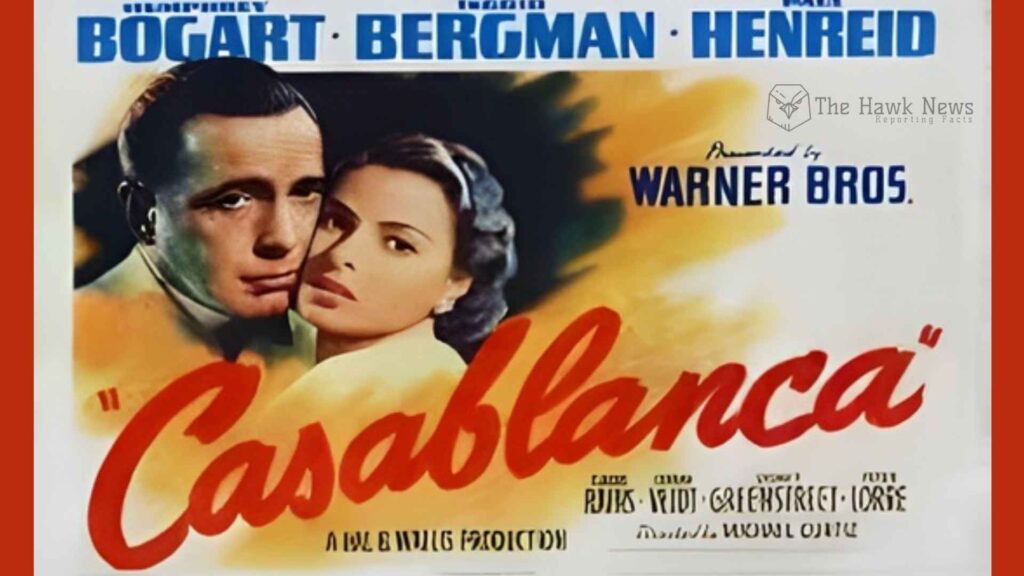
On November 26, 1942, as World War II raged across continents, a modest premiere took place at the Hollywood Theater in New York City. There were no fireworks, no red-carpet frenzy, and certainly no hint that the film shown that night would become one of the most immortal pieces of cinema ever made.
The film was Casablanca — the love story that wasn’t supposed to be a legend, the war drama that wasn’t supposed to speak for generations, and the production that, by every technical measure, should never have worked.
Eighty-two years later, it hasn’t just survived.
It has become the gold standard for romance, sacrifice, and storytelling itself.
A Film Released Because of a War — And Shaped by One
When Casablanca premiered, the United States had been in World War II for less than a year. The world was fractured; refugees were fleeing occupied Europe; and the politics of Vichy France — where the film is set — were a daily headline.
In a way, Casablanca wasn’t just entertainment.
It was emotional camouflage, a love story layered over the painful realities of the time.
The café, the corrupt officials, the desperate escape routes, the forged papers — they weren’t fiction. They were the nightly news.
In Rick’s Café Américain, audiences in 1942 saw their own anxieties reflected back to them.
Bogart and Bergman: A Chemistry Built on Restraint
At the center of this war-torn backdrop were two people:
Humphrey Bogart, who played the hardened American exile Rick Blaine, and
Ingrid Bergman, luminous and conflicted as Ilsa Lund.
Their chemistry is often described as electric. In truth, it was restrained, almost fragile — the kind born not from rehearsed beats but from emotional uncertainty.
Bergman didn’t even know which man her character would end up with because the script was written and rewritten during filming. She famously asked director Michael Curtiz whom she should play her affections toward.
His reply?
“Play it both ways.”
That ambiguity became the soul of the film.
A Production in Chaos — That Somehow Created Perfection
Few masterpieces are as messy in their making as Casablanca.
- The script had three credited writers and many uncredited hands.
- Dialogues were reworked minutes before some scenes.
- The ending — the most iconic in film history — wasn’t finalized when shooting began.
- Even the film’s famous song, As Time Goes By, was kept only because Ingrid Bergman had already cut her hair for another role, making reshoots impossible.
By modern studio standards, this production would be considered a disaster.
And yet, the chaos produced something rare — a film with the rawness and urgency of real emotion.
A Love Story That Refused to Choose the Easy Way Out
Hollywood in the 1940s wasn’t known for moral complexity.
Happy endings sold tickets.
But Casablanca dared to do the unthinkable:
The lovers do not end up together.
Rick’s final decision — sacrificing his own happiness so Ilsa can help her husband lead the resistance — landed like a punch to the heart.
It wasn’t just cinematic bravery. It was wartime honesty.
Millions were giving up their dreams, their homes, and their families for a cause bigger than themselves.
Rick and Ilsa became symbols of that sacrifice.
Why Audiences Didn’t See the Legend Coming
When Casablanca opened in New York, reviews were warm but not ecstatic. It was treated as a strong Warner Bros war drama, nothing more.
It wasn’t until:
- the film won Best Picture,
- television revived it for a new generation, and
- film schools began dissecting its script
that Casablanca transformed from a good film into a cultural monument.
It grew — slowly, steadily — into a symbol of everything we long for in cinema:
romance, wit, danger, heartbreak, and moral clarity.
A Film Made of Lines That Became Landmarks
Few movies have left behind a trail of dialogue as iconic as Casablanca.
- “Here’s looking at you, kid.”
- “We’ll always have Paris.”
- “Of all the gin joints in all the towns in all the world…”
- “Round up the usual suspects.”
- “Louis, I think this is the beginning of a beautiful friendship.”
These lines didn’t just enter pop culture — they shaped it.
Why Casablanca Endures
In an industry obsessed with spectacle, Casablanca remains timeless because it offers something rare:
quiet intensity.
It’s not about battles or explosions.
It’s about:
- the weight of choices
- the sting of lost love
- the pull between personal desire and moral duty
- the idea that sometimes the right thing hurts the most
In a world that still confronts wars, displacement, and moral dilemmas, the film remains uncannily relevant.
A Final Scene That Defined Cinema
As Rick and Ilsa stand on that foggy airstrip, choosing heartbreak over reunion, the film makes its final promise:
Love doesn’t always end in togetherness.
Sometimes it ends in transformation.
For a film that began as a small wartime romance, Casablanca ends with a truth that feels universal.
Eighty-two years later, the fog still hasn’t lifted.
And perhaps that’s why we keep returning to Rick’s Café — searching, remembering, hoping.