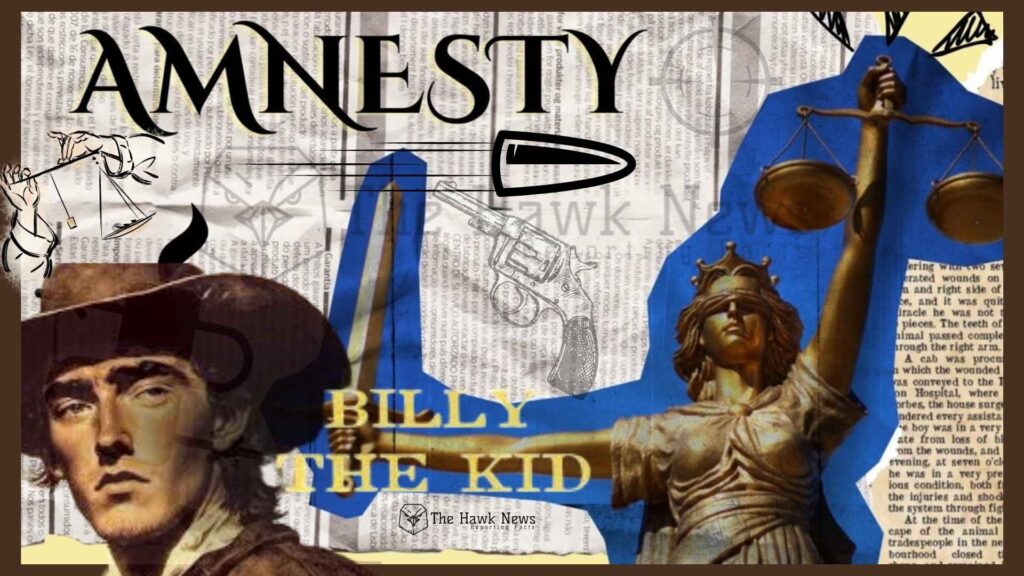
There is a word in our political and moral vocabulary that carries more weight than punishment, more responsibility than freedom, and more risk than forgiveness.
Amnesty.
At its simplest, amnesty means:
A government’s decision to officially pardon someone for a crime — wiping the slate clean, restoring rights, and offering a second chance.
But beneath this legal definition lies something far more human:
Amnesty is society’s willingness to believe that people can change.
It is the courage to choose restoration over revenge.
It is mercy stretched across the fault lines of human failure.
And few stories reveal its power — and its fragility — more painfully than the story of Billy the Kid.
Billy the Kid: The Outlaw Who Was Promised a Second Chance
Born on November 23, 1859, Billy the Kid remains one of the most mythologized names of the American West — a young gunslinger, a runaway, an orphan pushed into conflict more by circumstance than cruelty.
But behind the legend lies a truth few know:
Billy the Kid is one of the only outlaws in American history who was actually promised amnesty.
Governor Lew Wallace of New Mexico approached him with a deal during the Lincoln County War:
Help the government.
Testify against ruthless killers.
Risk your life to expose corruption.
In return: full amnesty. A clean start. A way out of the violence that had engulfed him.
Billy kept his word.
He testified.
He followed instructions.
And he trusted the promise.
But the promise never came.
Instead:
— His pleas were ignored.
— His deal was forgotten.
— And he found himself hunted once again.
A boy who believed in a future was pushed back into the past.
His story forces us to face a hard truth:
What happens when mercy is offered… but never delivered?
The Fragility of Amnesty
Amnesty is powerful precisely because it is rare.
It asks a nation to pause anger long enough to see possibility.
It asks society to believe that change is possible in even the most unlikely person.
It asks leaders to value redemption over raw punishment.
But amnesty also demands something equally difficult:
Integrity.
Because amnesty is not just a gift — it is a contract.
A promise that the state will not weaponize the past.
A promise that trust will be honored.
A promise that redemption is not a trap.
When Billy the Kid was denied the pardon he was promised, the message was devastatingly clear:
Mercy without commitment becomes manipulation.
And manipulation breeds something more dangerous than crime — disillusionment.
When Betrayal Pushes a Person Deeper Into Darkness
Psychologists describe betrayal as one of the most destabilizing human experiences.
It destroys trust not just in the betrayer — but in the entire idea of goodness itself.
When a person is promised forgiveness and then abandoned:
They don’t return to who they were.
They fall further.
Deeper.
Harder.
Because betrayal does something punishment never can:
It convinces a person that trying was pointless.
For Billy the Kid, betrayal became a turning point.
He had stepped forward in good faith.
He had risked his life for justice.
He had handed over dangerous criminals.
But when the state abandoned him, he learned a devastating lesson:
The system that demands honesty might not honor it.
After that, every escape, every gunfight, every desperate act was not just rebellion —
it was the behavior of a man who no longer believed redemption was possible.
And when society convinces someone that redemption is dead,
it should not be surprised when they act like they have nothing left to lose.
Why Amnesty Still Matters Today
Though we live far from dusty deserts and frontier jails, the idea of amnesty still shapes modern life.
It affects:
— Political prisoners
— Refugees seeking a future
— Whistleblowers risking everything
— People trapped in unjust legal systems
— Nations healing after civil conflict
Amnesty is not weakness.
It is not approval of wrongdoing.
It is not forgetting the past.
Amnesty is the belief that a society becomes stronger when it creates space for a new story.
Because justice without mercy becomes cruelty.
And mercy without justice becomes chaos.
Amnesty is the narrow bridge where these two forces meet.
But that bridge is fragile.
Break it once — and people stop crossing.
Billy the Kid’s broken deal stands as a warning about what happens when the powerful break promises:
People lose faith.
Reform collapses.
Resentment grows.
And hope becomes dangerous to hold.
The Legacy of a Promise That Could Have Saved a Life
Billy the Kid’s legend survived not just because of his escapes and his marksmanship,
but because of the what if that shadows his story.
What if the government had kept its word?
What if a young man, barely out of boyhood, had been given the new life he was promised?
What if mercy had been honored instead of delayed?
His death at 21 is not merely the end of an outlaw.
It is the end of a life that might have been rewritten.
That is the tragedy.
And it is why his story still echoes in modern debates about justice and forgiveness.
Amnesty is not just a legal tool.
It is a test of a nation’s soul.
The Final Truth
Amnesty is more than a pardon.
It is a declaration of belief — in transformation, in second chances, in human possibility.
But it must be real.
Honest.
Honored.
Otherwise, it becomes its opposite:
Not mercy, but manipulation.
Not hope, but humiliation.
Not justice, but betrayal.
Billy the Kid never received the amnesty he earned.
But his story asks a question every society must face:
Can we call ourselves just if we leave no room for redemption?
Because in the end, the greatest measure of civilization is not how it punishes…
but how — and whether — it forgives.