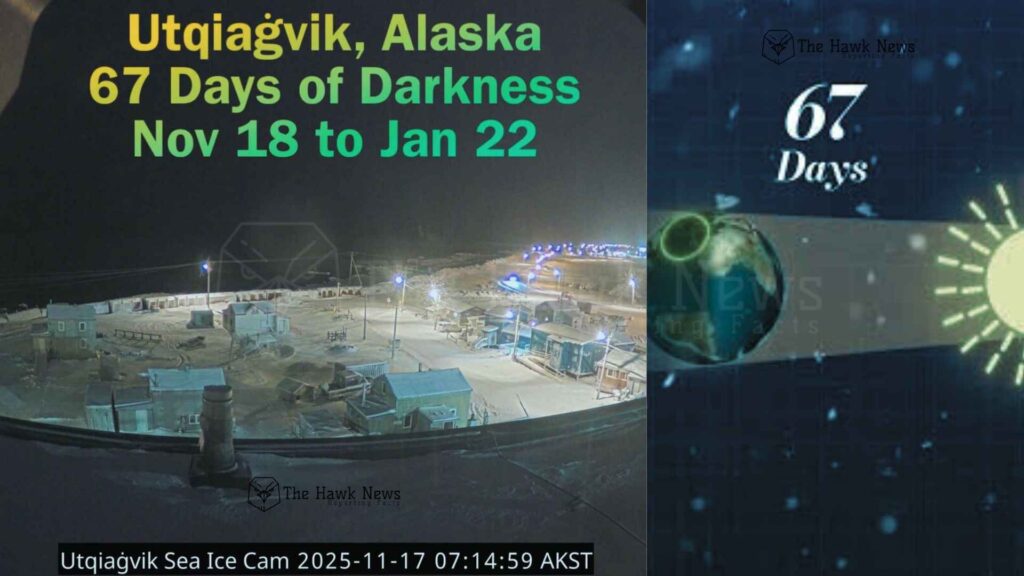
When the sun dips below the horizon in Utqiaġvik, Alaska each November, it does more than set — it disappears. For the next 67 days, the northernmost town in the United States enters a season known as polar night, a long stretch where the sun never rises, shadows never sharpen, and daylight becomes nothing more than memory.
For most of us, darkness is something temporary — a few hours between evening and morning. But here, darkness is a season, a presence, a rhythm of life. And remarkably, the people who call Utqiaġvik home don’t just endure it. They live inside it gracefully.
The Science Behind the Sun’s Long Sleep
This phenomenon happens because of the Earth’s tilt. During winter, the North Pole leans away from the sun, placing places like Utqiaġvik so far north that sunlight can’t climb above the horizon at all. Even though the sun is still there, its light skims past the Earth’s edge — like a lamp shining from the next room.
Not all is pitch black, though. Around midday, the sky glows a deep blue — a surreal light called civil twilight. It feels like the world is stuck at the moment just before sunrise, a kind of permanent dawn that never fully awakens.
A Darkness That Shimmers
Darkness here has texture.
The snow reflects moonlight like crushed diamonds.
Stars appear in numbers most of us can’t imagine.
And on some nights, the sky erupts in ribbons of green, pink, and violet as the Northern Lights dance above the frozen sea.
This isn’t the darkness of fear.
It’s the darkness of wonder.
Life Doesn’t Pause — It Adapts
What’s surprising to outsiders is how normal life remains.
Children attend school.
People go to work.
Families shop, cook, travel, and gather.
Hunters take snow machines out into the vast Arctic landscape.
Communities celebrate midwinter traditions and gatherings that bring warmth into the long cold.
Residents brighten their homes with warm lights, candles, and fires. Some use daylight lamps to help their bodies stay balanced. But mentally and emotionally, they carry a resilience shaped by generations who have embraced this cycle.
To them, darkness isn’t an interruption — it’s a season, like fall or spring.
The Emotional Weight — and Beauty — of Polar Night
People often assume the darkness is depressing, but many residents describe it differently. They say the world feels quieter, slower, calmer — almost sacred. There is a unique stillness that comes only when the sun sleeps.
Families bond more deeply.
Communities draw closer.
Indoor creativity flourishes — crafts, music, storytelling, cooking.
And maybe most importantly: the long darkness teaches gratitude in a way that constant sunlight never could.
The Day the Sun Returns
On a morning in late January, a golden glow appears on the horizon. It lasts only minutes, but it feels like a triumph.
Children run outside to watch it.
Parents cheer.
Teachers lead classes outdoors to greet the light.
People take photos, not just because it’s beautiful — but because they’ve missed it.
This moment is called “sunrise festival” by some locals. It’s not an official holiday, but it might as well be. After 67 days of twilight, the first sliver of sun feels like a promise.
Why This Story Matters
Utqiaġvik reminds us of something simple yet profound:
Humans are adaptable.
Resilient.
Capable of thriving in places that would overwhelm others.
Their life in darkness teaches us perspective — that even when light feels far away, there are ways to live, ways to flourish, and ways to find beauty in what seems difficult.
And somewhere in the far north, right now, the sun is sleeping — but life is wide awake.