Some leaders governed through force.
Some through charisma.
John Fitzgerald Kennedy governed through clarity — a rare mental stillness that allowed him to see beyond panic, beyond ego, beyond the noise of politics.
His presidency was brief, yet the imprint of his thinking remains one of the most fascinating legacies in modern leadership.
This is the story of his quiet brilliance — and how it changed the course of history.
Thinking Clearly When the World Couldn’t: The Cuban Missile Crisis
In October 1962, the world was seconds away from nuclear catastrophe.
Missiles in Cuba. Military pressure. A nation terrified.
Most advisors urged immediate airstrikes.
Generals demanded decisive aggression.
JFK didn’t react.
He reflected.
He said something that revealed his entire mental framework:
“We must never negotiate out of fear. But we must never fear to negotiate.”
Instead of rushing into war, he created EXCOMM, a group where every voice — even those who disagreed — was encouraged.
He listened more than he spoke.
He slowed the situation until reason could guide it.
The result?
A peaceful resolution that avoided nuclear war.
That moment alone shows why his mind was magnificent:
calm in chaos, cautious but not weak, moral without being naïve.
Learning From Failure: The Bay of Pigs
Early in his presidency, Kennedy approved the Bay of Pigs invasion — a major failure.
Many leaders would have deflected blame.
He didn’t.
He publicly accepted responsibility:
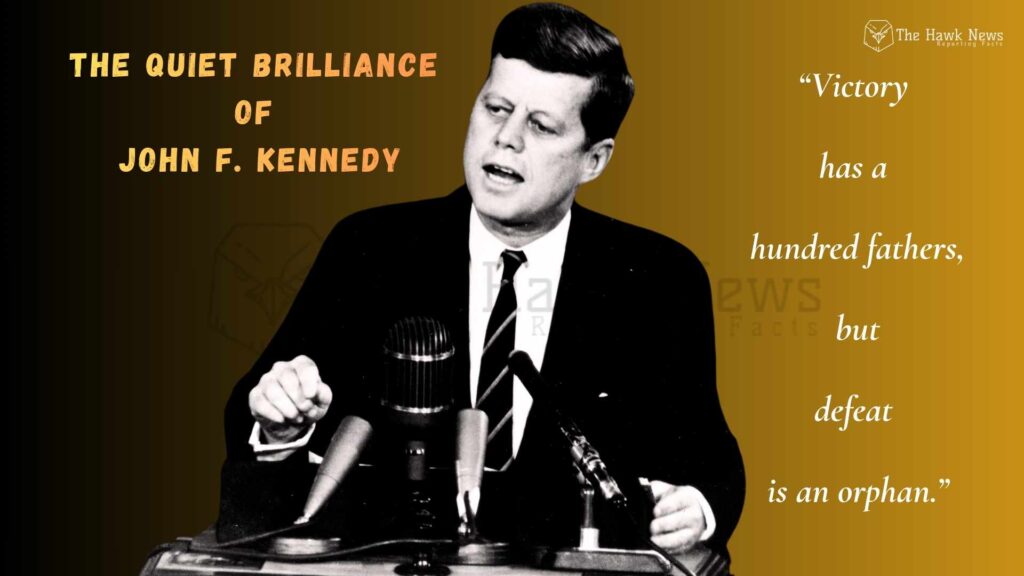
“Victory has a hundred fathers, but defeat is an orphan.”
And privately?
He changed.
He restructured how he made decisions.
He demanded more dissent, more data, more questioning.
He transformed a humiliating failure into a blueprint for wiser governance.
This ability — to learn, not hide — shows a mind grounded in humility and growth.
Seeing the Long View: The Moon Speech
Kennedy never focused only on immediate results.
His mind naturally searched for the horizon.
When America doubted itself technologically, he didn’t lower the bar.
He raised it into the stars.
He told the world:
“We choose to go to the Moon… not because it is easy, but because it is hard.”
This wasn’t just a scientific challenge.
It was a psychological awakening for an entire nation.
He understood something profound:
People grow when they are invited into greatness.
His mind wasn’t limited by present circumstances — it lived in the possibilities of tomorrow.
Blending Logic With Humanity: Civil Rights
Kennedy approached civil rights not only as a political issue but as a moral one.
He didn’t treat it with cold calculation — he felt it.
Yet he didn’t act impulsively either.
He weighed consequences, timing, and strategy.
Then he delivered one of the most powerful lines of his presidency:
“We are confronted primarily with a moral issue… whether all Americans are to be afforded equal rights.”
His mind fused empathy with analysis — a rare combination.
He recognized the human story behind the data, the suffering behind the statistics.
A Leader Who Thought, Not Reacted
JFK’s thinking style held several distinct qualities:
• He asked big questions
“What does this mean for the future?”
not
“What helps today’s headlines?”
• He embraced disagreement
He wanted people around him who challenged him — not echoed him.
• He balanced emotion and logic
He cared deeply, but he decided carefully.
• He believed in possibility over pessimism
“Let us never forget that the highest appreciation is not to utter words, but to live by them.”
• He led with grace, not fear
Even adversaries admitted:
he stayed cool when others lost their composure.
A Magnificent Mind in Action: Three Real Examples
➤ Example 1: Avoiding Nuclear War (Cuban Crisis)
Most leaders would have struck Cuba immediately.
Kennedy chose a naval blockade—
the only option that slowed the escalation instead of speeding it.
That deliberate pause saved the world.
➤ Example 2: Protecting Peace After a Diplomatic Insult
When Khrushchev tried to intimidate him at the Vienna Summit, many expected Kennedy to retaliate aggressively.
He didn’t.
He strengthened alliances instead of escalating conflict.
He chose strategy over ego.
That restraint kept Cold War tensions manageable.
➤ Example 3: The Space Program
NASA scientists doubted the Moon mission’s timeline.
The public questioned the cost.
But Kennedy understood the psychological power of ambition.
He used vision as a tool of national unity and global leadership.
The result?
Humanity stepped on the Moon in 1969 — because one mind dared to imagine it.
The Essence of His Mind
JFK embodied a rare blend:
- Clarity in crisis
- Curiosity in uncertainty
- Humility in leadership
- Courage in vision
- Calmness in conflict
- Empathy in decision-making
His brilliance was not loud.
It was steady, unwavering, thoughtful.
As he once said:
“The one unchangeable certainty is that nothing is unchangeable.”
He understood life’s fragility.
He understood power’s responsibility.
And he understood that thinking — truly thinking — is one of the greatest acts of leadership.
In the End
John F. Kennedy’s mind is remembered not because he lived long,
but because he thought deeply.
He showed the world that leadership is not the art of commanding —
but the art of understanding.
Not the noise of authority —
but the stillness of wisdom.
His magnificent mind didn’t just lead a nation.
It taught the world the quiet strength of clarity, calm, and compassion.