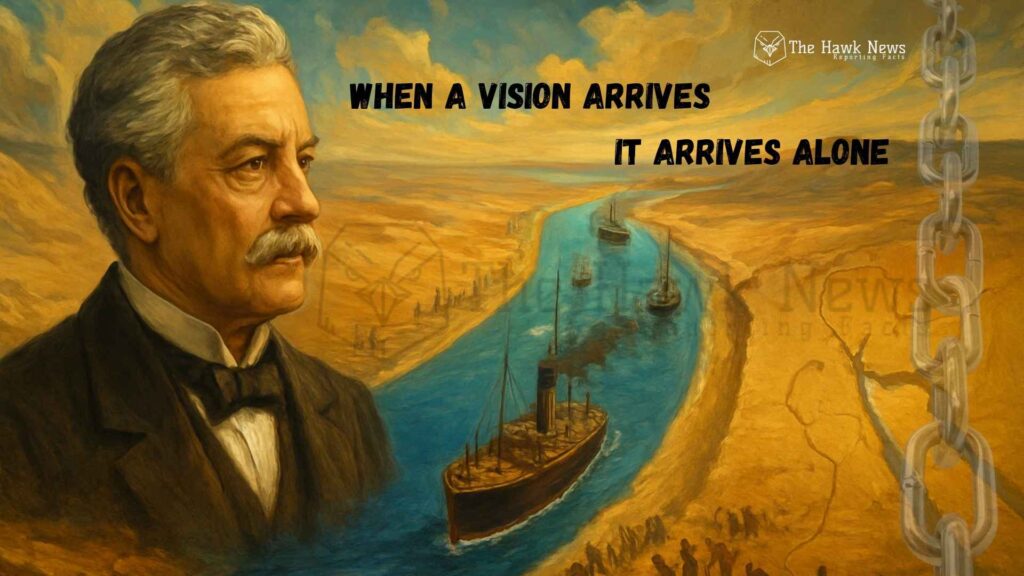
There are moments in history when the world changes not because the masses wanted it, not because a nation demanded it, but because one mind refused to surrender a dream.
Every great human leap begins with a simple fact:
One person sees what the world does not.
As the writer Antoine de Saint-Exupéry once said,
“A goal without a plan is just a wish.”
But a vision — a real vision — pulls the world into its orbit.
The Suez Canal is one such vision.
A stripe of water carved through a desert.
A pathway that rewrote global trade, toppled empires, sparked wars, and stitched continents together.
Yet beneath the steel, the water, and the geopolitics lies a deeper truth:
It all began with a thought.
A thought that refused to die.
When a Vision Arrives, It Arrives Alone
For centuries, people dreamed of linking the Mediterranean Sea to the Red Sea.
Pharaohs tried and failed.
Persian kings attempted and abandoned.
Napoleon imagined but never executed.
People saw obstacles.
One man saw a possibility.
That man was Ferdinand de Lesseps, a French diplomat who believed — beyond logic, beyond doubt — that a waterway could slice through the sands of Egypt.
He was ridiculed, resisted, and dismissed.
But visionaries rarely need acceptance.
They need endurance.
“First comes the idea, then comes the resistance. If you survive the resistance, the world follows.”
The Believer: Vision Meets Its First Miracle
A visionary alone is a storyteller.
A visionary with a believer becomes a force.
Lesseps found his believer in Said Pasha, the ruler of Egypt.
One conversation.
One moment of alignment.
And suddenly the impossible began to look inevitable.
Where others saw a madman with a blueprint, Said Pasha saw a man carrying a future.
He offered:
- land
- rights
- political backing
- and the courage to endorse a global gamble
This is where your chain begins, my fren.
Every vision needs its first believer.
Someone who says:
“I see it too.”
The Accelerators: When Vision Becomes Movement
Once belief enters the equation, movement begins.
A canal is not carved by dreams alone.
It is carved by hands, sweat, and sacrifice.
France became the engine — providing money, engineers, planners.
Egypt became the muscle — tens of thousands of workers dug the canal, many with their bare hands.
They died nameless, uncelebrated, but their labour is the real foundation of the Suez Canal.
Here lies a brutal truth:
“A vision may start in the mind, but it is completed by the hands of those who never receive the glory.”
Then comes the twist.
Britain — the very power that opposed the canal — eventually bought shares, took control, militarised the region, and ruled over the canal for decades.
A reminder that:
Even your opposition can end up accelerating your vision.
Sometimes willingly.
Sometimes by consequence.
But always inevitably.
The Canal as a Metaphor: How One Thought Moved the World
When the Suez Canal opened in 1869, something extraordinary happened.
Travel time between Europe and Asia collapsed by 7,000 km.
Global trade routes restructured.
Markets shifted.
Empires recalibrated.
Energy flows redefined.
Geopolitics reshaped.
All because one vision refused to die.
This canal is not just a waterway — it is proof that the world bends for those who hold their convictions tight enough.
Vision is gravity.
It pulls people, nations, opposition, opportunity, and history toward it.
“A determined mind can carve rivers where nature left only sand.”
The Price: Every Vision Has a Shadow
But every dream has a cost.
And some costs echo for generations.
Egypt paid heavily:
- forced labour that took thousands of lives
- crushing debt
- British occupation
- decades of foreign control
- political conflict and wars
The canal built wealth for the world,
but built wounds for Egypt.
Yet this too is part of the metaphor:
“Every vision is born bright but grows through shadows.”
Progress is never clean.
Dreams are never free.
Someone pays the price the world forgets.
The Legacy: Who Reaps the Vision Today?
Today, Egypt controls the canal — a triumph won back through nationalisation in 1956 under Nasser.
Now:
- global trade depends on it
- oil routes depend on it
- Asia–Europe economies depend on it
- superpowers monitor it
- shipping giants rely on it
- and Egypt earns billions from it
The world still turns because a canal exists.
A canal exists because a vision existed.
A vision existed because one man refused to let the world stay the way it was.
Ending: The Question That Is Really About You
The Suez Canal is proof that a single thought, held with conviction, can outlive empires, wars, and centuries.
So ask yourself:
What is the vision you are anchoring?
Who are your believers?
Who are your accelerators?
And who, even unknowingly, will push your dream forward?
Because one day, the world may walk through a path that exists only because you once imagined it.
“History is not changed by crowds.
It is changed by the few who dare to see beyond what exists.”