How a discovery that reshaped biology became a symbol of gender bias, erased brilliance, and scientific injustice.
1. The Discovery That Changed the World — But Not Its Memory
On May 22, 1953, the scientific world witnessed a revelation that reshaped the future of biology: the publication of the double-helix structure of DNA in Nature.
Its impact was seismic.
It altered medicine, genetics, forensics, evolution, and nearly every branch of the life sciences.
The paper bore two names in bold: James Watson and Francis Crick.
Yet behind this celebrated moment lived another truth — a truth that remained buried for decades:
The most crucial piece of evidence came from a woman who never received proper credit for it.
Her name was Rosalind Franklin.
Her data made the double helix possible.
Her contribution was foundational.
But history, at first, didn’t write her in ink — only in footnotes.
2. The Race to Decode Life
The early 1950s were marked by scientific frenzy.
Two competing groups — one at King’s College London (Maurice Wilkins and Rosalind Franklin) and one at Cambridge University (Watson and Crick) — were locked in a quiet but intense race to uncover the structure of DNA.
DNA was the holy grail.
Whoever solved it would change science forever.
Watson and Crick worked from theoretical models.
Franklin worked from empirical precision — X-ray crystallography, the most technically demanding method of the time.
Her approach was slower, but it was the only one capable of revealing the truth.
3. Photograph 51: The Image That Broke Open the Secret of Life
In early 1952, Rosalind Franklin captured Photograph 51, an X-ray diffraction image of DNA that revealed the unmistakable X-shaped pattern.
This single image contained the answer.
It was definitive, elegant, and mathematically precise.
It proved the helical structure of DNA — the core idea behind Watson and Crick’s model.
But there was a problem:
Franklin never shared it.
It was quietly shown to Watson by Franklin’s colleague Maurice Wilkins, without her knowledge, consent, or permission.
Watson later admitted that when he saw the image, he immediately understood the structure.
Franklin’s work unlocked the code.
But someone else turned the key.
4. The Paper That Erased a Woman
Watson and Crick’s now-famous paper was published in Nature on May 22, 1953.
It included a single understated line:
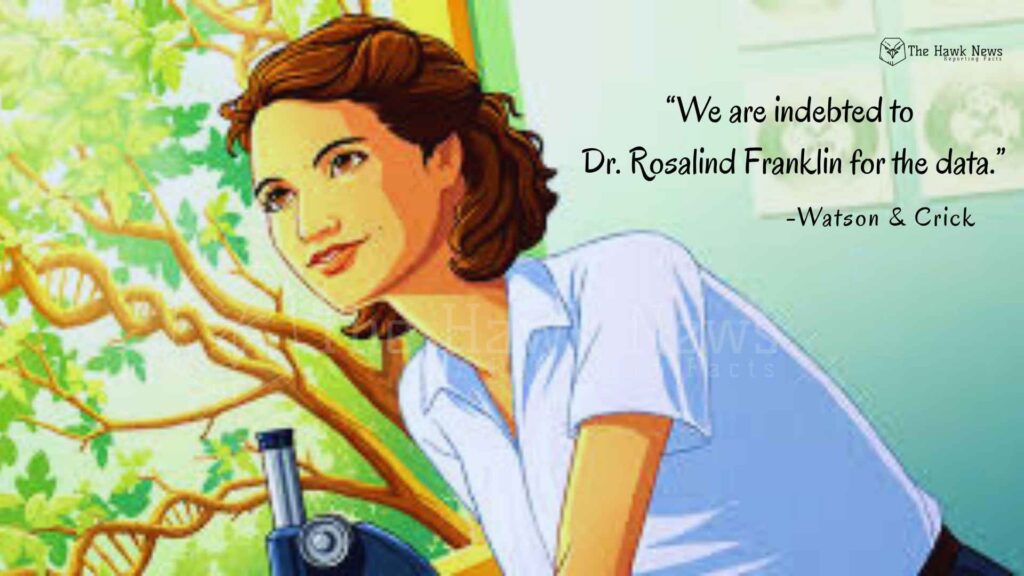
“We are indebted to Dr. Rosalind Franklin for the data.”
It was not debt.
It was dependence.
In the same issue, Franklin published her own paper — one that was accurate, original, and far more scientifically rigorous — but it appeared later in the journal and was framed as “supporting evidence.”
The order of publication created the illusion that she was confirming Watson and Crick’s model, not the other way around.
History rewarded the men.
And history overlooked the woman.
Nine years later, the 1962 Nobel Prize was awarded to Watson, Crick, and Wilkins.
Franklin had died four years earlier — and the Nobel is not awarded posthumously.
But even if she had lived, it is unclear whether she would have been included.
The world of science in the 1950s rarely recognized women fairly.
5. The Broader Pattern: Women in Science Have Always Been Overlooked
Rosalind Franklin’s story is not unique.
It is part of a long, painful lineage of women whose work was eclipsed, undermined, or outright claimed by men:
- Lise Meitner discovered nuclear fission, but Otto Hahn won the Nobel.
- Jocelyn Bell Burnell discovered pulsars; her supervisor received the prize.
- Chien-Shiung Wu proved the theory of parity violation; her male colleagues were awarded instead.
- Nettie Stevens discovered X and Y chromosomes; her male co-worker got credit.
The pattern is unmistakable:
When women discover, men are often celebrated.
When women create, men are often credited.
When women contribute, history often forgets to write their names.
Franklin’s erasure is not an exception — it is a mirror of systemic bias.
6. Ethics, Ambition, and the Price of Overlooked Genius
Rosalind Franklin was not only brilliant — she was principled.
She refused to publish incomplete findings.
She demanded scientific accuracy.
She believed in evidence, not speculation.
But science is not only a pursuit of truth.
It is a pursuit of credit, influence, and power.
Watson and Crick moved quickly, building a model based on fragments — some of which were obtained ethically, some unethically.
Franklin moved slowly because she respected the data.
In a race where speed mattered more than integrity, the medals went to the fastest, not the fairest.
7. The Legacy That Outlived the Injustice
Today, Rosalind Franklin’s name appears in textbooks, biographies, documentaries, buildings, research institutes, and scholarships.
Her story has been reclaimed, reexamined, and rewritten.
She is no longer the forgotten scientist.
She is the wronged pioneer who shapes conversations about scientific ethics, women in STEM, and intellectual credit.
Her life teaches us that:
- Recognition can be delayed.
- Credit can be misplaced.
- But truth, eventually, finds its way to the light.
Franklin didn’t just contribute to the discovery of DNA —
she embodied the resilience required to pursue science in a world that didn’t want women to lead it.
8. The Double Helix and the Double Standard
The structure of DNA explains how life replicates, adapts, and evolves.
But the story of its discovery explains how bias replicates, persists, and harms.
Rosalind Franklin’s erasure is more than a historical footnote —
it is a reminder of how society chooses whom to celebrate, whom to silence, and whom to overlook.
And perhaps that is the real lesson:
The double helix is the blueprint of life.
But Franklin’s story is the blueprint of the barriers women still face.
Conclusion: Finally Writing Her Name in Full
Rosalind Franklin changed the world without applause, without awards, and without the recognition she earned.
Today, as we navigate the age of genetics, personalized medicine, and DNA technology, we must remember that behind the double helix is a woman whose brilliance shaped the science of life — even if the world took decades to admit it.
History celebrated the discovery.
It failed the discoverer.
But at last, her name is written where it always belonged —
in the foundation of modern biology.