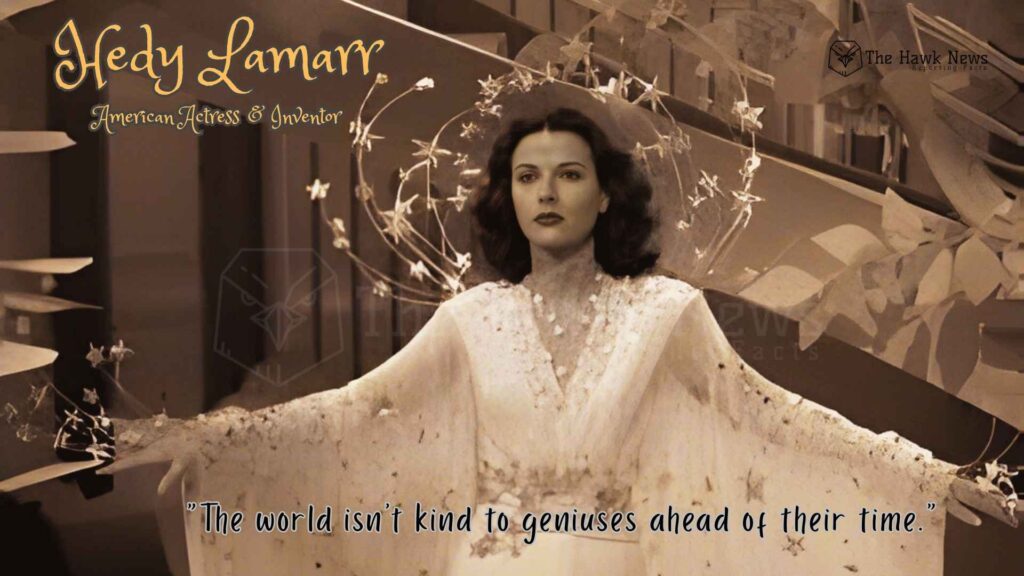
How a Hollywood icon reshaped the future of communication without ever touching a smartphone.
1. The Woman Hollywood Framed Wrong
History remembers certain women for their beauty, but rarely for their brilliance. Hedy Lamarr was one of those women — dazzling, desired, mythologized — and almost entirely misunderstood.
To the world, she was “the most beautiful woman in the world,” a Hollywood star whose face sold films, fantasies, and headlines.
But behind the makeup and marquees stood a mind quietly engineering one of the most important communication technologies of the modern era.
Every time you open your WiFi router, connect Bluetooth headphones, or follow GPS navigation, you are touching the legacy of a woman whom the world celebrated for her looks but ignored for her intellect.
This is the paradox of Hedy Lamarr — the actress who accidentally invented the backbone of wireless communication.
2. Fame Without Recognition
In the 1930s and 40s, Hollywood operated like an assembly line. It manufactured stars, polished images, and packaged beauty into consumable glamour. Hedy Lamarr fit perfectly into that mold — at least on the surface.
She starred alongside Spencer Tracy, Clark Gable, and Jimmy Stewart.
She appeared in magazines, on posters, and in interviews as the embodiment of cinematic elegance.
But Hollywood had no interest in her mind.
Executives preferred her silent, glamorous, and compliant — a living ornament.
Yet in her quiet hours, away from cameras and scripts, Lamarr took apart gadgets, studied engineering concepts, and scribbled technical ideas in notebooks. She often spent her breaks on set sketching mechanisms and equations while studio heads saw only a beautiful face posing under bright lights.
The world celebrated one version of her — and completely missed the other.
3. The Inventor Behind the Curtain
Hedy Lamarr was not merely curious; she was gifted.
Long before Hollywood, she had grown up in Vienna, taking apart music boxes and machinery, encouraged by a father who explained the inner workings of everything they encountered. Her mind was wired not for glamour, but for invention.
During World War II, she became deeply troubled by the news of Allied naval ships being destroyed by German torpedoes.
The problem: torpedoes were radio-guided, and enemy forces could easily jam the signal, sending them off-course.
Lamarr believed she could solve this.
In an unexpected partnership, she teamed up with George Antheil — an avant-garde composer known for synchronizing multiple pianos in complex patterns. Together, they came up with a radical idea:
Frequency-hopping spread spectrum.
A communication system that rapidly changes radio frequencies, preventing interception or jamming.
Their inspiration was elegant:
Just as multiple pianos could be synchronized to play in unison, radio signals could jump between frequencies in coordination — too fast for enemies to decode.
On August 11, 1942, they received U.S. Patent No. 2,292,387.
It was, by all scientific standards, groundbreaking.
But the world wasn’t ready for two unexpected inventors — an actress and a composer — to redefine wartime communication.
4. The Invention That Was Too Far Ahead of Its Time
The U.S. Navy dismissed the invention.
They called it “too complex,” and instead of exploring it, they suggested Lamarr contribute to the war by using her beauty — selling war bonds, boosting morale, and appearing at events.
In other words:
You’re too beautiful to be taken seriously.
It was an erasure wrapped in politeness, the kind history is full of.
While her patent sat unused, Lamarr continued acting, earning applause on-screen while her scientific breakthrough gathered dust.
What the Navy overlooked would become the cornerstone of secure communication decades later.
5. When the World Finally Caught Up
Two decades later, during the Cuban Missile Crisis, the U.S. military finally deployed frequency-hopping technology. By then, Lamarr’s patent had expired.
She received no profit, no recognition, no public credit.
Yet the idea evolved rapidly:
- WiFi relies on spread spectrum modulation.
- Bluetooth uses frequency hopping to avoid interference.
- GPS requires the secure, stable communication principles she pioneered.
- Modern defense communication still uses frequency-hopping for secure transmissions.
What Lamarr imagined in wartime became the foundation of modern connectivity.
She did not invent WiFi directly.
But she invented the reason WiFi is possible.
Her mind sketched the blueprint for the 21st century long before the tools to build it existed.
6. The Recognition That Came Too Late
For most of her life, Lamarr remained a footnote in history’s margins — admired for her face, forgotten for her mind.
She received long-overdue recognition in 1997 when the Electronic Frontier Foundation honored her contributions to communication technology. She was in her 80s by then.
When asked about her belated fame, she said simply:
“The world isn’t kind to geniuses ahead of their time.”
Hedy Lamarr died in 2000, unaware of the magnitude of her influence on modern technology: smartphones, wireless networks, smart devices, military communications, satellite systems — all carry traces of her forgotten invention.
7. Inventors’ Day: Reclaiming Her Legacy
Today, November 9 — her birthday — is celebrated as Inventors’ Day in countries like Germany, Austria, and Switzerland. It is a symbolic correction, a gesture that rewrites her position in cultural memory.
No longer just a Hollywood face.
No longer just a forgotten patent.
Today, she stands as a reminder that innovation rarely comes from where society expects it.
Sometimes brilliance arrives dressed as glamour.
8. Why Hedy Lamarr Matters Now
Hedy Lamarr’s story remains relevant because it is not just about technology — it is about perception, bias, and the cost of overlooking genius.
Her story matters because:
- Women in STEM still fight to be believed.
- Talent is still judged by appearance.
- Society still underestimates those who don’t “look” the part.
- Innovation often comes from unexpected places.
- Recognition still arrives too late for many pioneers.
Her life teaches a powerful truth:
Genius is not always loud.
Sometimes it wears eyeliner and stands under studio lights.
Sometimes it comes disguised as beauty — and the world must learn to look deeper.
Hedy Lamarr didn’t set out to change the world.
She simply refused to silence the part of herself that wanted to create, understand, and innovate.
And because of that, the world today is more connected than it ever imagined.
She didn’t just break Hollywood stereotypes.
She built the invisible bridges that hold the digital world together.