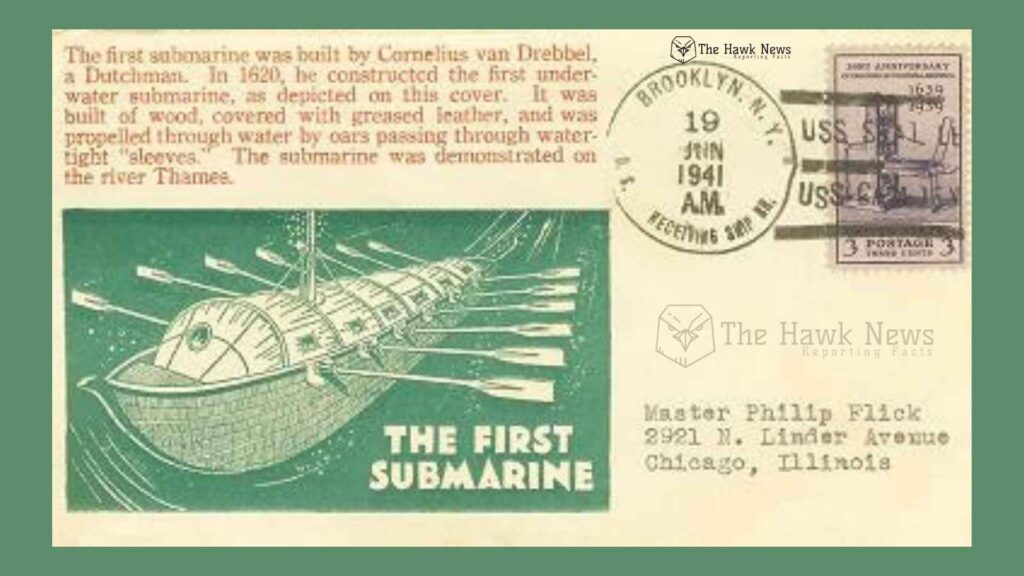
In 1624, when Londoners walked along the Thames unaware, something extraordinary slipped beneath the surface — something the world was not ready to see, something that did not belong in the age of wooden ships and open sails, something that felt almost mythic in its audacity.
A vessel — made of wood, covered in greased leather, powered not by engines or electricity but by twelve men rowing through sealed oar-ports — vanished beneath the river.
Inside it sat a Dutch inventor named Cornelis Drebbel, a handful of brave passengers, and, if eyewitness accounts are to be believed, even King James I himself.
They moved underwater at a depth no one at the time imagined possible.
They navigated unseen, unheard, unrecorded by official history.
And when they resurfaced, the world above remained unaware that humanity had quietly taken its first breath underwater.
More than two hundred years before submarines became real, Drebbel had already proven the impossible.
But this story is not merely about a machine — it is about something deeper, something stirring in the human spirit, something that has shaped every era:
the instinct to go where we “shouldn’t,”
the hunger to explore the forbidden,
the refusal to accept the boundaries handed to us.
Drebbel’s submarine was not just an invention.
It was a statement.
Curiosity: The Oldest Technology We Have
Before steel, electricity, engines, algorithms, or rockets, humans only had one real tool — an inconvenient, troublesome, unstoppable inner voice that kept telling them:
“Go further.”
“Look deeper.”
“What if?”
“Why not?”
This voice lived in Drebbel too.
In an age when people still feared deep water, when most believed the sea hid monsters, when even maps carried warnings at the edges — “here be dragons” — Drebbel dared to imagine a vessel slipping beneath the current like a creature of the deep.
Nobody asked him to do it.
Nobody expected him to succeed.
Most probably thought he was wasting his time.
Yet he persisted, not because he had evidence it would work, but because he had imagination — that strange, wild human instinct that sends us into caves, across oceans, through skies, and eventually, into space.
Long before technology existed, curiosity drove humanity forward.
Drebbel simply listened to it more loudly than most.
The Inventor the World Forgot, and the Dreams We All Carry
Cornelis Drebbel never received the recognition of later inventors.
He has no statues in city squares, no popular movies, no school chapters with his name printed in bold.
But perhaps that is what makes his story powerful.
He represents every person in history who tried something before the world was ready to understand it.
The kind of person who takes risks quietly, without applause, without guarantees, without knowing whether their idea will be called genius or madness.
Every generation has a Drebbel.
In fact, every family has one.
Sometimes every heart does too.
The one who dreams differently.
The one who sees beyond the edges.
The one who leaps where others hesitate.
The one who believes there is something more.
Drebbel’s submarine tells us that the future often begins in the minds of those who are willing to look foolish before they look brilliant.
The Silent Journey Under the Thames: A Metaphor for Every Hidden Breakthrough
Imagine this scene:
Above the water —
Londoners walk, talk, trade, eat, argue, and move on with their day, unaware of anything unusual.
Below the water —
A leather-covered submarine glides silently like a secret.
Oars slice the river from beneath.
The king sits with his breath held.
History changes —
and nobody knows.
This is how breakthroughs happen.
Not always with fanfare.
Not always with speeches.
Not always in headlines.
Sometimes the greatest leaps occur quietly,
beneath the surface,
far from public attention,
in the unseen places where courage and curiosity meet.
Every modern innovation — from aviation to the Internet—had a moment like Drebbel’s submarine:
a moment nobody noticed until years later when the world finally understood.
Breakthroughs whisper before they roar.
Humanity Was Never Meant to Stay in Shallow Waters
We are the only species that continuously tries to escape the boundaries nature gave us.
Birds fly because they were built to.
Fish swim because they were shaped for it.
But humans?
We do everything we’re not built for.
We grow wings from metal.
We breathe underwater through machines.
We walk on the moon.
We send robots to Mars.
We dive into the deepest trenches.
We stare into atoms.
We crash into the limits of knowledge just to see what breaks.
The human story is the story of breaking boundaries — physically, emotionally, intellectually, spiritually.
And long before a rocket climbed into the sky, a leather submarine slipped under the Thames.
Everything we do today, at scale and with technology, began with someone like Drebbel imagining a world that didn’t yet exist.
The Lesson for Our Generation: Innovation Isn’t About Resources — It’s About Courage
Drebbel had no engines.
No blueprints.
No engineering textbooks.
No scientific instruments.
No support.
No funding.
Not even a proper workshop.
He built the world’s first workable submarine with wood, leather, grease, and stubbornness.
And still, he did what no one else dared.
In our generation —
where innovation is often confused with money, branding, or access —
Drebbel reminds us that courage outperforms resources.
You do not need perfect conditions to begin.
You do not need approval to attempt.
You do not need certainty to take the first step.
Every breakthrough begins with someone asking,
“What if this works?”
Why This Story Matters Today
We live in an age where:
People hesitate to take risks.
Fear of failure paralyzes creativity.
Criticism kills ideas before they grow.
Perfection becomes the enemy of beginnings.
But Drebbel’s story cracks the surface like sunlight through water.
It reminds us that progress is rarely comfortable, rarely logical, rarely supported — and never waiting for permission.
The world changes when someone builds something that looks impossible to everyone else.
If a leather submarine could glide silently under the Thames 400 years ago, then what excuses do we make today?
The Final Reflection: We Are Still the Same Humans Who Want to Go Beyond
Technology has advanced.
Knowledge has multiplied.
Tools have evolved.
But the core of human nature hasn’t changed.
We still long to go deeper.
To go further.
To push limits.
To explore the forbidden.
To touch the unreachable.
To step into the unknown.
Drebbel’s submarine is not just history.
It is a mirror.
It shows us who we were,
who we are,
and who we are still becoming.
Humanity has always been a species that moves toward what lies beyond the horizon.
Sometimes above the surface.
Sometimes below it.
But always forward.