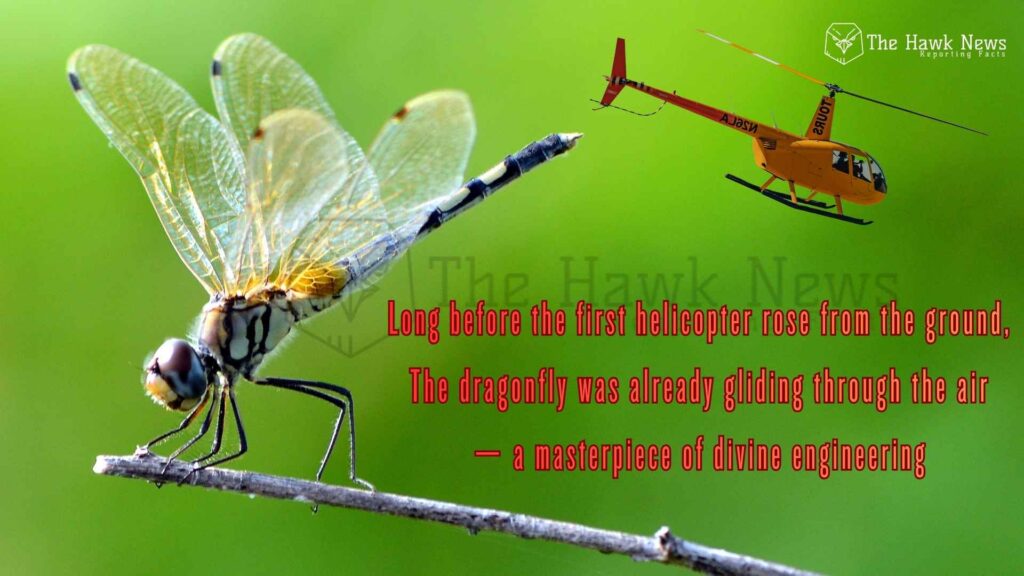
There’s a quiet moment, somewhere by the edge of a pond, when the world stands still — and a dragonfly hovers.
Its glass-like wings shimmer with sunlight, tilting, pausing, reversing, and darting away with a grace no human machine has ever fully matched. Long before the first helicopter blade sliced through air, this small creature mastered the skies.
Was it evolution? Or could it be something more intentional — a divine lesson in motion?
Humanity likes to call itself inventive. But what if many of our greatest breakthroughs are, in truth, rediscoveries of designs already perfected by the Creator?
1. The Flight That Came Before the Blueprint
The dragonfly is one of the oldest flying creatures on Earth — fossils suggest it has danced through the air for over 300 million years. It predates humankind, predates civilization, predates the dream of flight itself.
It can hover in one place, soar straight up, dart backward, and even fly upside down. Its wings beat independently — two on each side — allowing the insect to maneuver with impossible precision. Every motion seems choreographed, like a living ballet of aerodynamics.
When engineers and biologists studied it, they found that this simple creature accomplishes what humans spent centuries trying to understand: lift, stability, agility, and control.
The helicopter — our proud emblem of vertical flight — mirrors this exact pattern. Four blades spinning, each adjusted independently, to rise, descend, and hover.
But the dragonfly was there first.
Perhaps that’s the first lesson: what humanity calls innovation, God calls creation.
2. God’s Blueprint Hidden in Plain Sight
In the early 20th century, engineers like Igor Sikorsky struggled to crack the mystery of stable vertical flight. Airplanes could soar forward, but hovering seemed impossible. Until they began to look toward nature — to birds, bees, and yes, dragonflies.
Sikorsky once said, “The work of the individual still remains the spark that moves mankind forward.” But perhaps that spark itself comes from observing what the Divine has already built.
Dragonflies inspired not only the motion of helicopter rotors but also the balance between lift and torque, the concept of tail rotors to stabilize spin, and even wing shape designs in prototype aircraft.
Psalm 104:24 says, “How many are your works, Lord! In wisdom you made them all; the earth is full of your creatures.”
That verse reads almost like an engineering statement — acknowledging that wisdom itself is woven into creation.
We didn’t invent aerodynamics. We discovered it, because it was already written into the design of wings, winds, and wonder.
3. Learning From the Creator’s Creations
Every invention carries echoes of divine fingerprints.
The human eye inspired the camera.
The bat’s echolocation birthed sonar and radar.
The whale’s fins influenced submarine design.
And the dragonfly’s flight whispered the secret of the helicopter.
In Proverbs 8, wisdom is personified as being “present at creation.” That same wisdom still speaks through creation — quietly, patiently, inviting human minds to look, study, and reflect.
It’s not that God hid His blueprints from us — He placed them everywhere. The sound of a heartbeat inspires medical rhythm monitors; the hexagons of a beehive shape aerospace engineering; the natural patterns in leaves inform solar panel efficiency.
Science is not an enemy of faith. It is faith in motion — an act of curiosity that honors the Creator by seeking to understand His work.
We build machines, but God built the logic that lets them work.
4. Faith Meets Flight
Helicopters are remarkable inventions — capable of hovering mid-air, lifting people from danger, and reaching places airplanes cannot. They’ve become instruments of rescue, medical relief, and exploration.
Yet there’s something almost poetic about their origin. A machine that imitates a dragonfly ends up saving lives — the same way nature itself sustains life.
For believers, this isn’t coincidence. It’s a reflection of divine order — how creation holds both mystery and instruction. God didn’t just make beauty; He made blueprints.
Romans 1:20 declares, “For since the creation of the world God’s invisible qualities — his eternal power and divine nature — have been clearly seen, being understood from what has been made.”
Every blade that spins, every rotor that hums, echoes a truth that has been visible all along: the world is not a random accident. It’s a crafted symphony — and we are invited to learn its notes.
5. When Innovation Forgets Its Source
But there’s a caution too. Humanity sometimes forgets its source — turning creation into conquest.
In our rush to innovate, we sometimes behave as if the world is raw material to dominate, rather than revelation to respect. The dragonfly’s design was a gift, a whisper of divine genius — yet we’ve too often turned such wisdom into ego, claiming ownership over what was freely shown.
It’s not wrong to invent — but it is dangerous to forget Who made invention possible.
The dragonfly’s dance was never meant to feed our pride, but our praise.
Perhaps this is why even our machines are humbled by nature.
A helicopter can mimic flight, but not beauty.
It can hover, but not shimmer.
It can soar, but not sing.
We can engineer the movement — but only God can breathe in the life.
6. The Signature in the Sky
There’s an old saying among pilots: “To most people, the sky’s the limit. To those who love aviation, the sky is home.”
For those of faith, the sky is not just home — it’s handwriting.
When you watch a dragonfly hover in the golden light, you’re not just seeing biology; you’re seeing theology. You’re seeing design, purpose, rhythm, and grace all folded into one flick of a wing.
The helicopter, in all its human triumph, is merely an echo of that miracle. A marvel born from marvel, a discovery drawn from divine art.
As the rotors spin, the air stirs — like the breath of inspiration itself. Maybe, in every hum of an engine, we’re hearing an ancient whisper: “Look, and see what I have made. Learn, but never forget who taught you.”
Because before humanity dreamed of flight, God had already filled the skies with teachers.
Closing Reflection
The dragonfly reminds us that faith and science don’t stand on opposite sides of a battlefield — they kneel before the same mystery.
We study the world not to rival God but to recognize Him.
Every discovery is, in truth, a rediscovery — of His brilliance, His order, His love.
So next time you see a dragonfly hover over still water, remember: the secret of flight didn’t begin in a lab.
It began in the mind of God — and it continues in the hearts of those who still believe that creation speaks.
Tagline:
“Before humankind learned to fly, God had already filled the skies with teachers.”