They say rejection fuels greatness. That every “no” is just the spark before the engine roars.
And yet, history’s most inspiring success stories also hide something darker — how those who were once dismissed often become the very gatekeepers they once fought to break past.
Take a drive down the high-speed lane of automotive legends — Ferrari, Lamborghini, Pagani, Hennessey — and you’ll see more than innovation.
You’ll see a cycle. A chain reaction where pride, pain, and purpose collided to create empires… and egos.
The Chain Reaction of “No”
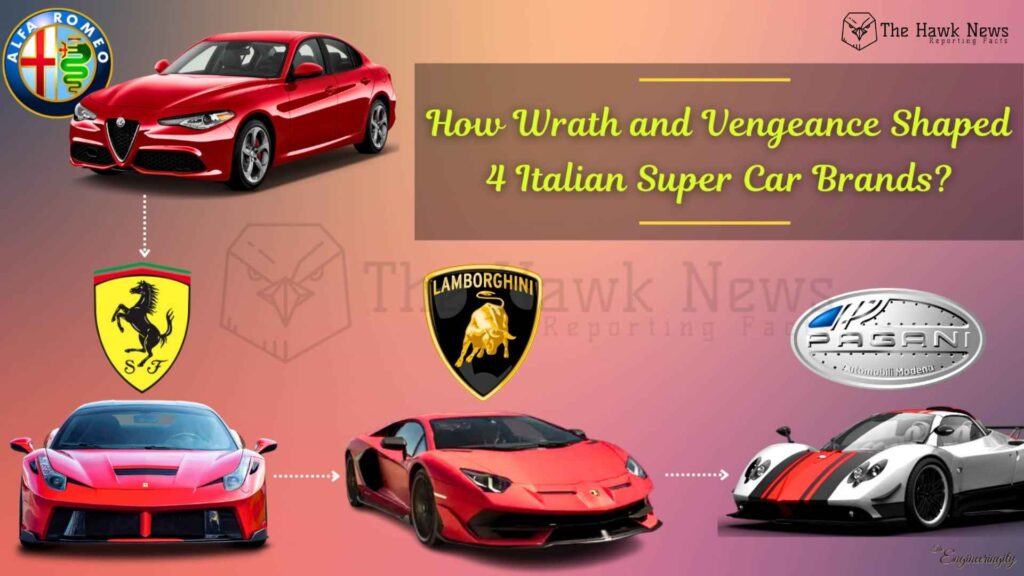
It began with Enzo Ferrari — a young Italian driver with grit, charm, and an unshakable love for engines.
He once sought a job at Alfa Romeo, hoping to learn, to build, to belong. They turned him away.
Instead of surrendering, he built his own dream — Ferrari — a name that would one day symbolize perfection and prestige, worth billions of dollars.
Years later, another man walked into Ferrari’s world — Ferruccio Lamborghini, a tractor manufacturer with a passion for speed. He offered advice to Enzo on how to make Ferrari’s clutch better.
Enzo mocked him. Told him to stick to tractors.
Lamborghini went home, furious, and built a rival — the bull to Ferrari’s prancing horse.
Today, Lamborghini is one of the most iconic car brands in the world.
Then came Horacio Pagani, a gifted craftsman working for Lamborghini. He dreamed of cars made entirely of carbon fiber — lightweight, futuristic, divine.
Lamborghini’s management refused. Pagani left, founded his own company, and created Pagani Automobili — the maker of some of the most stunning hypercars on Earth.
And years later, John Hennessey approached Pagani seeking engines capable of record-breaking speeds. Pagani declined. So, Hennessey built his own.
Today, Hennessey Performance pushes cars beyond 300 mph, rewriting what “fast” even means.
Every rejection lit another fuse.
Every ego, another explosion.
And somewhere between the roar of engines and the echo of pride, we see the truth: every rejection can create a revolution — but every revolution risks becoming a replica of the system it once rebelled against.
The Rise and Repeat of Power
It’s easy to glorify these stories as “never give up” mantras. But look closer.
Each of these men — Enzo, Ferruccio, Horacio, John — didn’t just build cars. They built empires. And empires, by nature, forget.
The rejected became the rejectors. The mocked became the mockers.
The dreamers turned into the doubters.
It’s not just the car industry. It’s the cycle of human power.
In technology, Steve Jobs was ousted from Apple, then returned to create the world’s most valuable company — and became infamous for his own ruthless perfectionism.
In music, artists once ignored by labels now own labels that reject others.
In startups, the outsider soon becomes the one guarding the gates.
It’s the oldest paradox of ambition — success doesn’t just reward us. It reshapes us.
And unless we remember the taste of rejection, power becomes the very poison we once swore to resist.
The Psychology Behind the Pattern
Psychologists call this the “reversal effect” — when individuals who were once powerless, upon gaining authority, unconsciously replicate the systems that oppressed them. Why? Because pain, unprocessed, becomes pride. And pride always wants proof — to show it has arrived, to ensure it’s never humiliated again.
Rejection doesn’t just hurt the ego. It rewires it.
It’s why so many success stories have a sharp edge — a hunger not just to win, but to be seen winning.
There’s another layer to this — the “arrival fallacy.” It’s the illusion that once you reach your goal, the emptiness will disappear.
But when you build something out of revenge, the silence after success can feel louder than the applause. Because deep down, you didn’t build to create — you built to prove.
“In chasing acceptance, we build fortresses instead of bridges.”
And those fortresses, over time, turn innovation into isolation.
What This Means for a New Generation
Gen Z and Gen Alpha live in a world that glorifies the grind — “prove them wrong,” “show your haters,” “build your empire.” But what if we’re chasing the wrong victory?
The real challenge isn’t proving others wrong — it’s proving to yourself that rejection doesn’t need to make you ruthless. That creation born from love lasts longer than creation born from bitterness.
Yes, rejection can be a gift — it reveals your resilience. But if your story ends with you rejecting others the same way you were rejected, the cycle isn’t broken. It’s reborn.
Maybe the true test of success is remembering what it felt like to be unseen — and making sure no one around you feels that again.
The Engine Beneath It All
Ferrari, Lamborghini, Pagani, Hennessey — their stories aren’t just about horsepower.
They’re about human power — the energy that drives creation, ambition, rebellion, and redemption.
Each man took a “no” and turned it into motion. But the question remains — motion toward what?
Did they rise because they loved what they built?
Or because they couldn’t bear to be underestimated again?
History suggests it’s both. But our generation gets to choose which part of that legacy to keep.
To build not from bruised ego, but from inspired vision. To innovate without imitation.
To lead without forgetting.
Because in the end, the greatest engine isn’t the one under a hood — it’s the one inside a heart that remembers where it started.
“Every roar of a supercar carries the echo of a ‘no’ once spoken.
But maybe the world doesn’t need more engines born of spite — it needs creators who remember what silence felt like before their first ignition.”