On November 4, 1922, in the sunburnt Valley of the Kings, a British archaeologist named Howard Carter brushed dust from stone and peered into the shadows of eternity.
His lantern flickered across gold, ebony, and lapis — treasures untouched for more than 3,000 years. When his patron, Lord Carnarvon, asked if he could see anything, Carter whispered words that would change history: “Yes, wonderful things.”
The world called it the greatest archaeological discovery of all time. But beneath the glitter and triumph, another story was quietly being buried — a story not about gold, but about morality.
A century later, we must ask: what happens when human curiosity, however noble, trespasses into the sacred?
The Day the Dead Were Disturbed
Tutankhamun’s tomb was unique because it was intact — a time capsule sealed by the sands of Egypt since 1323 B.C. Inside lay the boy king, surrounded by symbols of rebirth, guardians, and prayers meant to protect him in the afterlife.
But in 1922, reverence yielded to revelation. The West was gripped by Egyptomania. Newspapers printed every finding like a serial adventure. Gold masks and jeweled daggers captivated imaginations, while the boy king became a brand.
The Egyptians called their ancient rulers “The Lords of Silence.” Yet the silence of Tutankhamun was shattered. He had been prepared to journey to eternity — not to a museum.
The Triumph and the Temptation
Carter’s discovery undeniably changed history. It gave archaeologists a detailed picture of Egypt’s artistry, rituals, and beliefs about life after death. Scholars learned more about ancient medicine, burial practices, and spiritual symbolism than ever before.
But this triumph came with temptation — the human tendency to possess what we should only witness. Every object removed from that tomb became a symbol of the West’s hunger to claim history itself.
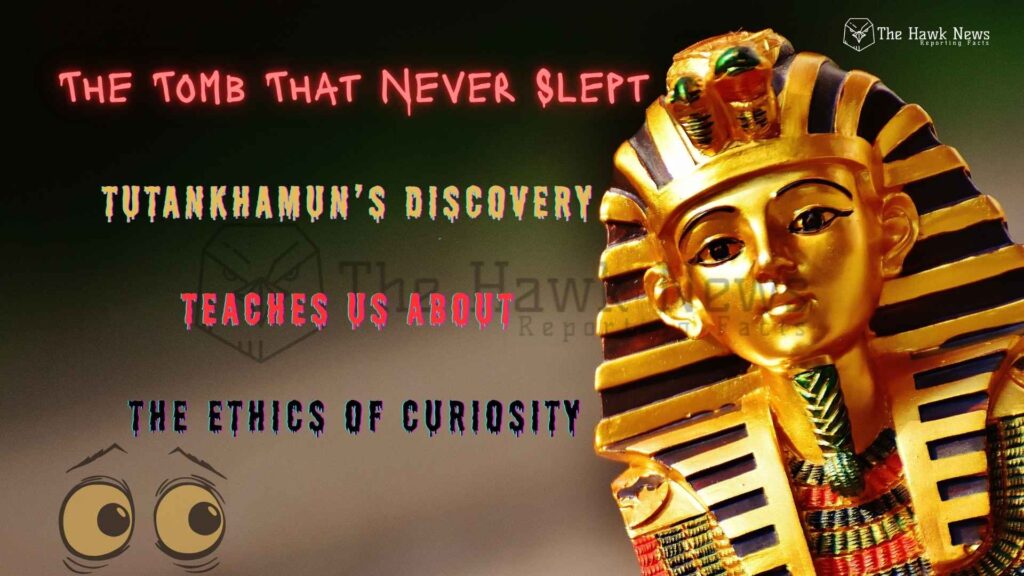
Tutankhamun’s mask now stands behind glass in Cairo, adored by millions. But sometimes, admiration feels like intrusion. We call it preservation; ancient Egyptians might have called it disturbance.
The Curse of the Pharaohs — Or the Curse of Hubris?
Soon after the tomb’s opening, the world whispered of “The Curse of the Pharaohs.” Lord Carnarvon, bitten by a mosquito, died mysteriously. Others fell ill. Lights flickered, canaries died, and the myth grew that Tutankhamun’s wrath was real.
Modern science dismissed it — bacteria, coincidence, hysteria. But perhaps the curse wasn’t supernatural at all. Perhaps it was moral.
Every civilization that forgets reverence pays a price. The ancient tombs remind us that some places were sealed not out of secrecy, but sanctity. The “curse” may simply be the echo of human arrogance — the belief that everything hidden must be found, everything sacred must be studied.
The Modern Mirror — Curiosity in the Age of AI
A century later, our tools have changed — spades have turned into algorithms — but our temptations remain.
We exhume not tombs, but private lives. We unearth personal data, genetic codes, and digital footprints. Artificial Intelligence recreates the faces and voices of the dead. Scientists discuss resurrecting extinct species through cloning.
In our hunger to know, we forget to respect.
Howard Carter’s torch has become the blue light of our screens — still searching, still peering into forbidden rooms. But if the tomb of Tutankhamun teaches us anything, it’s that discovery without discernment becomes desecration.
Curiosity must have conscience, or it will consume the very soul of wonder.
Cultural Possession and the Western Gaze
The story of Tutankhamun is also the story of cultural power. For decades, Egypt’s treasures were shipped to London, Paris, and New York. They became exhibits in imperial museums — silent, displaced reminders of history’s uneven ownership.
Was it preservation or possession?
This question still lingers in global debates today — from Greece’s Parthenon marbles to African artifacts in European halls. When the colonized past becomes the West’s curiosity cabinet, what lesson are we really learning from history?
Tutankhamun’s mask is magnificent. But every time we gaze at it, perhaps we should ask: who gets to tell the story of the dead?
When Curiosity Crosses the Line
Discovery is not evil — it is, in fact, divine curiosity that has driven every step of civilization. Without it, there would be no science, no art, no progress.
But when curiosity forgets humility, it mutates into exploitation. The same impulse that unearthed Tutankhamun’s tomb once dug up nuclear power — and with it, the atom bomb. The same curiosity that mapped the genome now plays with the fabric of life itself.
The line between discovery and desecration is drawn not by ability, but by awareness. Just because we can doesn’t mean we should.
Lessons from the Sand
In the ancient Egyptian belief system, disturbing the dead was a grave sin. They built elaborate tombs not for pride, but for peace — a space where the soul could journey unbothered.
When Carter opened that tomb, he didn’t just find gold — he found a mirror. One that reflected humanity’s endless need to open every closed door.
Perhaps that’s why the myth of Tutankhamun endures. Because deep down, it asks each of us: when will we learn to balance wonder with wisdom?
A Message for Our Times
Today, our “tombs” are digital — private memories, forgotten files, ancient servers. Yet the question is the same: what do we do with what we find?
In an age of deepfakes, genetic editing, and endless excavation — both literal and virtual — Tutankhamun’s story feels like prophecy. Every time we dig into what was meant to rest, we awaken echoes we cannot control.
It’s not superstition — it’s balance. The ancients understood that life and death, known and unknown, must coexist. One gives meaning to the other. When we violate that boundary, we lose our reverence — and with it, our humanity.
The Tomb That Never Slept
A hundred years later, Tutankhamun still does not sleep. His image is everywhere — on posters, museum walls, documentaries, and merchandise. The boy who ruled for nine years has ruled over a century of fascination.
Howard Carter once said, “The past is not dead; it is living in us.” He was right — but perhaps not in the way he imagined.
The past lives when we learn from it, not when we loot it. The true treasure of Tutankhamun was not his gold, but his silence — the peace of a soul that sought to rest in eternity.
And maybe, just maybe, some doors are meant to remain unopened — not because they hide secrets, but because they hold sanctity.
Final Reflection
In a world that worships discovery, restraint may be the holiest form of wisdom.
Carter’s lantern revealed “wonderful things.”
But perhaps the greatest wonder would have been leaving them in peace.