In 1636, when a small group of Puritans in Massachusetts founded a college they named Harvard, they could not have imagined a world where knowledge would live not in books, but in clouds.
Their intent was simple yet profound — “to advance learning and perpetuate it to posterity.” They saw education not as a transaction but a torch — one that must never be allowed to go out.
Nearly four centuries later, that same torch flickers in the glare of LED screens and endless notifications. Knowledge, once sacred and sought, now scrolls past our eyes faster than we can absorb.
Harvard’s birth reminds us of a truth we’ve quietly forgotten: education isn’t about information — it’s about transformation.
The Spark That Lit the Mind
When Harvard was founded, books were scarce, literacy was privilege, and learning was sacrifice. To learn meant to wrestle with silence, to commune with ideas in solitude, and to find one’s moral compass in thought.
Knowledge was considered a sacred trust — a gift to be nurtured and shared responsibly.
Today, we live in an age of abundance — digital libraries in our pockets, open-source courses, AI tutors. Yet the soul of learning feels endangered. The challenge is no longer access but attention. The question is not “Can we learn?” but “Do we still know how?”
From Ink to Algorithms
The journey from quills and parchments to algorithms and code is one of humanity’s most dazzling leaps. But with it came a subtle shift — from depth to speed. We measure intellect by output, not insight; by degrees, not discernment.
The digital age, for all its brilliance, has birthed a culture of instant expertise. A few clicks and one can mimic mastery.
But as Harvard’s founders knew, true education is not accumulation; it’s cultivation. Knowledge was never meant to inflate the mind, but to enlarge the heart.
Degrees vs. Discernment
It’s ironic that in an age where education is more accessible than ever, wisdom feels rarer than ever.
We’ve mistaken information for understanding and qualifications for capability.
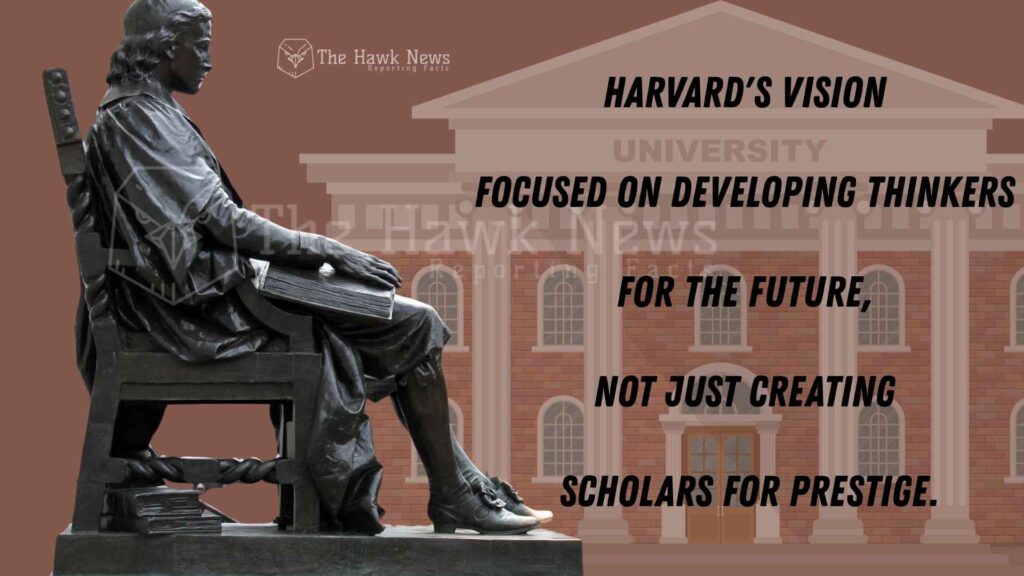
The Harvard vision wasn’t about creating scholars for prestige — it was about forming thinkers for posterity.
Discernment — the ability to separate truth from noise — has become the new literacy. And this is where digital learning often falls short. In a world of AI-generated essays and viral misinformation, the truest education is learning to pause, question, and think for oneself.
The Digital Classroom: A Revolution with Shadows
Online education has democratized learning, breaking barriers of class, geography, and cost. A student in a small Indian village can learn from a Harvard lecture streamed across the world — something unimaginable in 1636.
But this revolution carries shadows. The screen that connects us also isolates us. The lecture that educates also distracts. Learning, once an act of reflection, has become a race — fast-paced, result-driven, and often soul-draining. The classroom is no longer a space of shared wonder but a grid of muted faces.
The question that looms: Have we made learning efficient, or have we made it empty?
AI, Access, and Accountability
Artificial Intelligence now writes, summarizes, and even grades. It promises to personalize education and free humans for “higher thinking.” But can machines cultivate curiosity? Can algorithms instill empathy?
AI can process data — but it cannot ponder meaning. It can replicate knowledge — but not the wonder that fuels discovery.
The responsibility, therefore, falls on us — educators, parents, and students alike — to ensure that technology remains a tool, not a teacher.
Harvard’s founders built walls to house wisdom. Today, we must build boundaries — digital and moral — to protect it.
The Timeless Call: Learn to Know, Not Just to Earn
Somewhere between Harvard’s birth and the modern university boom, learning became an industry.
The question shifted from “What truth can I serve?” to “What career can I secure?”
Yet every crisis — from misinformation to mental health — traces back to one thing: we stopped learning for life, and started learning for labels.
Real learning still begins with humility — the courage to admit “I don’t know.” It thrives in curiosity and dies in complacency. And in that sense, the Harvard spirit is not tied to a campus — it’s a compass. It reminds us that knowledge divorced from character is just data, not wisdom.
Conclusion: The Torch Still Burns
From 1636’s candlelit halls to today’s fiber-optic highways, the pursuit of knowledge has always been about light — the kind that outlives us.
As the world drowns in data, perhaps we need to return to that first Harvard principle: learning as legacy.
For in an age of artificial intelligence, the most radical act may be to remain authentically human — to think deeply, question bravely, and learn endlessly.