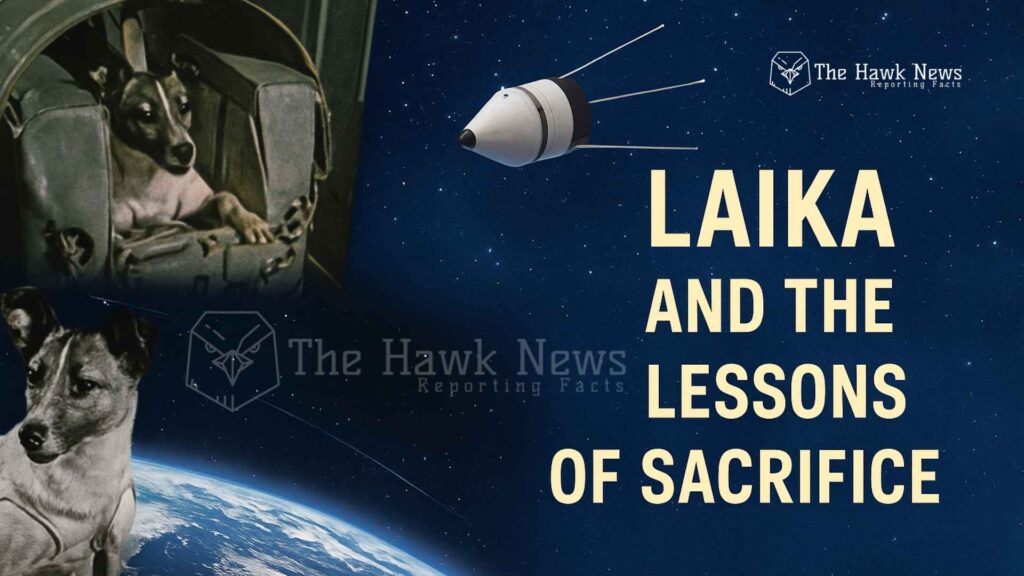
A Bark That Echoed Beyond Earth
It was November 3, 1957. In the bitter cold of Moscow, a small stray dog—plucked from the city’s streets—was strapped into a metal capsule atop a rocket that would change history. Her name was Laika, and she was about to become the first living creature to orbit the Earth.
The mission was Sputnik 2, the Soviet Union’s answer to America’s growing space ambitions. The Cold War had transformed the heavens into a new battlefield, and each launch was a declaration of dominance.
But beneath the steel and science, Laika’s story remains one of paradox—a symbol of triumph and tragedy, progress and cruelty, wonder and guilt.
Why a Dog?
The Soviet scientists needed a living passenger to test the effects of space travel on a biological organism. They wanted to see if life—breathing, beating, feeling life—could endure the violence of launch, the weightlessness of orbit, and the loneliness of space.
They chose a dog, not just for loyalty or simplicity, but for survivability. Stray dogs, the scientists believed, were already adapted to hunger, cold, and confinement. They picked Laika—a gentle, mixed-breed stray, weighing just six kilograms—for her calm nature.
To the Soviets, she was a hero before she even left the ground. To history, she became something more haunting—the embodiment of sacrifice in the name of progress.
The Mission of Urgency and Pressure
Sputnik 2 was built in less than a month. It was a rush job, ordered by Nikita Khrushchev himself to follow the success of Sputnik 1 just weeks earlier. The goal: launch another spectacular mission before the 40th anniversary of the Bolshevik Revolution.
In the race against time, there was no space for sentiment or ethics. Laika’s craft wasn’t designed for re-entry. There was never a plan to bring her back alive.
The scientists knew it, the engineers knew it, and some—like lead biologist Oleg Gazenko—admitted later that they never forgave themselves for it.
“The more time passes,” he said, “the more I’m sorry about it. We did not learn enough from this mission to justify the death of the dog.”
Launch Day: November 3, 1957
As the rocket ignited, flames roared beneath the steel, and the world held its breath. Sputnik 2 pierced through the atmosphere, carrying with it the heartbeat of a stray turned pioneer.
For a brief moment, humanity looked up in awe—a dog was orbiting Earth. Soviet media called her “the first traveler into the cosmos,” and the global press exploded with fascination and empathy.
But what the world didn’t know was that Laika died within hours of launch—not after days as early reports claimed. Her capsule overheated due to a malfunction, and the temperature rose above 40°C.
She panted, whined, and then fell silent. Her heart, which had raced three times its normal rate during launch, stopped beating within five hours.
It took decades before the truth emerged.
The Aftermath: The Orbit of Regret
For 163 days, Sputnik 2 continued circling Earth—a silent tomb orbiting the planet 2,570 times—until it finally burned up upon re-entry on April 14, 1958.
By then, Laika had become more than a Soviet experiment. She was a universal symbol, sparking debates on animal ethics, science, and the price of ambition.
In the Soviet Union, she was celebrated in songs and stamps. Statues were erected in her honor.
In the West, her death provoked outrage and sorrow, with protests from animal rights groups. Yet both sides shared a strange unity: awe at what humanity had achieved, and grief over what it had cost.
The Science and the Soul
From a purely scientific standpoint, Laika’s mission paved the way for human spaceflight. The data from her sensors helped scientists understand how living organisms respond to weightlessness, acceleration, and the isolation of space.
Without her, Yuri Gagarin’s historic flight in 1961 might not have been possible.
But what Laika proved, more profoundly, was that progress without compassion becomes peril.
Her story raises a timeless question:
What do we sacrifice when we rush toward greatness?
From Orbit to Conscience
In the decades that followed, space exploration became safer, smarter, and more humane. Today, no living creature is sent into orbit without the intent of return.
Laika’s mission is remembered not for its cruelty alone, but for forcing humanity to look at the moral side of science.
In 2008, a small statue of Laika was unveiled near Moscow. She stands tall, head tilted toward the sky—a bronze echo of the little stray who once circled the Earth.
The plaque beneath doesn’t glorify her as a hero or martyr—it honors her as the first life to journey where none had gone before.
The Dog Who Made Us Human
Perhaps the greatest irony is this: it wasn’t a soldier, a scientist, or a statesman who first orbited Earth. It was a homeless dog—a creature defined by loyalty and innocence.
Laika’s journey forces us to confront what we often forget—that the quest for greatness must not come at the cost of gentleness.
Her orbit was not just around the planet—it was around the human heart, drawing a line between progress and empathy, achievement and exploitation.
For Gen Alpha and Beyond: Lessons from a Stray
For today’s generation—born into a world of AI, rockets, and billion-dollar moonshots—Laika’s story isn’t about pity. It’s a mirror.
It asks: How far would we go for glory?
Would we still send the innocent to prove our might?
In a world obsessed with being “first,” Laika reminds us that being kind is greater than being fastest.
The stray who once wandered Moscow’s alleys taught humanity its most cosmic truth:
“You can conquer space, but not without compassion.”
Her orbit may have decayed, but her story will forever remain—
a small, warm heartbeat echoing in the cold silence of space.