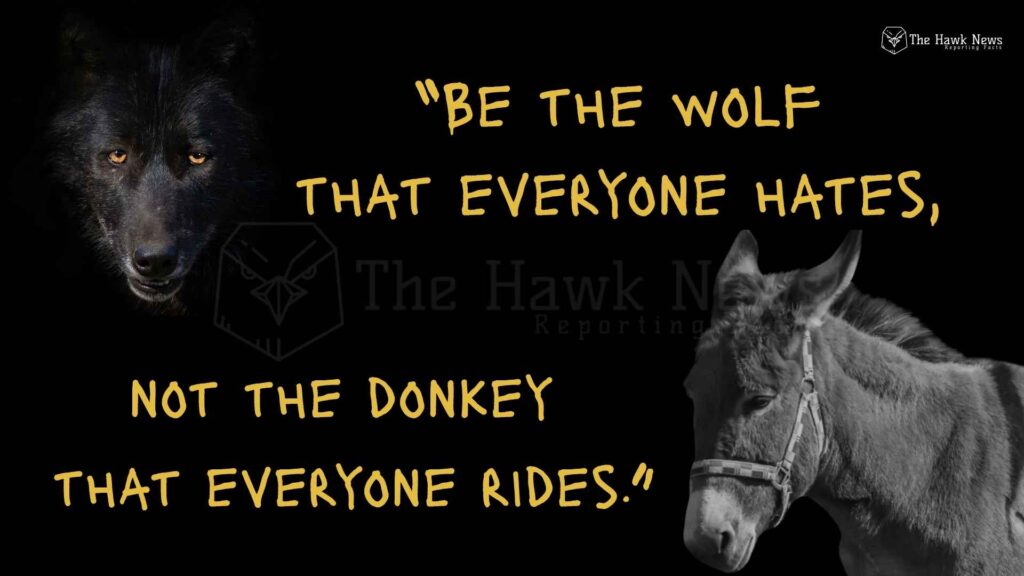
“Be the wolf that everyone hates, not the donkey that everyone rides.”
It’s a phrase that prowls through social media with quiet ferocity — a modern proverb that scratches beneath the surface of how we live, work, and seek validation. At first glance, it sounds savage. But beneath the sharpness lies a timeless truth: those who stand for something will never be liked by everyone.
We live in an age obsessed with acceptance. From the boardroom to the comment section, people bend themselves to fit others’ expectations. We soften our edges, swallow our truth, and serve our time on the altar of approval. Yet somehow, the more we please, the more empty we feel.
The wolf and the donkey aren’t just animals here; they’re archetypes — two mirrors showing us what happens when we either own our power or give it away. One walks with clarity and solitude; the other carries the weight of others’ opinions until its spirit bends.
The Culture of Pleasing
From a young age, we’re taught to be agreeable. To smile even when uncomfortable. To say “yes” when everything inside us whispers “no.” We call it politeness, but often it’s quiet surrender.
This conditioning follows us into adulthood — into relationships, careers, even our online personas. We’ve mistaken kindness for compliance, and peacekeeping for silence. The donkey represents this endless loop of overextension — bearing burdens that were never ours to carry.
The wolf, in contrast, knows its ground. It doesn’t seek conflict, but it doesn’t flee from it either. It walks alone when it must, not because it despises the herd, but because it refuses to lose itself in it.
Assertiveness: The Art of Balance
In psychology, there’s a term — assertiveness — the balance point between passivity and aggression. It’s not shouting louder; it’s speaking truer. It’s the calm firmness of someone who knows their worth and doesn’t need to prove it.
The wolf lives in that balance. It doesn’t beg for respect; it earns it by its stance. Meanwhile, the donkey lives at the mercy of approval. Its worth depends on how much it can give, carry, or accommodate — until there’s nothing left for itself.
We see this everywhere. The employee who never says no until burnout sets in. The friend who’s always available, yet feels unseen. The influencer who posts for applause, not expression. Each one trades authenticity for acceptance — and the exchange rate is cruel.
In the Digital Arena: The Noise of Approval
Social media magnifies our deepest insecurities. We measure self-worth in likes, shares, and follows — digital echoes that vanish as quickly as they appear.
But you cannot build a solid identity on shifting opinions.
The applause of the crowd is the most unreliable currency of all.
In this sense, being the “wolf” doesn’t mean being unkind — it means being unmoved. It’s the quiet person who no longer edits themselves to fit an algorithm. It’s the creative who stays true to their craft even when trends move on.
The wolf doesn’t chase validation; it draws it naturally by being real. Its silence commands more presence than the donkey’s endless braying for attention.
A Spiritual Undercurrent
Even scripture reflects this paradox. Jesus, the most compassionate man to walk the earth, was also the most misunderstood. Truth has always divided crowds; conviction has always carried a cost.
Being the wolf, spiritually, is standing in light while the world prefers shades of gray. It’s holding your ground when compromise feels easier. The path of integrity is narrow, but it’s lined with peace — the kind that doesn’t crumble under disapproval.
The donkey, however, represents those who try to please everyone and end up pleasing no one — not even themselves. Their peace is always conditional, hanging on others’ moods, opinions, or validation.
Why Being Liked Is Overrated
The hardest lesson of adulthood is realizing that you can’t be both authentic and universally liked.
There will always be people who misread your boundaries as arrogance, your silence as coldness, your confidence as pride. Let them. Because the truth is — being disliked for who you are is far better than being loved for who you’re not.
Wolves don’t chase acceptance; they attract respect. And while respect may come slower, it lasts longer. Popularity fades; authenticity echoes.
The Donkey’s Dilemma
It feels safe to be the donkey — to say yes, to agree, to blend in. But it’s an expensive kind of safety. Every time you bend your truth, you chip away at your strength.
The tragedy is that society rewards such behavior — until it doesn’t. When the donkey collapses from exhaustion, the crowd simply finds another to ride.
The wolf, meanwhile, is often feared or criticized — but never forgotten. It stands apart not because it seeks isolation, but because it chooses integrity over imitation.
Choosing the Wolf Within
To “be the wolf” doesn’t mean becoming hard or cruel. It means becoming whole. It’s about setting boundaries without bitterness, walking alone without arrogance, and leading with quiet confidence.
Wolves lead through presence, not noise. They protect their pack but never lose their sense of self. They are not guided by fear or flattery, but by instinct — that quiet knowing of what’s right, what’s worth it, and what’s not.
The world doesn’t need more donkeys carrying loads of empty opinions. It needs wolves who can think clearly, act wisely, and stand firmly — even when misunderstood.
The Takeaway
If you feel drained, overlooked, or constantly stretched thin, it might be time to ask yourself: Whose weight am I carrying?
Let people call you difficult. Let them call you proud. It’s fine. What matters is that you are true.
Because at the end of the day, wolves sleep peacefully knowing they’ve been real, while donkeys collapse under the weight of pretense.
Don’t aim to be liked. Aim to be respected.
Don’t chase validation. Chase truth.
Be kind — but never compliant.
Be humble — but never hollow.
Be the wolf — not because the world hates it, but because it refuses to live as anything less than itself.