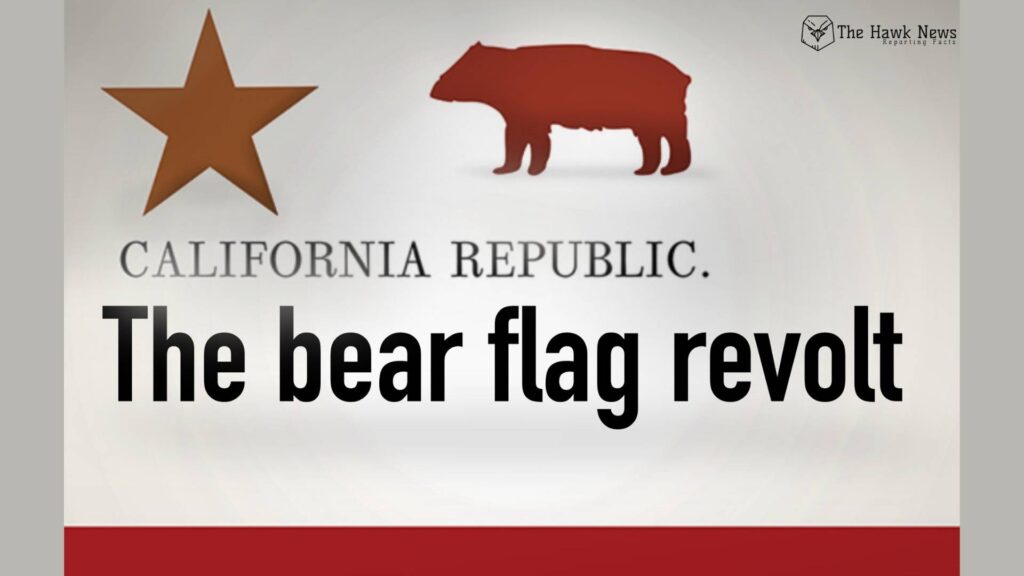
In the summer of 1846, a small band of American settlers raised a hastily stitched flag bearing a single star and a crude image of a grizzly bear.
For twenty-five days that banner fluttered above Sonoma, proclaiming the California Republic — an independent nation that lasted less than a month before the Stars and Stripes replaced it.
Though short-lived, the Bear Flag Revolt revealed the volatile collision of Mexican authority, American expansionism, and local ambition that would shape the U.S. West.
From Empire to Unrest
The roots of California’s independence trace back decades earlier to the political upheavals of Napoleonic Europe. When Napoleon Bonaparte invaded Spain in 1808, the Spanish crown turned inward to fight for survival, leaving its vast American colonies vulnerable.
From Argentina to California, local elites began imagining self-government. By 1821, the Mexican War of Independence ended three centuries of Spanish rule, and Mexico inherited not only its freedom but also an enormous northern frontier: today’s California, Arizona, New Mexico, Nevada, Utah, and parts of Colorado and Texas.
Mexico faced the same challenge that Spain once had — distance. Northern provinces were sparsely populated, garrisoned by a handful of soldiers, and economically isolated.
To strengthen control, Mexico encouraged foreign settlement, especially from the neighboring United States.
A Frontier Filling with Americans
By the 1830s and 1840s, hundreds of U.S. settlers had migrated into Mexican territory under promises of cheap land and opportunity.
The policy backfired. Immigrants often ignored Mexican laws requiring conversion to Catholicism, citizenship, and the use of Spanish. Anglo-American communities multiplied in Texas and California, bringing Protestant churches, English schools, and loyalty to the U.S. rather than to Mexico City.
When General Antonio López de Santa Anna suspended Mexico’s liberal constitution and assumed dictatorial power, distrust turned to open rebellion.
The Texas Revolution of 1836 created the Republic of Texas — an example that emboldened American settlers elsewhere.
California under Mexican Rule
By the mid-1840s, Alta California remained a remote Mexican province governed from Monterey.
General José Castro commanded local forces, while Governor Mariano Guadalupe Vallejo administered civilian affairs from Sonoma.
Few Mexicans lived north of San Francisco Bay; American trappers and farmers vastly outnumbered them.
Meanwhile, U.S. “Manifest Destiny” — the belief that the republic was destined to span the continent — drove Washington’s attention westward.
In 1845, President James K. Polk quietly sent Captain John C. Frémont, an army officer and explorer, to survey the Oregon-California border.
Though nominally a scientific expedition, Frémont’s presence with a heavily armed survey party alarmed Mexican officials.
General Castro ordered Frémont to leave. The American complied — briefly — retreating toward Oregon before returning months later.
Rumors spread that the U.S. and Mexico were on the brink of war, and nervous American settlers feared Castro would expel or arrest them.
The Spark of the Bear Flag Revolt
On June 14, 1846, a group of about thirty-three settlers, hunters, and adventurers seized Sonoma, capturing Governor Vallejo at his home without bloodshed.
Their leader, William B. Ide, a former carpenter from Massachusetts, declared independence from Mexico.
Ide issued a proclamation: “We are not robbers and plunderers, but American settlers determined to defend our rights.”
The rebels hoisted their new flag — a red star, a grizzly bear, and the words “California Republic.” It was designed by William Todd, nephew of Mary Todd Lincoln, the future First Lady of the United States.
For roughly three weeks, the so-called Bear Flaggers held northern California towns and outposts, forming militias and attempting to organize a provisional government.
Frémont soon re-entered the region, lending the authority of a U.S. officer to the insurrection.
Though he never formally led the revolt, his endorsement merged the movement with American military operations that were about to begin.
War Overtakes the Republic
Even as the Bear Flag rose over Sonoma, war had already broken out between the United States and Mexico along the Rio Grande. U.S. naval forces under Commodore John D. Sloat received orders to seize California’s ports once hostilities were confirmed.
On July 7, 1846, Sloat’s squadron sailed into Monterey Bay, occupied the town without resistance, and raised the American flag.
Frémont and the Bear Flag rebels quickly joined U.S. forces. The California Republic, having existed for just 25 days, dissolved peacefully as its members swore allegiance to the United States. Within months, California was firmly in American hands.
The Cost and the Legacy
The Bear Flag Revolt was small in scale — involving fewer than one hundred combatants and minimal bloodshed — but immense in symbolism.
For Mexico, it underscored the fragility of its northern frontier. For the United States, it served as a convenient pretext and moral justification for annexing a vast territory during the Mexican-American War (1846–1848).
The Treaty of Guadalupe Hidalgo, signed in 1848, formally transferred California to U.S. control, along with the entire Southwest, in exchange for $15 million.
Today, the Bear Flag endures as California’s state flag — a reminder of that brief, improvised republic and the restless ambitions of a continent in motion.
What began as a local revolt by frightened settlers became a key episode in the American expansion westward and a turning point in the history of both nations.