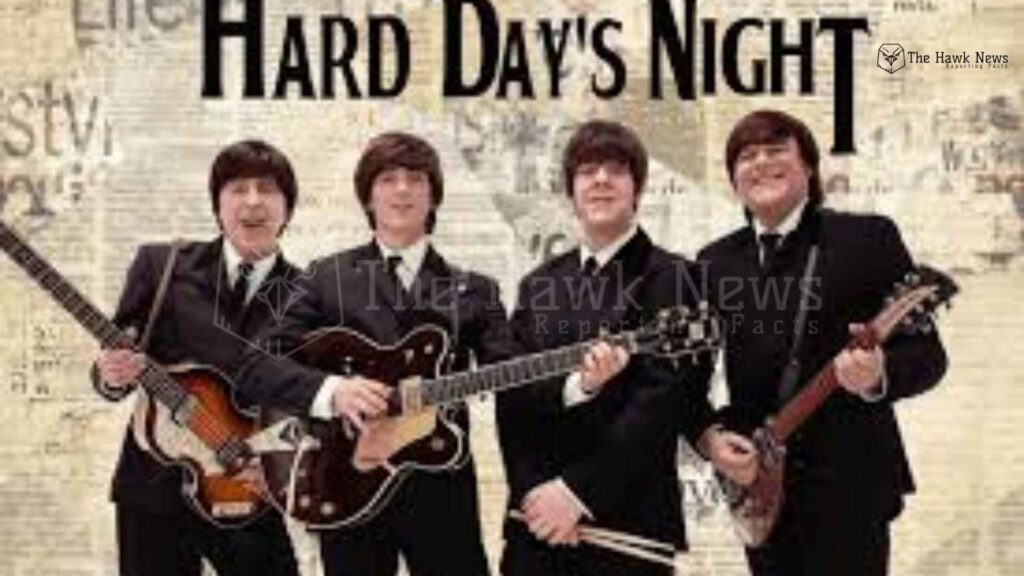
When A Hard Day’s Night premiered in New York City in August 1964, it wasn’t just another movie release — it was a cultural thunderclap.
Four lads from Liverpool, whose songs had already swept across continents, now took the silver screen by storm.
The Beatles’ first feature film didn’t just mirror their fame; it defined an era and reimagined how music, humor, and cinema could intertwine.
The World Before the “Hard Day”
The early 1960s were shifting sands. The post-war generation was seeking a new voice — something youthful, rebellious, and alive. Into that void stepped The Beatles — John Lennon, Paul McCartney, George Harrison, and Ringo Starr — a band whose sound was as infectious as their laughter.
By 1964, Beatlemania wasn’t just a British phenomenon; it was a global fever. Their arrival in America that February drew tens of thousands of screaming fans at JFK Airport. The Ed Sullivan Show appearance soon after cemented their transatlantic takeover.
United Artists, sensing the craze might fade, rushed to sign them for a quick film deal — a way to capitalize on the moment.
But fate had other plans. What began as a marketing move became a masterpiece of musical cinema.
A New Kind of Music Film
Directed by Richard Lester, A Hard Day’s Night was unlike anything audiences had seen before. Instead of a formulaic musical filled with stage numbers and scripted drama, it played out like a mockumentary — a witty, fast-paced, day-in-the-life glimpse into the Beatles’ chaotic world.
We see the band running from screaming fans, bantering with managers, dodging press questions, and sneaking cheeky moments of freedom.
Their natural humor, charm, and camaraderie were on full display. It wasn’t acting — it was authenticity.
Lester’s direction gave the film an energetic rhythm. His use of handheld cameras, quick cuts, and spontaneous dialogue mirrored the pulse of youth itself. It was cinema that moved to a beat — the Beatles’ beat.
As one critic later put it, A Hard Day’s Night “didn’t just show the Beatles — it showed how the world felt listening to them.”
The Soundtrack: When Pop Became Poetry
Released alongside the film, the A Hard Day’s Night album was the first to feature songs entirely written by Lennon and McCartney. It was pure, melodic storytelling — pop perfection.
From the opening chord of the title track — that mysterious, jangly 12-string guitar note that still puzzles musicians today — to the tender harmonies of If I Fell and the exuberance of Can’t Buy Me Love, the soundtrack was revolutionary.
These weren’t just songs; they were snapshots of youth, brimming with energy and emotional sincerity. Every melody carried the sound of freedom — the echo of a generation stepping into color after a decade of grey.
The film’s musical sequences, shot with clever camera angles and kinetic edits, became templates for what the world would later call the music video.
Long before MTV, The Beatles were already blending music and motion into something modern and mesmerizing.
The U.S. Premiere: Beatlemania Meets Broadway
When A Hard Day’s Night premiered in New York on August 11, 1964, pandemonium met prestige. Thousands of fans gathered outside the Capitol Theatre, waving signs, singing lyrics, and hoping for even a fleeting glimpse of their idols.
Inside, critics and cultural commentators braced for another “teen movie.” What they witnessed instead stunned them.
The New York Times hailed it as “a whale of a comedy.” TIME magazine dubbed it “the Citizen Kane of jukebox musicals.”
Even the most cynical journalists admitted the Beatles weren’t just a passing fad — they were artists with something genuine to say.
It was the moment rock ‘n’ roll stepped out of the dance hall and into the history books.
Beyond the Beat: A Cultural Mirror
At its heart, A Hard Day’s Night captured the spirit of an awakening world.
It was cheeky, irreverent, full of motion — everything the new generation longed to be.
Beneath its humor lay subtle commentary on fame, media obsession, and individuality. The Beatles — constantly chased, interviewed, and commodified — mirrored the growing tension between authenticity and image. Yet, through it all, they laughed. That laughter was rebellion — gentle, human, disarming.
Their humor cut through class divides, their accents refused to conform, and their camaraderie made success look effortless. A Hard Day’s Night didn’t just entertain; it humanized fame.
The Key to Modern Music Cinema
Richard Lester’s techniques would go on to influence filmmakers for decades.
His playful edits and visual rhythm inspired directors from Martin Scorsese to Michel Gondry, and even shaped the way MTV framed its storytelling.
The film’s visual language — jump cuts, direct camera glances, real-world backdrops — was radical for its time. It bridged documentary realism with pop-art energy.
In essence, it was cinema’s way of learning to swing.
Timeless Legacy
Sixty years later, A Hard Day’s Night remains not just a beloved Beatles artifact but a touchstone of 20th-century culture.
In 1999, the Library of Congress selected it for preservation in the U.S. National Film Registry, recognizing its “cultural, historical, and aesthetic significance.”
Today, film scholars dissect its techniques, musicians study its soundtrack, and fans still smile at Ringo’s endearing clumsiness.
The movie endures because it captured something eternal — joy. The joy of creating, of being young, of finding your rhythm in a noisy world.
The Beatles’ Magic: Harmony Beyond Sound
Perhaps what makes A Hard Day’s Night so timeless is that it never pretends to be more than what it is — a glimpse of four friends at the height of their magic.
Their chemistry wasn’t scripted; it was divine timing.
John’s wit, Paul’s charm, George’s quiet depth, and Ringo’s unfiltered honesty blended into something rare — authentic harmony.
And that’s what the world saw: not four celebrities, but four hearts beating in sync with theirs.
Closing Note: The Dawn After a Hard Day
In hindsight, A Hard Day’s Night was more than a movie — it was a mirror reflecting the dawn of a new cultural age.
Rock ‘n’ roll grew up that summer. The youth of the 1960s found their anthem, their humor, and their heroes. The Beatles showed that music could be cinematic, and cinema could sing.
The title may have spoken of toil — a “hard day’s night” — but for the world that watched, it marked the beginning of a bright new morning in sound, style, and spirit.