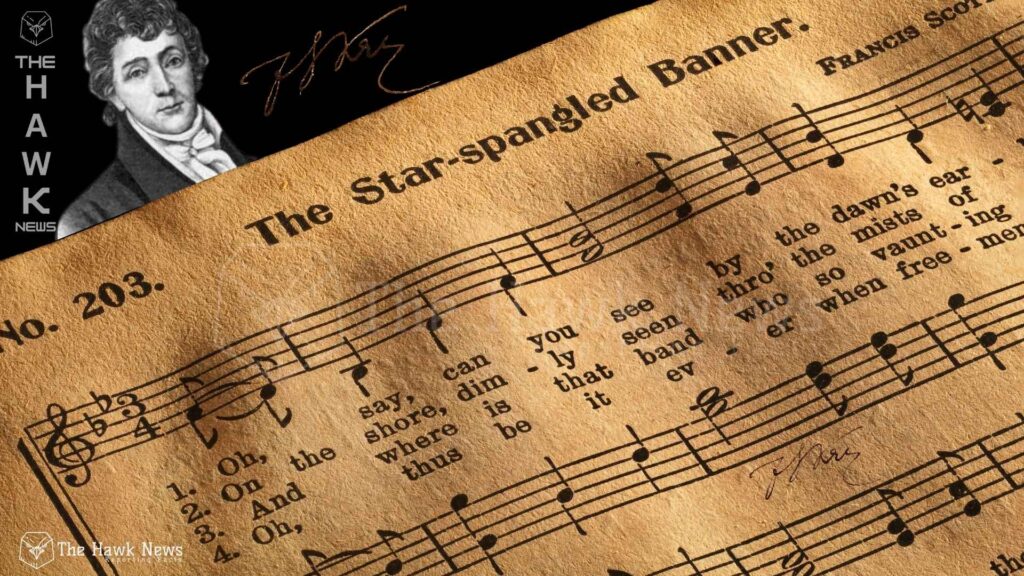
In September 1814, as cannons thundered across the Chesapeake Bay and smoke veiled the dawn above Fort McHenry, few could have imagined that a poem scribbled amid battle would one day become the voice of a nation.
Yet out of that night of conflict rose The Star-Spangled Banner—a song born from war, carried by hope, and destined to define the American spirit for centuries to come.
A Nation at War
The War of 1812 had dragged on for more than two years. The fledgling United States, barely three decades old, was locked in a tense struggle with Great Britain, the world’s greatest naval power.
Washington D.C. had been burned only weeks earlier, its Capitol and White House left in ruins. Now Baltimore stood as the next British target—a strategic port and a symbol of American resolve.
As the British fleet advanced toward the city in early September, citizens fortified their defenses. Inside Fort McHenry, roughly a thousand men prepared to withstand what they feared would be a merciless assault.
Among the witnesses to this pivotal moment was Francis Scott Key, a 35-year-old lawyer and amateur poet from Maryland.
Francis Scott Key’s Moment of Inspiration
Key had boarded a British ship to negotiate the release of an American prisoner. Though successful, he and his companions were detained aboard the vessel during the bombardment of Fort McHenry—unable to return to shore until the battle concluded.
From that vantage point, Key watched through the night as rockets flared and shells burst over the fort.
Hours of relentless bombardment followed. When dawn finally broke on September 14, 1814, Key strained to see whether the fort had fallen.
Through the smoke, he glimpsed the American flag—thirty-by-forty-two feet of stars and stripes—still waving proudly above the ramparts.
The sight stirred something deep within him. What he had witnessed was not just survival; it was defiance.
As fate would have it, the man who gave America its enduring anthem bore a name that mirrored his purpose. Francis Scott Key—the Key to a nation’s voice—turned a fleeting moment of triumph into a timeless symbol of freedom.
His words UNLOCKED something far greater than a melody; they opened the collective heart of a country still defining what liberty meant.
From Poem to Song
As soon as he was released, Key began to put his emotions into verse. His poem, titled “Defence of Fort M’Henry,” captured the awe and gratitude he felt on seeing the flag endure.
The lines pulsed with rhythm and imagery:
“O say can you see, by the dawn’s early light,
What so proudly we hailed at the twilight’s last gleaming?”
Within days, the poem was printed in Baltimore newspapers and quickly spread through the young republic. Someone—historians differ on exactly who—suggested pairing Key’s words with the melody of a well-known British club song, “To Anacreon in Heaven.”
Despite its challenging vocal range, the tune fit perfectly, giving Key’s words both structure and soul.
The first official sheet-music edition, published later in September 1814, bore the title “The Star-Spangled Banner.” It was the start of a journey that would carry the anthem from taverns and parlors to battlefields and ballparks.
A Growing Symbol of Patriotism
Throughout the 19th century, The Star-Spangled Banner became a staple at patriotic events, military ceremonies, and Independence Day celebrations. The Civil War gave it renewed life, as both Union and Confederate soldiers looked to songs to express loyalty and courage.
For many, Key’s words encapsulated the enduring question at the heart of the American experiment—whether the flag and the ideals it represented could survive internal and external trials alike.
By the late 1800s, the song had become the unofficial anthem of the U.S. Armed Forces. Navy bands performed it to signal flag-raising ceremonies, and its notes rang out at public gatherings across the nation. Still, it lacked formal recognition.
From Popular Tune to National Anthem
The push to make The Star-Spangled Banner the official national anthem gained momentum in the early 20th century. In 1916, President Woodrow Wilson signed an executive order designating it for military and ceremonial use.
Yet it wasn’t until March 3, 1931—after years of public campaigns—that Congress passed a resolution making the song the United States’ national anthem. President Herbert Hoover signed it into law, sealing a process more than a century in the making.
Its adoption unified the nation under one song, though not without debate. Some critics argued that the melody was difficult to sing and its war imagery too martial. Others believed its story—born from the defense of freedom—was precisely what gave it its power.
The Meaning Behind the Music
At its heart, The Star-Spangled Banner is more than a patriotic hymn. It is a snapshot of a defining moment: the triumph of endurance over destruction.
The “broad stripes and bright stars” that Key described symbolized not just a physical banner but the resilience of an ideal—that liberty and unity can withstand any siege.
Each verse (rarely sung beyond the first) expands on that idea, moving from awe to gratitude to trust in divine providence.
In this way, the anthem bridges faith and national identity, grounding patriotism not merely in pride but in perseverance.
Echoes Through History
Over two centuries later, the anthem continues to echo through America’s most public moments. It opens sporting events, inaugurations, and memorials, its familiar strains invoking reflection and reverence.
Yet it has also sparked dialogue—about freedom, protest, and what it means to love one’s country.
From Whitney Houston’s soaring 1991 Super Bowl performance to the silent kneeling of athletes decades later, The Star-Spangled Banner remains a canvas onto which each generation projects its understanding of patriotism.
That dynamism—its ability to provoke, to unite, to inspire—may be its greatest strength.
Preserving the Legacy
Today, the original Star-Spangled Banner flag that inspired Key’s poem hangs in the Smithsonian Institution’s National Museum of American History, preserved under dim light and careful climate control.
Its tattered fabric bears scars from the bombardment, yet its presence continues to stir the same emotions Key felt that dawn.
Schoolchildren still learn the anthem’s opening lines, and millions stand with hands over hearts as the first notes rise—a ritual that connects modern America to the nation’s earliest struggles for identity.
Why It Still Matters
In an age of global tension and digital distraction, it’s easy to forget how fragile the early United States once was.
The Star-Spangled Banner endures as a reminder that freedom was not born in ease but in endurance. The flag’s survival over Fort McHenry symbolized a truth that remains timeless: unity does not mean the absence of conflict, but the courage to persevere through it.
The anthem invites reflection—not on perfection, but on progress. When Key asked, “Oh, say does that star-spangled banner yet wave,” he left the question open.
Each generation must answer it anew, through its values, its actions, and its care for the nation that flag represents.
Conclusion
On that smoky morning in 1814, Francis Scott Key saw a flag that refused to fall—and found the words that would ensure it never would. In the truest sense, he became what his name foretold: the Key that helped America find its song, its courage, and its soul.
From a battlefield poem to a national hymn, The Star-Spangled Banner remains a living testament to resilience, faith, and the enduring promise of freedom.
Two hundred years later, its question still hangs in the air, calling every American to look up at the flag and answer: yes, it still waves—over the land of the free and the home of the brave.