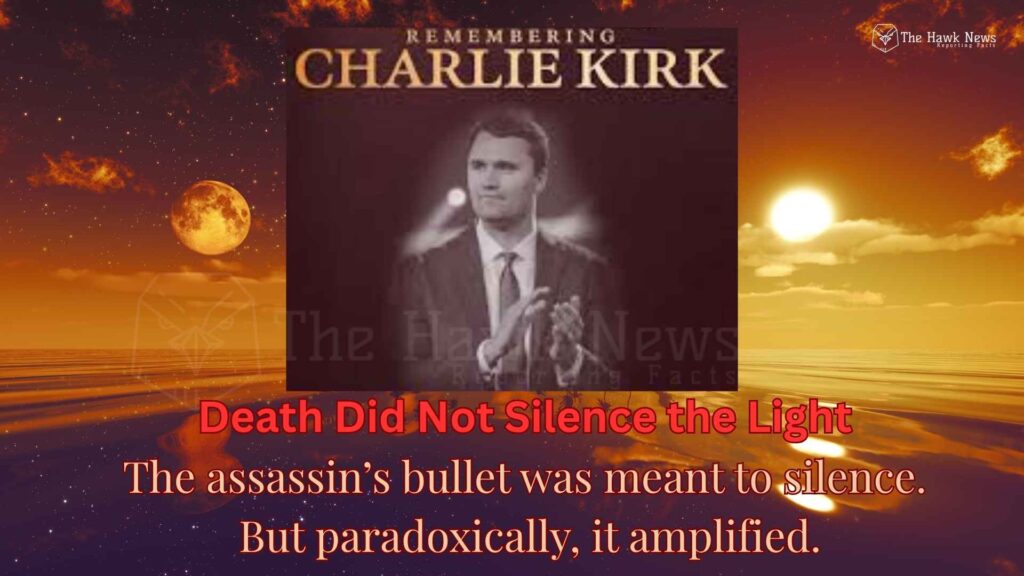
The news of Charlie Kirk’s assassination struck like a thunderclap across the nation. One moment, he was speaking with conviction at Utah Valley University, his words echoing through the hall, and the next, a single shot silenced his voice.
The world staggered in disbelief. To many, it felt as though a brother, a son, a steadfast companion had been torn from our lives.
But while grief has carved its sharp edges into our collective spirit, it has also uncovered something deeper: a testimony. Charlie’s life, though abruptly cut short, was not extinguished.
His legacy endures — not as mere memory, but as light. Like the moon in the night sky, Charlie did not shine of his own accord. Rather, he reflected the radiant light of Christ Jesus, the true Son, into a darkened world.
A Life That Reflected the Son
The moon has no light of its own. It is but a rock suspended in the void, cold and barren without the sun’s glow. Yet, when the night falls, the moon becomes our beacon — guiding sailors, comforting the weary, reminding us that darkness is never absolute.
Charlie Kirk’s life was much the same. He was never the source of the light; he was a vessel. He reflected the brilliance of Christ into places where shadows threatened to overtake truth. His courage to speak, his compassion in debate, his generosity toward the broken — all were but reflections of the greater glory of God shining through him.
It is written in John 1:5, “The light shines in the darkness, and the darkness has not overcome it.” Charlie believed this with all his heart. And in his living, we saw this truth personified.
Courage in Conviction
In an age where truth is often ridiculed, Charlie stood firm. He was unashamed of the gospel, unafraid to challenge cultural currents, and unyielding in his pursuit of what was right. To some, his words provoked anger; to others, they awakened hope.
But what made Charlie different was not just his boldness — it was the grace with which he carried it. Even in heated exchanges, he sought not to crush but to convict, not to humiliate but to awaken. His life embodied Matthew 5:16, “Let your light shine before others, that they may see your good deeds and glorify your Father in heaven.”
Charlie knew that every platform was an opportunity, not for self-promotion, but for witness. His speeches, his writings, and even his silences were meant to reflect Christ’s light to a generation stumbling in shadows.
A Family Man, A Faithful Servant
Behind the headlines and microphones was a man deeply devoted to his family. Charlie was a husband who cherished his wife and a father who led with gentleness and integrity. His faith was not confined to the public square; it was lived out in the quiet rhythms of daily life.
He taught us that leadership is not measured in applause, but in faithfulness. In this, he mirrored Christ, who came not to be served but to serve. Charlie’s greatest victories were not in the debates he won, but in the lives he touched, the young people he inspired, and the countless hearts he pointed to Jesus.
Death Did Not Silence the Light
The assassin’s bullet was meant to silence. But paradoxically, it amplified. Death has a way of stripping away pretense, leaving only what is eternal. And what remains of Charlie’s life is the echo of Christ’s call to live boldly, faithfully, and unashamedly.
Paul wrote in Philippians 1:21, “For to me, to live is Christ and to die is gain.” For Charlie, this was not theory — it was reality. His life was Christ. His death was gain. And though his earthly journey ended in tragedy, his testimony continues to shine.
In the days since his passing, many have confessed to feeling as though a piece of themselves was taken. And in a way, that is true. For Charlie was not just one man; he was a reflection of what we all long to be — unafraid, unwavering, a torchbearer of truth.
The Moon and the Son
The image that lingers is this: a moon in the night sky. Alone, it is powerless. Yet when aligned with the sun, it becomes luminous, casting light across oceans and deserts, cities and countrysides.
Charlie was that moon. He aligned himself with Christ, and in doing so, became a beacon in our darkest hours. Just as the moon waxes and wanes, Charlie had his struggles and weaknesses. But through it all, the Son remained his source, his anchor, his brilliance.
And so, when we look back on his life, we must not fix our gaze on the man himself, but on the Light he reflected. For just as the moon’s glow points us to the sun, Charlie’s testimony points us to Jesus.
A Call to Carry the Torch
What then shall we do with this grief? Shall we bury it? Shall we let it fester into bitterness? Or shall we transform it into courage?
Charlie’s life leaves us no choice but the latter. His voice may be silenced, but ours are not. His race is finished, but ours continues. If he was the moon, then we too must be — countless moons reflecting the same Son into the same darkness.
The writer of Hebrews reminds us: “Therefore, since we are surrounded by such a great cloud of witnesses, let us throw off everything that hinders and the sin that so easily entangles. And let us run with perseverance the race marked out for us, fixing our eyes on Jesus, the pioneer and perfecter of faith.” (Hebrews 12:1-2).
This is our charge. To take up the torch Charlie carried. To reflect Christ’s light with the same boldness, the same tenderness, the same unwavering conviction.
The Eternal Hope
Our sorrow is real. But it is not without hope. For Charlie’s testimony does not end in the grave. Just as Christ triumphed over death, so too do those who are in Him share that victory.
In 2 Timothy 4:7-8, Paul declares: “I have fought the good fight, I have finished the race, I have kept the faith. Now there is in store for me the crown of righteousness, which the Lord, the righteous Judge, will award to me on that day—and not only to me, but also to all who have longed for his appearing.”
Charlie has finished his race. His crown awaits him. And we, still running, are left not only with grief but with inspiration.
Conclusion
Charlie Kirk’s assassination was a wound upon the nation’s conscience, but more than that, it was a revelation. His life was not about him; it was about Christ. He was not the source, but the reflection. Not the flame, but the mirror. Not the sun, but the moon.
And now, the question rests with us: will we let his light fade, or will we carry it forward?
As we mourn, let us also rise. As we grieve, let us also hope. As we remember, let us also reflect — not Charlie himself, but the Christ whom he so faithfully mirrored.
For though the world grows dark, the Son still shines. And as long as we reflect His light, darkness will never prevail.