“History repeats itself, first as tragedy, second as farce.” – Karl Marx
On September 27, 2025, tragedy struck Karur, Tamil Nadu, when a rally organized by actor-turned-politician Vijay’s newly formed Tamilaga Vettri Kazhagam (TVK) ended in a devastating stampede.
Forty-one people lost their lives—ordinary citizens who had come in hope, only to return in coffins. Yet, despite the magnitude of the disaster, the political aftermath has raised as many questions as the tragedy itself.
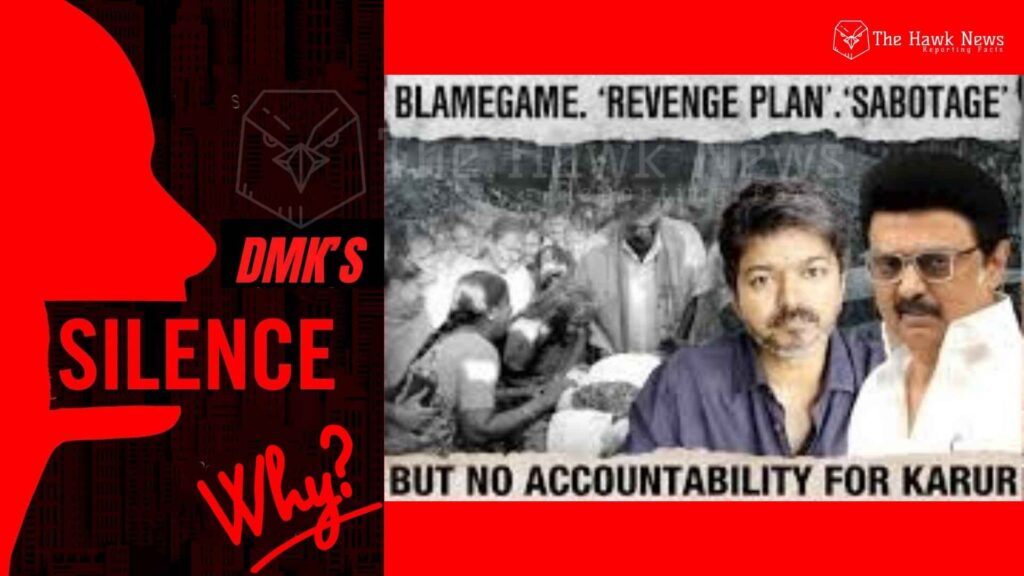
The most glaring of these: why was no First Information Report (FIR) filed against Vijay, the party’s leader, even though he was at the very heart of the event?
A Calculated Silence from the Government
The ruling DMK government has been accused of shielding Vijay, despite massive public outrage. Political analysts suggest that this hesitation is less about justice and more about strategy.
- Avoiding Sympathy for TVK: A direct FIR against Vijay could backfire, turning him into a victim and fueling sympathy for his fledgling political outfit.
- Future Political Equations: With whispers that TVK could align with the AIADMK-BJP front, the DMK may be hedging its bets to prevent a consolidation of anti-incumbency votes.
- Preventing Escalation: With the 2026 Assembly elections looming, the DMK is wary of actions that could spark unrest or violence.
- The Martyr Narrative: Vijay, adored by millions of fans, already carries a near-mythical status. Any punitive action could elevate him further, from a celebrity to a political martyr.
But this silence is not without consequences—it erodes faith in institutions meant to uphold accountability and exposes the disturbing nexus between politics, power, and selective justice.
The Opposition Cries Foul
The government’s cautious handling has sparked outrage across the political spectrum:
- VCK leader Thol. Thirumavalavan openly questioned whether there was a “secret understanding” between DMK and Vijay. He accused the police of discriminatory treatment: charging some TVK functionaries while omitting the party’s president.
- On October 2, 2025, a petitioner moved the Madras High Court, alleging that Vijay was being shielded for “political reasons.”
- The Madras High Court, in a strong rebuke on October 3, criticized Vijay’s “poor quality of leadership” and set up a Special Investigation Team (SIT) to probe the incident.
The judiciary’s intervention has become a reminder that when governments fail to act decisively, the courts often step in to fill the vacuum.
TVK’s Counterattack: Shifting the Blame
Vijay’s party, TVK, has not taken the criticism quietly. Instead, it has alleged that:
- The DMK government deliberately sabotaged the rally, failing to provide adequate crowd management.
- The police mishandled the situation, escalating panic rather than diffusing it.
- A CBI investigation is required to ensure fairness, suggesting they have little faith in the state-led probe.
Vijay himself released a video statement, but his words were met with skepticism. Critics called it disingenuous and far removed from the gravity of the tragedy. Adding to the unease, he suspended all rallies, a move interpreted as both damage control and silent acknowledgment of the disaster’s scale.
FIRs Against Party Leaders, Not the Leader
While Vijay escaped direct charges, his close aides did not.
- An FIR was filed against senior TVK functionaries, including general secretary Bussy Anand, citing negligence in controlling the crowd despite repeated police warnings.
- The FIR also referenced Vijay’s delayed arrival, which allegedly triggered the surge of panic in the restless crowd.
- Chief Minister M.K. Stalin announced a one-member judicial inquiry, tasked with investigating the tragedy and suggesting safety guidelines for future rallies.
This selective targeting of subordinates, while shielding the figurehead, is not new in Indian politics. Too often, accountability stops just short of the powerful.
Stampedes in Indian History: A Recurring Tragedy
The Karur disaster is not an isolated event but part of a grim pattern in India’s public life.
- 1954, Kumbh Mela (Allahabad/Prayagraj) – Over 800 killed in chaos during bathing rituals.
- 2008, Chamunda Devi Temple (Jodhpur) – 220 devotees crushed to death during Navratri.
- 2013, Ratangarh Temple (Madhya Pradesh) – A bridge collapse panic killed 115+.
- 2016, Varanasi (Rajghat Bridge) – 25+ killed in a procession stampede.
- 2022, Mata Vaishno Devi Shrine (J&K) – 12 pilgrims lost their lives in a New Year rush.
- 2024, Hathras (Uttar Pradesh) – Over 120 dead during a satsang stampede, one of the worst in decades.
- 2025, Karur (Tamil Nadu) – 41 dead at Vijay’s political rally.
These tragedies carry a chilling similarity: preventable chaos, poor crowd control, and political silence after the fact.
Celebrity Worship and Blind Faith
In South India, particularly Tamil Nadu, film stars have long transcended the silver screen to become political icons. From MGR to Jayalalithaa, charisma and fandom have routinely shaped electoral fortunes.
But this cult of celebrity worship also carries risks. When fans elevate actors to divine status, critical judgment is blurred. The leader is no longer seen as a fallible human but as a messianic figure—an illusion that collapses most brutally in moments of crisis, like Karur.
As political scientist Rajni Kothari once observed, “Indian politics has often been less about institutions and more about personalities.” The Karur tragedy is a painful reflection of this truth.
Why We Never Learn
Every stampede in India is followed by the same cycle: outrage, commissions of inquiry, promises of reform—and eventual amnesia. But the questions remain:
- Why are safety protocols not standardized and enforced?
- Why does political expediency override public safety?
- Why are leaders never held personally accountable for the lives lost under their watch?
When justice is selective and memory is short, tragedy becomes inevitable.
A Warning for Democracy
The Karur stampede is not just about crowd mismanagement—it is a test of India’s democratic integrity. When leaders escape accountability because of their popularity, democracy itself begins to rot.
The DMK’s cautious silence may appear clever in the short term, but it sends a dangerous message: in India, the powerful can walk away untouched, while the ordinary citizen pays with life.
If democracy is to mean anything, accountability must flow upward, not just downward. A leader cannot bask in adulation during victory and then retreat into silence when tragedy strikes.
Conclusion: Learning or Losing Ourselves
The 41 lives lost in Karur are not mere statistics—they are voices silenced by negligence, by political calculation, and by our collective failure to demand change.
As the Madras High Court has already noted, Vijay’s leadership was lacking. But the bigger question is: will Tamil Nadu and India as a whole confront this systemic rot, or will we, once again, move on until the next disaster?
The Bible reminds us in Proverbs 29:2:
“When the righteous are in authority, the people rejoice: but when the wicked beareth rule, the people mourn.”
Karur’s stampede is more than a political crisis; it is a moral reckoning. Will we continue to elevate personalities over principles, or will we finally demand accountability that transcends popularity?
The answer will decide whether tragedies like Karur remain our recurring nightmare—or become the catalyst for real reform.