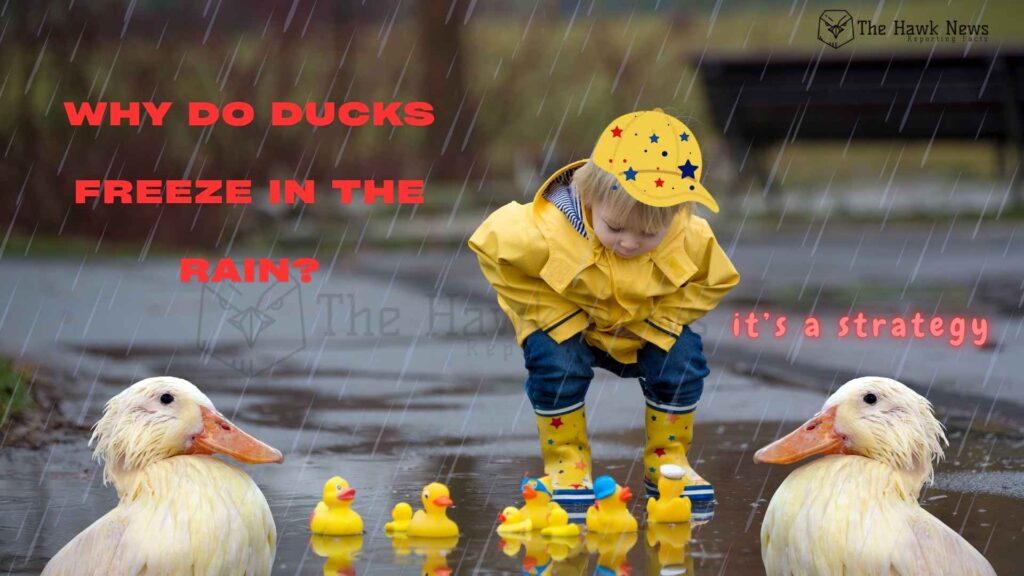
A rainy day walk often brings small wonders—droplets glistening on leaves, the earthy perfume of wet soil, and, if you’re near a pond, the quiet sight of ducks standing still in the downpour.
At first glance, their stillness looks odd. Why don’t they move? Why do they simply freeze, feathers slick with rain? For many, it seems like apathy or laziness. But as with much in nature, there’s far more than meets the eye.
The simple act of a duck freezing in the rain is not helplessness—it’s strategy. It is, in fact, an example of nature’s genius survival blueprint, hidden in plain sight.
And it teaches us a profound truth: to understand life, we often need to look beyond what we see.
The Science Behind the Stillness
When ducks freeze in the rain, they’re doing something incredibly practical: conserving energy. Movement requires calories, and in cold, wet conditions, those calories are needed for one thing above all—keeping warm. By staying still, ducks minimize unnecessary exertion and allow their insulating feathers to do the work.
Their feathers are marvels of design. Coated with natural oils from a gland near the tail, they repel water, creating a waterproof shield. Underneath, layers of down trap air, forming an insulating layer.
When a duck freezes in the rain, it’s not surrender—it’s activating this insulation system, letting nature’s engineering keep it dry and warm.
In essence, ducks freezing in the rain isn’t weakness. It’s efficiency. It’s survival.
Nature’s Economy of Energy
This duck behavior illustrates a principle that runs through all of nature: conserve energy when conditions demand it. Animals across ecosystems practice this.
Bears hibernate, snakes slow their metabolism, and even plants reduce activity in winter. Nature understands that thriving is not about constant action—it’s about timing. Knowing when to move and when to stay still.
For ducks, freezing in rain ensures survival in the long term. They save calories for flight, foraging, or evading predators later. Every pause has purpose.
The Human Parallel
It’s easy to look at ducks and dismiss their stillness as odd—but what if it’s a mirror for our own lives? In modern society, we often believe productivity means constant motion, endless hustle, and non-stop output. Pausing feels like laziness. Yet, just like ducks, humans also need moments of stillness to conserve emotional and mental energy.
In fact, science backs this up. Studies show that rest and recovery improve memory, creativity, and problem-solving. Pausing isn’t wasted time—it’s the hidden ingredient of progress. In the same way ducks survive rainstorms by freezing, humans navigate life’s storms best when they allow themselves to stop, breathe, and reset.
Looking Beyond What We See
This everyday sight of ducks freezing in the rain nudges us toward a deeper perspective: things are not always what they appear to be. On the surface, stillness can look like passivity. In reality, it can be strategy.
Nature constantly invites us to look closer. A spider web glistening in dew is not just beauty—it’s engineering at the molecular level. A sunflower turning toward the sun is not just charming—it’s heliotropism, a survival mechanism. Ducks freezing in rain? Not helplessness—brilliance.
The lesson is clear: to appreciate life fully, we must move beyond casual observation into thoughtful understanding.
Lessons for Daily Living
The next time rain interrupts your day and you see ducks standing still, consider what they’re teaching us:
- Conservation is wisdom. Energy—physical, mental, emotional—is finite. Spend it wisely.
- Stillness is power. Pausing is not weakness; it’s preparation for strength.
- Adaptation beats resistance. Instead of fighting rain, ducks adapt. Instead of fighting every storm in life, we too can learn to adapt.
- What you see is not always the whole story. True understanding requires curiosity and depth.
Nature’s Blueprint for Us
Nature’s strategies are more than survival tactics; they’re blueprints for how humans can live more intentionally. Ducks freezing in the rain remind us that sometimes the best action is inaction—that conserving strength for the right moment is smarter than scattering energy on every passing challenge.
In our own lives, storms come in many forms: work pressures, personal conflicts, emotional lows. Our instinct might be to keep pushing harder. Yet, just like the duck, perhaps the wiser strategy is to pause, let our “insulating layers” of resilience protect us, and wait until the storm passes.
Conclusion: The Hidden Brilliance of Stillness
When we look at ducks in the rain, we can either see birds standing idly—or we can see survival scientists in feathered coats, practicing nature’s economy of energy. The difference lies not in the ducks but in the observer’s eye.
Nature is filled with genius that reveals itself only when we look beyond the surface. The duck’s stillness is more than behavior—it’s a reminder for us, too. In storms, whether of weather or life, stillness can be the smartest move of all.
So, the next time you find yourself caught in rain—literal or metaphorical—remember the duck. Freezing doesn’t mean failure. Sometimes, it’s nature’s way of saying: hold steady, conserve, endure—and when the sun returns, you’ll be ready to move again.