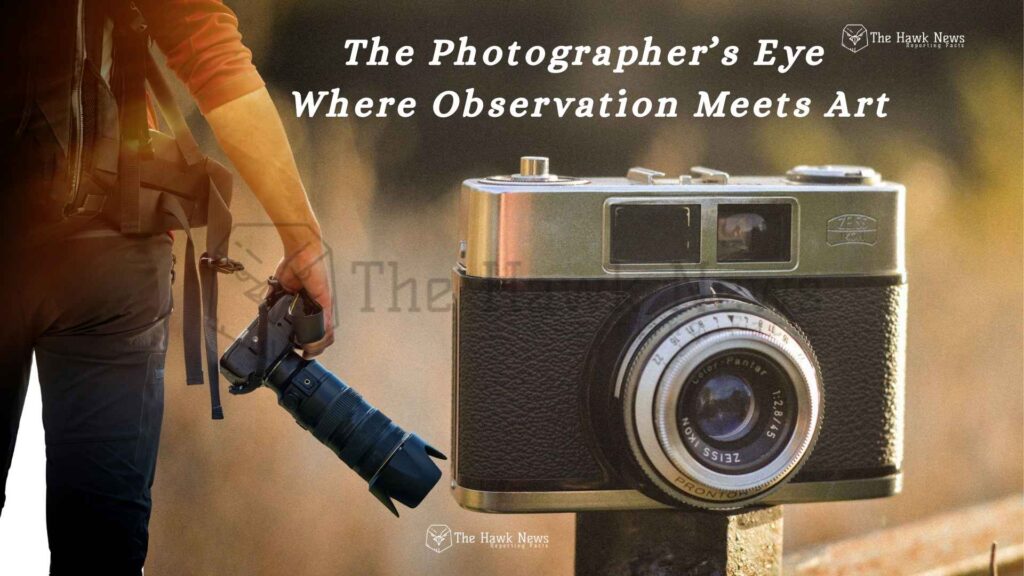
In an age where nearly everyone carries a camera in their pocket, the art of photography is often mistaken for the simple act of clicking a button. Yet, behind every unforgettable photograph lies something deeper than technology: the photographer’s eye.
It is the power to observe the world differently, to notice what others overlook, and to transform fleeting moments into timeless art.
This concept—where observation meets art—is what distinguishes a snapshot from a story, a picture from a masterpiece.
Let’s explore how the photographer’s eye is shaped, what it reveals about humanity, and why it remains one of the most important creative forces of our time.
Beyond the Lens: The Art of Seeing
The camera, no matter how advanced, is only a tool. The true work begins with perception. A photographer must see not only what is but what can be.
For example, two people may walk through the same street. One may notice nothing more than the rush of traffic, while another notices the play of sunlight on a rain-soaked road, or the expression of a child looking out from a rickety window. The difference lies in awareness—the heightened attention that allows a photographer to frame the extraordinary within the ordinary.
In many ways, photography is about training the eye to linger. It demands patience and a willingness to look twice. This discipline transforms simple observation into an act of art.
Storytelling in Stillness
Every photograph tells a story, but the depth of that story depends on how the photographer interprets reality. A skilled eye doesn’t just capture what is happening—it conveys why it matters.
Consider iconic photographs: the migrant mother during the Great Depression, the lone man standing before tanks in Tiananmen Square, or even candid images from family albums. These pictures endure because they are more than records; they are narratives.
The photographer’s eye is what makes this possible. By recognizing human emotion, subtle gestures, or the tension in a moment, the photographer creates a frame that resonates long after the shutter has closed.
Observation as Empathy
To truly “see” is also to empathize. Photographers must often immerse themselves in their subjects—whether that subject is a person, a landscape, or an abstract play of light.
Observation becomes a bridge of connection. A wildlife photographer must wait for hours, even days, to earn the trust of an animal. A portrait photographer must sense the quiet vulnerability behind a smile. A street photographer must merge with the rhythm of the city, becoming almost invisible to capture its soul.
This empathy-driven observation allows photographers to document reality without exploiting it, to witness without intruding. The result is not just an image, but an encounter—an honest reflection of life.
The Dance of Light and Shadow
The photographer’s eye is deeply attuned to light. In fact, photography, by definition, means “drawing with light.” A photographer does not merely see brightness and darkness; they see mood, drama, possibility.
A golden sunset becomes more than a backdrop; it becomes a metaphor for endings. A dimly lit alley can evoke mystery or fear. Even shadows, often overlooked, can become the main subject when framed with intention.
This sensitivity to light is what allows photographers to transform the mundane into the magical. Observation, once again, becomes the foundation of artistry.
Framing Life: Order in Chaos
Life is chaotic, full of moving parts and endless distractions. Yet the photographer’s eye has the uncanny ability to impose order through framing.
By choosing what to include and exclude, the photographer creates meaning. A bustling market can be distilled into the focused expression of a vendor. A sprawling landscape can be reduced to a single tree standing against the horizon.
This act of framing is not just technical—it is philosophical. It reflects how the photographer interprets the world, how they choose to make sense of its overwhelming complexity.
A Journey of Self-Discovery
While photography documents the external world, it also reveals the inner world of the photographer. Each image reflects not only what the photographer sees but also what they feel.
A minimalist may gravitate toward clean lines and empty spaces. A romantic may focus on soft light and intimacy. A realist may document life with raw honesty, refusing to beautify what is harsh.
In this way, the photographer’s eye is as unique as a fingerprint. It becomes a mirror of personality, values, and vision. Observation, once cultivated, evolves into self-expression.
The Role of Patience in a Fast World
In today’s era of instant everything, photography remains an art that rewards patience. A sunrise cannot be rushed; a candid smile cannot be forced.
Photographers often speak of the “decisive moment”—a split second when everything aligns, and the image becomes inevitable. But to catch that moment requires waiting, watching, and being fully present.
This patience, born from observation, teaches a lesson beyond photography: that life itself is best appreciated when slowed down, when we pause to notice rather than rush to consume.
Observation in the Digital Age
Ironically, the digital age has made observation both easier and harder. With billions of images uploaded daily, photography has never been more accessible. Yet, this flood of visuals often dilutes attention, making it harder for individuals to stop and truly see.
The photographer’s eye, therefore, has become even more valuable. In a world addicted to scrolling, photographers remind us of the power of pausing. They show us that depth still matters, that moments still deserve reverence, and that beauty is often hidden in plain sight.
Where Observation Meets Art
At its core, the photographer’s eye is not about expensive equipment or exotic locations. It is about cultivating a mindset—a way of seeing the world with curiosity, empathy, and patience.
Photography teaches us that art is not separate from life but woven into it. The way shadows fall across a dinner table, the laughter shared in a crowded festival, or the silent dignity of an aged face—all of these become art when framed with intention.
The photographer’s eye, then, is a reminder to all of us: life is fleeting, but observation can make it eternal. By looking closely, we not only create art but also discover meaning, connection, and wonder.
Conclusion
“The Photographer’s Eye: Where Observation Meets Art” is more than a phrase—it’s a philosophy. It is the belief that by sharpening our ability to observe, we can find beauty in chaos, stories in silence, and art in the everyday.
In the end, photography is less about capturing what we see and more about teaching us how to see.