Peacock: The Eternal Symbol of India’s Beauty, Art, and Spirit
When a peacock unfurls its magnificent train of iridescent feathers, it commands awe unlike any other bird.
The sheer vibrancy of its plumage, glimmering in hues of emerald, sapphire, and gold, has enchanted people for centuries.
But beyond its striking beauty, the peacock carries with it a weight of symbolism, history, and spirituality that makes it far more than just a bird—it is a cultural emblem, a muse for artists, and a spiritual beacon for millions.
The Bird of Beauty and Grace
The Indian peafowl (Pavo cristatus), commonly known as the peacock, is native to the Indian subcontinent. Found across forests, grasslands, and even human settlements, the bird is instantly recognizable by the male’s extravagant plumage.
These elongated feathers, each adorned with a mesmerizing “eye-spot,” serve as part of the male’s courtship display. During the monsoon, peacocks are often seen dancing with their feathers spread wide, an image that has long been celebrated as nature’s own festival of joy.
But the peacock is not just about appearances. Ecologically, the bird plays a significant role in balancing ecosystems. Feeding on insects, small reptiles, and even poisonous snakes, peacocks help maintain natural pest control.
Their loud calls, often heard before rainfall, have earned them a reputation as heralds of the monsoon—another reason they are loved in agrarian communities.
The National Bird of India
In 1963, the Government of India declared the peacock as the National Bird, a choice rooted in both natural pride and cultural heritage. Unlike other birds, the peacock stood out as a symbol deeply woven into India’s history, mythology, and traditions. Its vibrant presence mirrored the diversity and vibrancy of the nation itself.
The peacock symbolizes qualities that resonate with India’s identity—beauty, dignity, immortality, and pride. It finds mention in countless folk songs, poems, and proverbs across languages. Even in rural India today, the sight of a peacock dancing in the fields is met with reverence, often interpreted as a sign of prosperity and divine blessing.
Moreover, the peacock’s prominence in Indian mythology cemented its place as a national emblem. In Hindu tradition, the bird is associated with Lord Krishna, who is often depicted with a peacock feather in his crown, signifying divine love and eternal charm. It is also linked to Saraswati, the goddess of wisdom, and Murugan, the god of war, whose mount is a peacock symbolizing valor and triumph.
A Muse for Art and Architecture
From the walls of ancient temples to the corridors of Mughal palaces, the peacock has been an enduring motif in Indian art and architecture.
In temple carvings, peacocks often appear alongside deities, their forms etched with meticulous detail, symbolizing grace and divinity. In Mughal art, the bird found new expression in miniature paintings and royal décor.
The most famous example perhaps is the Peacock Throne of Emperor Shah Jahan, a dazzling marvel of jewels and craftsmanship, designed to capture the magnificence of the bird itself.
Architectural elements inspired by peacocks can still be seen in Jaipur’s Peacock Gate at the City Palace, where vivid frescoes depict the bird in full splendor. Similarly, in southern India, temple gopurams and mandapams showcase peacock motifs as reminders of divine presence and protection.
Fashion, Textiles, and Creative Inspirations
The peacock’s influence extends far beyond monuments—it has left an indelible mark on textiles, fashion, and design.
In traditional Indian weaving, the peacock is a recurring motif. Sarees from regions like Kanchipuram, Banaras, and Odisha often feature peacock patterns in gold thread, symbolizing fertility, love, and beauty. Embroidery, especially in Rajasthan and Gujarat, frequently draws inspiration from the bird’s feathers.
Jewel-toned fabrics—deep blues, greens, and purples—are directly modeled after the peacock’s plumage, creating timeless color palettes in Indian couture.
In modern fashion, the bird continues to inspire global designers. Runways often showcase gowns and jewelry pieces echoing the elegance of peacock feathers. Even in popular culture, the motif finds its way into film sets, wedding décor, and home interiors, signifying luxury and opulence.
Peacocks also inspire creators in less visible ways. Painters, sculptors, and digital artists often draw on the symmetry, balance, and vibrancy of the bird as metaphors for harmony and artistic perfection.
The Spiritual Symbolism of the Peacock
Perhaps the deepest connection humanity shares with the peacock lies in its spiritual symbolism. In India, the bird is not merely admired for its beauty but revered as a symbol of higher truths.
The peacock’s feathers, with their thousand shimmering eyes, are seen as symbols of watchfulness and divine protection. In Buddhist traditions, the peacock represents wisdom and openness, believed to be able to consume poisonous plants without harm—a metaphor for transforming negativity into enlightenment.
In Hindu iconography, Lord Krishna’s peacock feather represents purity of heart and eternal bliss. The bird’s association with Murugan embodies courage, while with Saraswati, it conveys wisdom and knowledge. In Christian symbolism too, the peacock is often linked with immortality and resurrection.
It is no wonder, then, that the English poet William Blake once wrote: “The pride of the peacock is the glory of God.” This line captures the essence of why the bird continues to inspire wonder—not just for its earthly beauty but for the divine spark it symbolizes.
On a broader level, the peacock teaches us spiritual lessons of renewal and inner beauty. Just as the bird sheds its feathers and regrows them, it becomes a metaphor for resilience, rebirth, and transformation.
More Than a Bird
The peacock is more than just a creature that graces India’s fields and forests—it is a timeless emblem of the nation’s soul. As India’s national bird, it represents the diversity, pride, and vibrancy of the country.
As a muse, it inspires artists, architects, and designers across generations. And as a spiritual symbol, it reminds humanity of divine beauty, purity, and resilience.
The next time one sees a peacock spreading its radiant feathers under the monsoon skies, it is worth pausing—not just to admire its beauty, but to reflect on what it represents.
A reminder that nature’s artistry often surpasses our own, and that in the quiet dance of a bird, entire civilizations can find inspiration, meaning, and faith.
Conclusion
As India’s national bird, the peacock is more than just a creature of beauty. It is a symbol of resilience, pride, and spirituality that continues to inspire artists, architects, designers, and poets. From temple carvings to haute couture, its feathers remind us that grace and strength can coexist.
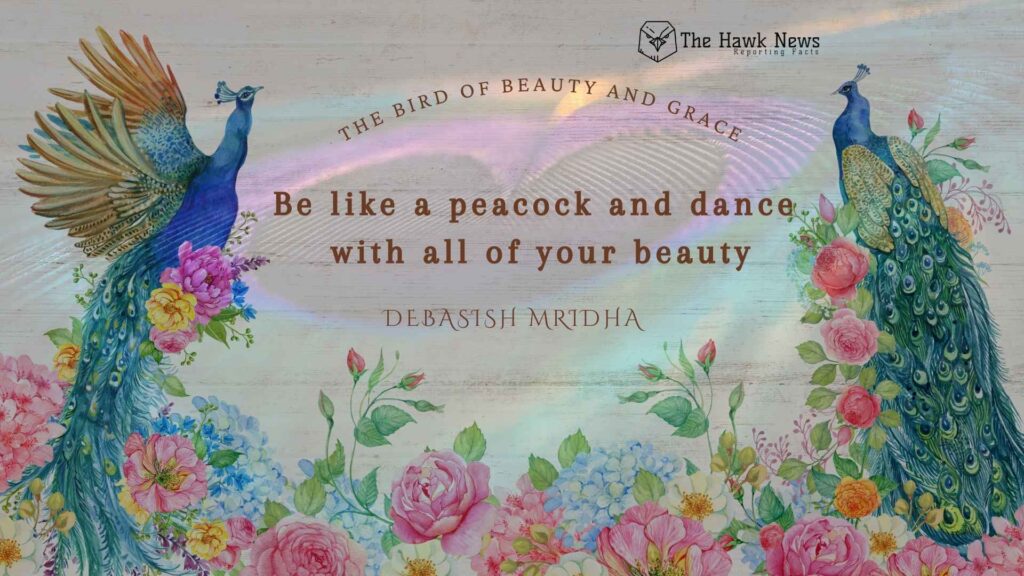
And as Debasish Mridha beautifully said:
“Be like a peacock and dance with all of your beauty.”
Perhaps that is the greatest lesson the peacock imparts—to live fully, embrace uniqueness, and reflect the divine glory in our own lives.