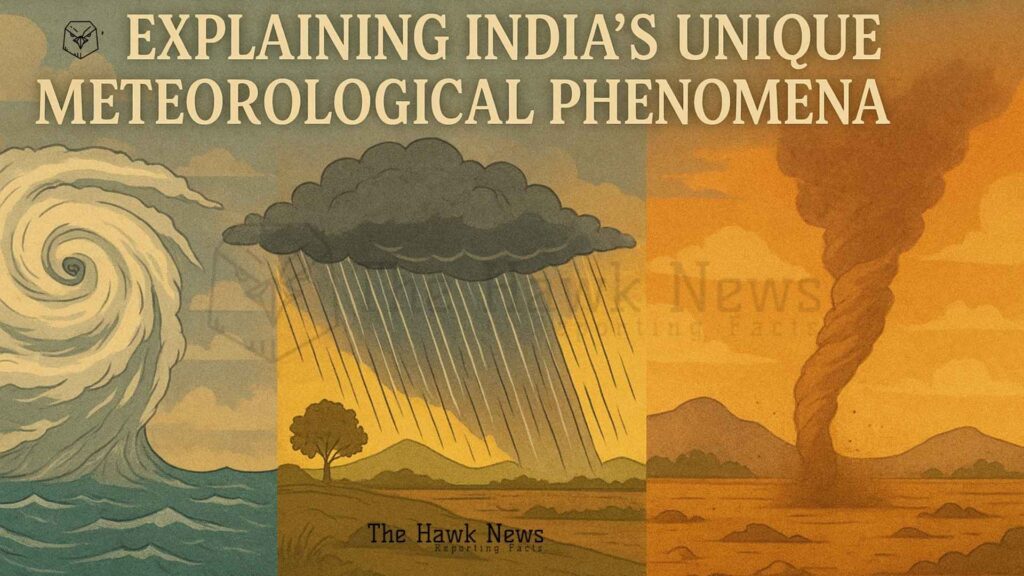
India’s weather is as diverse as its culture. Stretching from the icy Himalayas to the arid deserts of Rajasthan, and from lush coastal plains to dense forests, the country experiences a spectrum of meteorological events that range from awe-inspiring to devastating.
While tropical cyclones often dominate headlines due to their destructive potential, less-discussed phenomena like haboobs (intense dust storms) and dust devils are equally important to understand, especially in the context of climate change and increasing urbanization.
In recent years, India has witnessed an uptick in extreme weather events. From Cyclone Remal (2024), which battered West Bengal and Bangladesh, to intense dust storms sweeping across North India’s plains, the country’s climate narrative is becoming more unpredictable.
By exploring these phenomena, we gain not only an appreciation of India’s dynamic weather system but also insight into the urgent need for preparedness and resilience.
Tropical Cyclones: India’s Coastal Guardians and Destroyers
Cyclones are among the most devastating weather events India faces. Every year, the Bay of Bengal and the Arabian Sea spawn multiple cyclones, fueled by warm ocean waters.
The Bay of Bengal, in particular, is a hotbed for cyclone formation due to its funnel-like geography and high sea surface temperatures.
Recent years have seen a rise in cyclone intensity. Cyclone Amphan (2020) caused damages worth billions, while Cyclone Tauktae (2021) battered India’s western coast.
More recently, Cyclone Remal (2024) underscored the vulnerability of India’s eastern states, displacing thousands and flooding agricultural lands.
Meteorologists note that climate change is intensifying these cyclones. Warmer waters provide more energy, leading to storms that are not only stronger but also linger longer, dumping unprecedented amounts of rain.
For India, this means coastal infrastructure, agriculture, and fishing communities must continuously adapt.
Dust Storms and Haboobs: The Desert’s Wrath
Far from the coastal cyclones, India’s arid and semi-arid regions, especially Rajasthan and parts of Uttar Pradesh and Haryana, regularly witness dust storms.
These storms occur when strong winds lift loose sand and soil, creating massive walls of dust that sweep across towns and villages.
A more extreme version of this is the haboob, a term derived from Arabic, describing an intense dust storm typically triggered by the downdrafts of collapsing thunderstorms.
In India, haboobs have been reported in Rajasthan’s Thar Desert, where they can reduce visibility to near zero within minutes.
In May 2018, a deadly dust storm killed more than 125 people across northern India, toppling trees, damaging homes, and disrupting power lines.
The growing frequency of such events is linked to rising land degradation, deforestation, and unplanned urbanization.
Dust Devils: Miniature Tornadoes of Heat
While less destructive, dust devils are fascinating meteorological phenomena often spotted during hot afternoons in India’s dry plains.
These small, rotating columns of air form when intense surface heating causes air near the ground to rise rapidly, creating a vortex.
Dust devils usually last only a few minutes, lifting dust and debris high into the air. They are common during summer in states like Madhya Pradesh, Maharashtra, and parts of Uttar Pradesh.
While generally harmless, larger dust devils can occasionally damage property, posing risks to outdoor workers and small settlements.
Monsoon: The Lifeline and the Floodbringer
No discussion of India’s meteorological events is complete without mentioning the monsoon. The annual southwest monsoon, arriving in June and retreating by September, is the backbone of India’s agriculture. However, it also brings challenges in the form of flash floods, cloudbursts, and landslides.
Recent events highlight this duality. In 2023 and 2024, Himachal Pradesh and Uttarakhand were battered by extreme rainfall, leading to catastrophic floods and landslides that wiped out entire villages.
Experts attribute these extreme monsoon swings to climate variability and urban expansion into ecologically sensitive zones.
Cloudbursts: Sudden Torrents in the Himalayas
Cloudbursts—sudden, intense rainfall events where more than 100 mm of rain can fall in under an hour—are increasingly common in India’s Himalayan regions. These events often trigger flash floods and landslides, posing enormous risks to mountain communities and pilgrims.
In July 2023, a cloudburst near Amarnath in Jammu and Kashmir caused flash floods that killed more than 15 people. Similarly, Uttarakhand continues to face annual devastation from cloudbursts, underscoring the fragile balance between human settlement and nature in the Himalayas.
Heatwaves and Urban Heat Islands
India is also battling a silent meteorological crisis: heatwaves. With global warming pushing temperatures higher, Indian cities are recording record-breaking heat. In 2024, Delhi, Rajasthan, and Uttar Pradesh experienced prolonged heatwaves, with temperatures exceeding 47°C.
The urban heat island effect—where cities become hotter than surrounding rural areas due to concrete surfaces, limited greenery, and vehicular emissions—worsens this crisis. Meteorologists warn that heatwaves are now among India’s deadliest weather events, particularly for vulnerable groups such as the elderly, children, and outdoor workers.
The Science Behind These Phenomena
India’s meteorological phenomena are deeply interconnected:
- Cyclones are fueled by rising sea surface temperatures.
- Dust storms are aggravated by desertification and changing wind patterns.
- Cloudbursts result from rapid condensation in moisture-laden clouds trapped by mountains.
- Heatwaves intensify due to greenhouse gas emissions and urbanization.
Data from the India Meteorological Department (IMD) and international climate studies suggest that extreme events are becoming more frequent and intense. This places India in a precarious position, given its dense population and heavy reliance on climate-sensitive sectors like agriculture.
How Prepared Is India?
India has made strides in weather forecasting and disaster preparedness. The IMD’s cyclone warning systems have saved countless lives by providing timely alerts. States like Odisha, once vulnerable to cyclones, are now global models for disaster management.
However, challenges remain. Dust storms and cloudbursts are harder to predict with accuracy, leaving communities exposed. Urban flooding continues to plague India’s major cities, from Mumbai to Bengaluru, due to poor drainage infrastructure.
To address these gaps, experts advocate for:
- Investments in resilient infrastructure – flood-resistant housing, smart drainage systems, and green cover.
- Strengthening local governance – empowering municipalities to prepare disaster action plans.
- Public awareness campaigns – educating citizens about safety measures during extreme weather.
- Harnessing technology – deploying AI-driven predictive models and satellite monitoring for early warnings.
Looking Ahead: A Climate-Ready India
India’s meteorological diversity is both a gift and a challenge. While the country celebrates the life-giving monsoon, it must also contend with cyclones, dust storms, and extreme heat. Climate change ensures that these phenomena will become more erratic, demanding adaptive strategies.
The future lies in integrating scientific research with policy and community action. Smart cities must incorporate weather resilience, farmers must be given real-time weather data for crop planning, and citizens must be equipped with awareness about survival during extreme events.
By embracing preparedness, India can transform its vulnerability into resilience—navigating the unpredictability of its skies with wisdom and strength.